
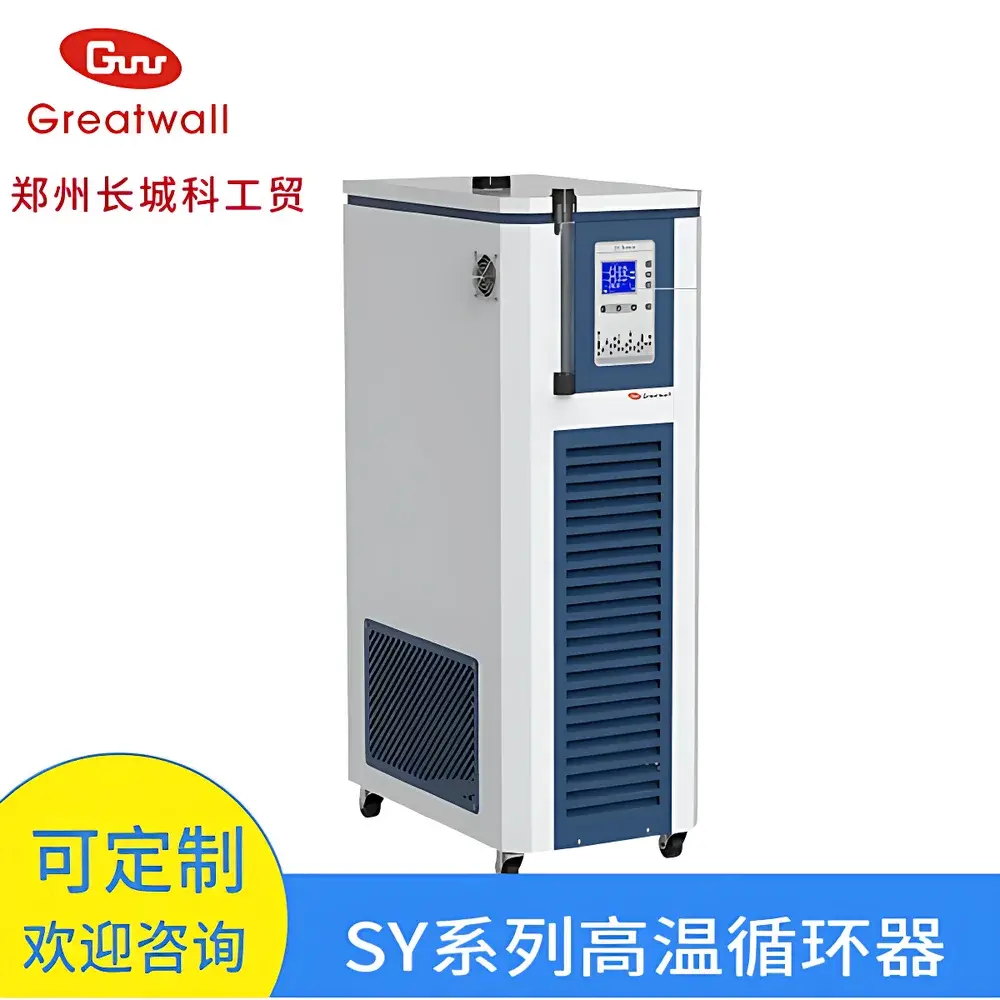
The Great Wall SY-50-250D Sealed High-Temperature Circulating Chiller
| Brand | The Great Wall |
|---|---|
| Origin | Henan, China |
| Manufacturer Type | OEM Manufacturer |
| Country of Origin | China |
| Model | SY-50-250D |
| Pricing | Upon Request |
| Pump Type | Stainless Steel Magnetic Drive Pump |
| Expansion Tank Material | SUS304 Stainless Steel |
| Tubing Material | SUS304 Stainless Steel |
| Control Algorithm | PID Temperature Control |
| Communication Interface | RS485 |
| Safety Features | Over-Temperature Cut-Off with Audible/Visual Alarm |
| Cooling Option | External Cooling Coil (Water-Cooled) |
| Mobility | Lockable Casters with Brake |
| Fluid Level Monitoring | Integrated Sight Gauge |
Overview
The Great Wall SY-50-250D is a sealed, electrically heated high-temperature circulating chiller engineered for precise thermal management in process-critical laboratory and pilot-scale applications. Unlike open-bath or ambient-cooled systems, the SY-50-250D operates as a fully closed-loop thermal fluid circulation unit—maintaining consistent temperature delivery to external reactors, jacketed vessels, or synthesis modules under elevated thermal loads. Its core principle relies on resistive electric heating of thermally stable synthetic heat transfer fluids (e.g., silicone oil or high-temperature glycol blends), which are circulated via a magnetically coupled stainless steel pump to eliminate seal leakage risks at temperatures up to 250 °C. Designed for continuous duty in regulated environments, the system integrates passive thermal inertia control, active over-temperature protection, and compatibility with external cooling water circuits—enabling both heating-only and dynamic heat removal modes depending on process requirements.
Key Features
- Hermetically sealed circulation architecture minimizes fluid oxidation and vapor loss, extending service life of heat transfer media and reducing maintenance frequency.
- SUS304 stainless steel wetted components—including expansion tank, piping, and pump housing—ensure long-term resistance to corrosion from organic solvents, acidic vapors, and high-temperature thermal degradation byproducts.
- PID-based digital temperature controller delivers ±0.3 °C stability across the full operating range (ambient to 250 °C), with programmable ramp/soak profiles accessible via intuitive membrane keypad and backlit LCD interface.
- Integrated sight gauge enables real-time visual verification of thermal fluid volume, preventing dry-run operation and supporting GLP-compliant documentation of fluid top-up events.
- Lockable dual-brake casters facilitate safe repositioning within fume hoods, reactor farms, or modular skid-mounted installations without compromising operational stability.
- RS485 serial interface supports Modbus RTU protocol for integration into centralized SCADA or LIMS platforms, enabling remote setpoint adjustment, alarm logging, and audit-trail generation per FDA 21 CFR Part 11 requirements.
Sample Compatibility & Compliance
The SY-50-250D is compatible with a broad spectrum of thermally sensitive and chemically aggressive reaction systems, including glass-lined reactors, Hastelloy-jacketed vessels, and PTFE-lined crystallizers. It meets structural and electrical safety benchmarks aligned with IEC 61000-6-3 (EMC emission limits) and IEC 61000-6-2 (immunity). While not certified to UL or CE as a standalone appliance, its component-level compliance (e.g., IP54-rated enclosure, Class H insulation motor windings) supports integration into larger ASME-coded or GMP-aligned process trains. Documentation packages include material traceability records for all SUS304 parts and factory calibration certificates for the integrated Pt100 sensor and controller output stage.
Software & Data Management
No proprietary software is bundled; however, the RS485 port permits seamless integration with third-party data acquisition tools such as LabVIEW, Ignition SCADA, or DeltaV DCS. Users may configure event-triggered data logging—including temperature setpoint, actual bath temperature, pump status, and alarm flags—at user-defined intervals (1–60 seconds). All communication logs retain timestamps with millisecond resolution, satisfying ALCOA+ principles for raw data integrity in regulated pharmaceutical development workflows. Optional firmware updates (via USB-to-RS485 adapter) maintain backward-compatible command syntax while adding enhanced diagnostic diagnostics and extended alarm history buffers.
Applications
This system serves as a primary thermal utility in API synthesis (e.g., Friedel–Crafts acylations above 200 °C), polymerization initiation (free-radical or Ziegler–Natta catalysis), hydrogenation under elevated pressure, and continuous-flow chemistry requiring precise exotherm management. It is routinely deployed alongside Parr autoclaves, Chemtrix microreactors, and Buchi Rotavaps where solvent boiling points exceed 150 °C. In biopharma settings, it supports temperature-controlled refolding of inclusion bodies and controlled denaturation studies under non-aqueous conditions. Food-grade variants (with food-contact compliant seals and NSF-certified fluids) are available upon request for flavor extraction or enzymatic transesterification processes.
FAQ
What is the maximum allowable operating temperature of the thermal fluid?
The system is rated for sustained operation at 250 °C using approved high-temperature silicone oils (e.g., Dow Corning PM-705); maximum fluid temperature must be validated against the specific fluid’s flash point and thermal stability curve.
Can the unit operate without external cooling water?
Yes—the cooling coil remains inactive during pure heating mode; however, for rapid cooldown or heat-load balancing during exothermic reactions, connection to a chilled water supply (5–15 °C) is recommended.
Is the controller compliant with 21 CFR Part 11 for electronic records?
The embedded controller does not provide user authentication or electronic signatures; however, when interfaced with validated third-party SCADA systems that implement audit trails, role-based access, and digital signature workflows, full Part 11 compliance can be achieved at the enterprise level.
What maintenance intervals are recommended for the magnetic drive pump?
Under continuous operation at ≤220 °C, the pump requires inspection every 12 months—focusing on bearing clearance, magnet coupling integrity, and shaft runout per ISO 20816-1 vibration thresholds.
Does the unit support multi-stage temperature programming?
Yes—up to 10 independent ramp-hold segments can be stored locally, each with defined rate (°C/min), target temperature, and dwell time; sequences execute autonomously without PC connectivity.



