
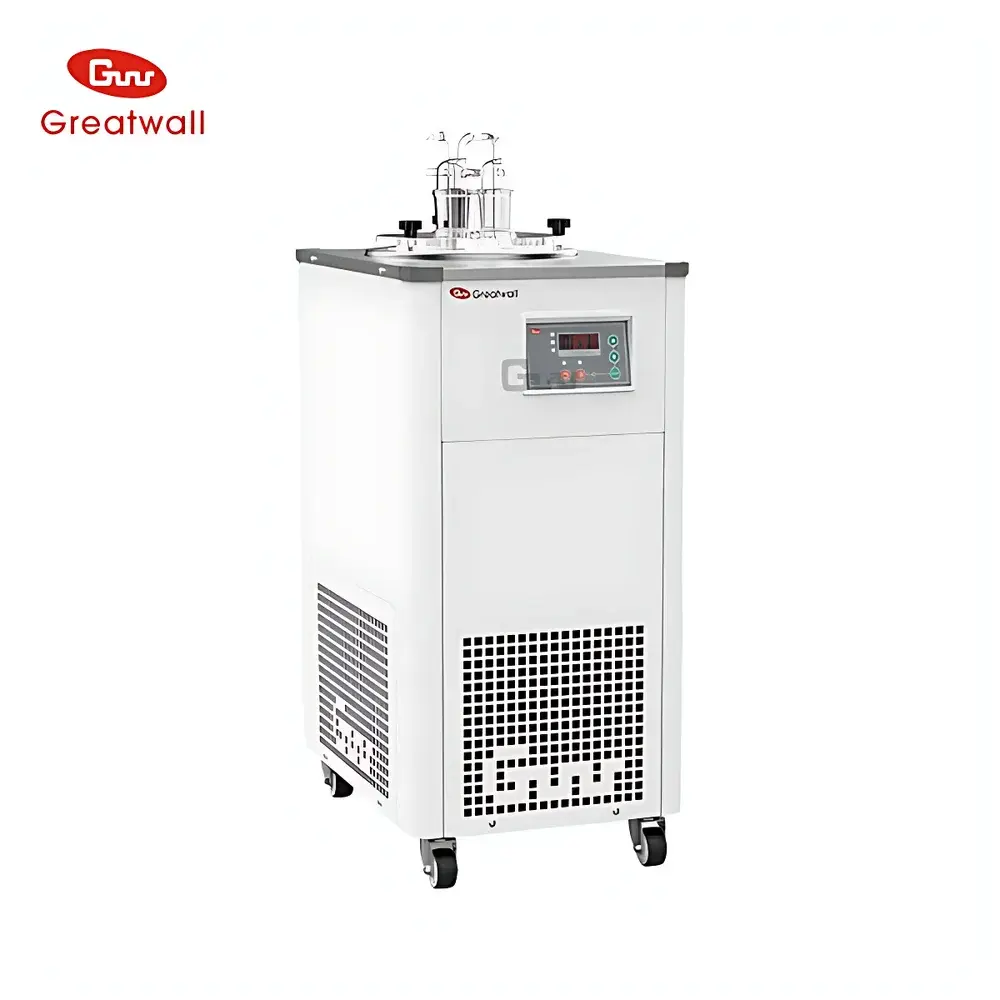
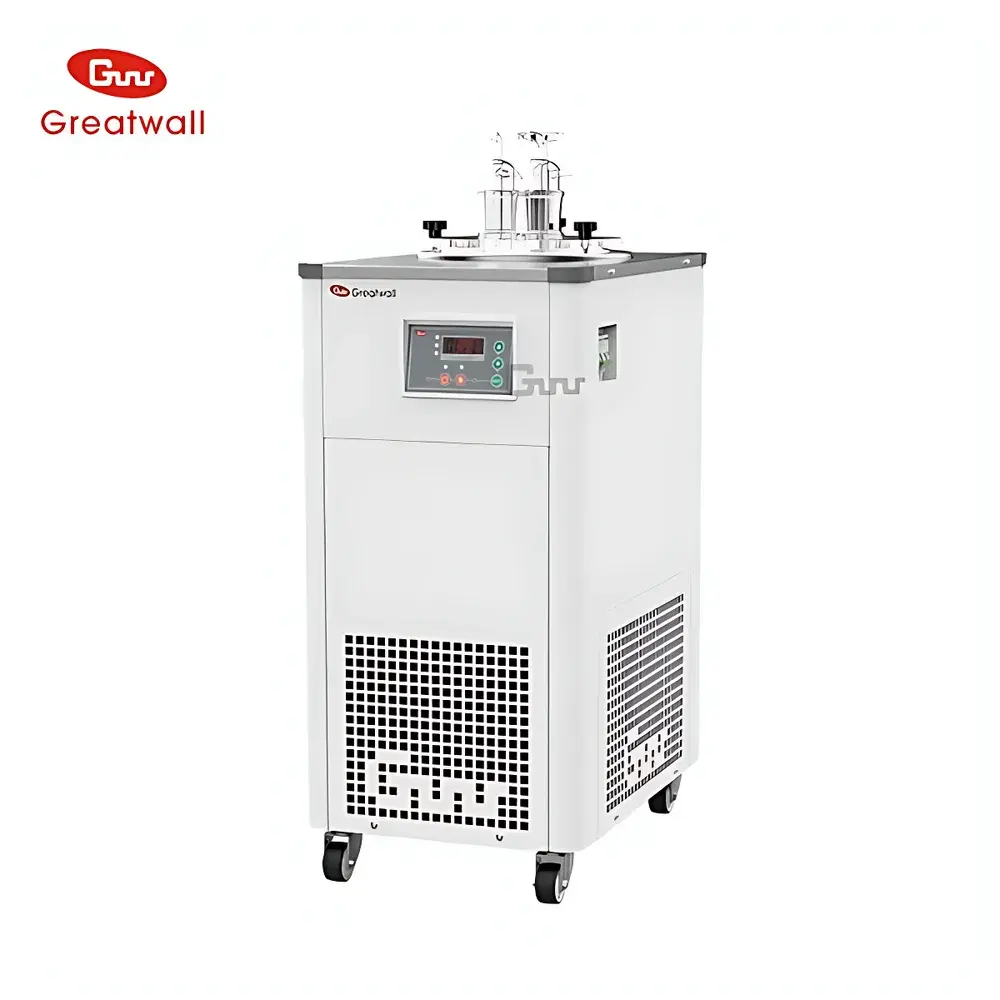
The Great Wall VT-2000HC Gas Condensation Trap Pump
| Brand | The Great Wall |
|---|---|
| Origin | Henan, China |
| Manufacturer Type | Direct Manufacturer |
| Country of Origin | China |
| Model | VT-2000HC |
| Price | USD 2,150 (approx.) |
Overview
The Great Wall VT-2000HC Gas Condensation Trap Pump is a laboratory-grade cryogenic condensation system engineered for efficient vapor capture in vacuum-assisted processes. It operates on the principle of low-temperature condensation—cooling process vapors below their dew point to convert gaseous species (e.g., water vapor, ethanol, acetone, acetic acid, and other volatile organic compounds) into liquid or solid phases within a thermally controlled trapping chamber. Designed for integration with vacuum drying ovens, rotary evaporators, freeze dryers, and battery electrode drying lines, the VT-2000HC mitigates backstreaming of condensables into primary vacuum pumps—thereby extending pump service life, maintaining stable ultimate vacuum levels, and reducing maintenance frequency. Its dual-mode configuration supports both direct-contact metal trap operation and interchangeable glass cold-finger assemblies, enabling flexible adaptation to aqueous, alcoholic, acidic, and aprotic solvent systems without cross-contamination.
Key Features
- Stainless steel 304 cold trap chamber with integrated Peltier-based thermoelectric cooling—capable of reaching ≤ −35 °C under standard ambient conditions (25 °C, 50% RH)
- Real-time digital temperature display (±0.5 °C accuracy) with programmable setpoint control for precise thermal management during multi-stage drying protocols
- Modular design supporting two distinct condensation configurations: (1) direct-cylinder trapping via chilled stainless-steel walls; (2) removable borosilicate glass cold-finger assembly rated for chemical compatibility with corrosive media (e.g., HCl, HF, THF, DMF)
- Thermal insulation housing minimizes ambient heat ingress and improves energy efficiency during prolonged operation
- Compact footprint (W × D × H: 280 × 320 × 510 mm) optimized for benchtop integration alongside vacuum manifolds and process controllers
- Overheat protection circuitry and automatic fan-cooling activation prevent thermal runaway during extended duty cycles
Sample Compatibility & Compliance
The VT-2000HC accommodates a broad range of volatile species commonly encountered in pharmaceutical lyophilization, materials science R&D, and lithium-ion battery manufacturing. Its 304 stainless steel trap chamber complies with ASTM A240 for corrosion resistance in neutral-to-mildly acidic aqueous and ethanol-based environments. The optional glass cold-finger assembly meets ISO 3585 specifications for borosilicate glass 3.3 and is validated for use with halogenated solvents, strong acids, and polar aprotic solvents—enabling safe deployment in GLP-compliant QC laboratories conducting residual solvent analysis per ICH Q3C guidelines. All electrical components conform to IEC 61010-1 safety standards for laboratory equipment. No CE or UL certification is pre-installed; users must validate local regulatory alignment prior to installation in EU or North American facilities.
Software & Data Management
The VT-2000HC operates as a standalone analog-controlled unit without embedded firmware or network connectivity. Temperature monitoring is performed via a calibrated NTC thermistor linked to a front-panel LED display. For traceable process documentation, external data loggers (e.g., Omega OM-DAQPRO-5300 or Testo 176-T4) may be connected via 0–5 V analog output (provided as optional accessory). While the device itself does not support FDA 21 CFR Part 11-compliant electronic signatures or audit trails, its deterministic thermal response and mechanical simplicity facilitate straightforward validation under GMP Annex 15 and ISO/IEC 17025 frameworks when paired with qualified peripheral instrumentation.
Applications
- Vacuum drying of cathode/anode slurries and separator films in Li-ion battery production lines
- Removal of moisture and residual solvents during capacitor dielectric film formation
- Condensation of distillates and reaction by-products in small-scale organic synthesis under reduced pressure
- Protection of oil-sealed and dry scroll vacuum pumps in pharmaceutical freeze-drying skids
- Cold trapping of VOCs during environmental sample preparation (e.g., EPA Method 502.2, 8260D)
- Pre-freezing and low-temperature hold functions for sample conditioning prior to lyophilization
FAQ
Can the VT-2000HC be used continuously for >8 hours?
Yes—its thermoelectric cooling module and forced-air heat dissipation system are rated for uninterrupted operation at ambient temperatures ≤30 °C. Continuous use beyond 12 hours requires periodic inspection of condensate accumulation and chamber frost buildup.
Is the glass cold-finger assembly autoclavable?
No—borosilicate glass components are not designed for steam sterilization. Cleaning must be performed using compatible solvents followed by nitrogen purge and oven drying at ≤120 °C.
Does the unit include vacuum hose fittings and mounting hardware?
Standard configuration includes one 1/4″ Swagelok-compatible stainless steel inlet port and one matching outlet port. Vacuum hose clamps and flange adapters are available as optional accessories.
What is the maximum allowable inlet pressure during operation?
The trap is rated for continuous operation at inlet pressures between 10 Pa and 100 kPa (absolute); operation above 100 kPa may compromise condensation efficiency and thermal stability.
How often should the cold trap chamber be defrosted?
Defrosting frequency depends on vapor load. Under typical lab-scale rotary evaporation (e.g., 500 mL ethanol at 40 °C, 200 mbar), manual defrost is recommended every 4–6 hours to maintain ≥92% condensation efficiency.



