
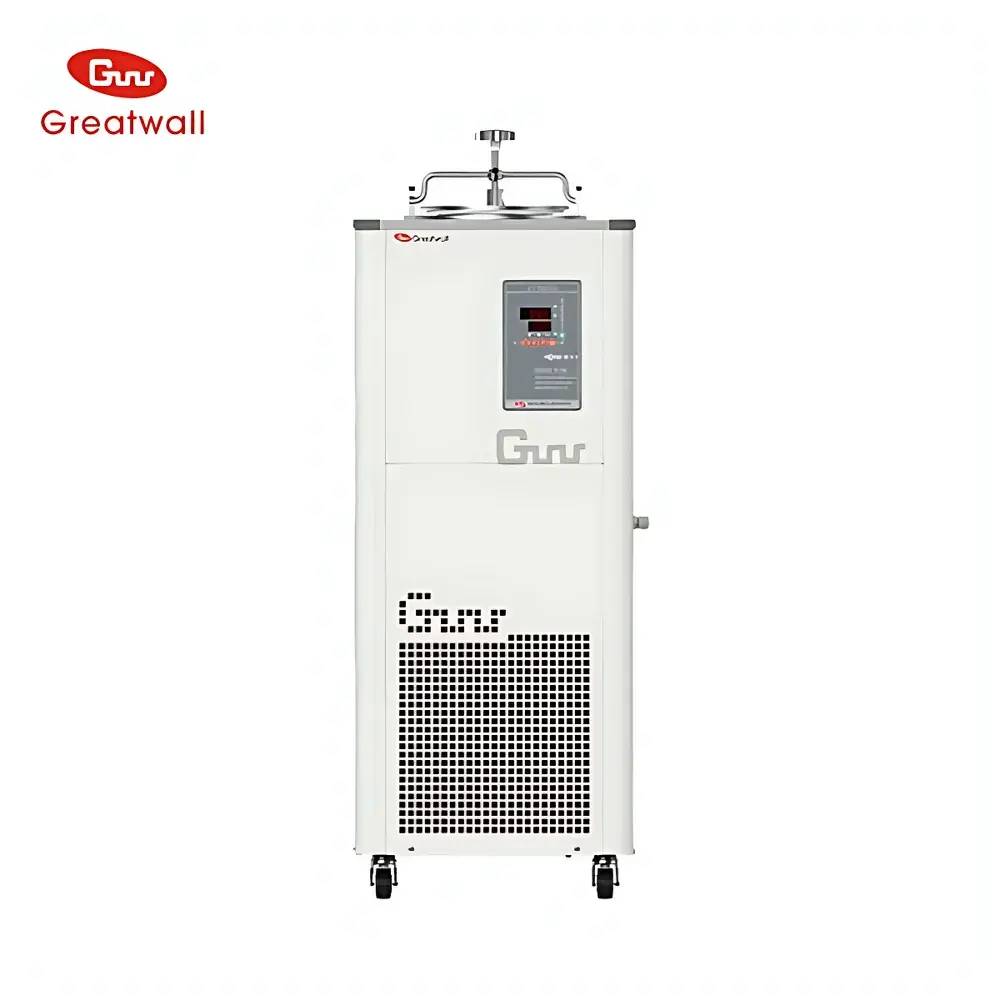
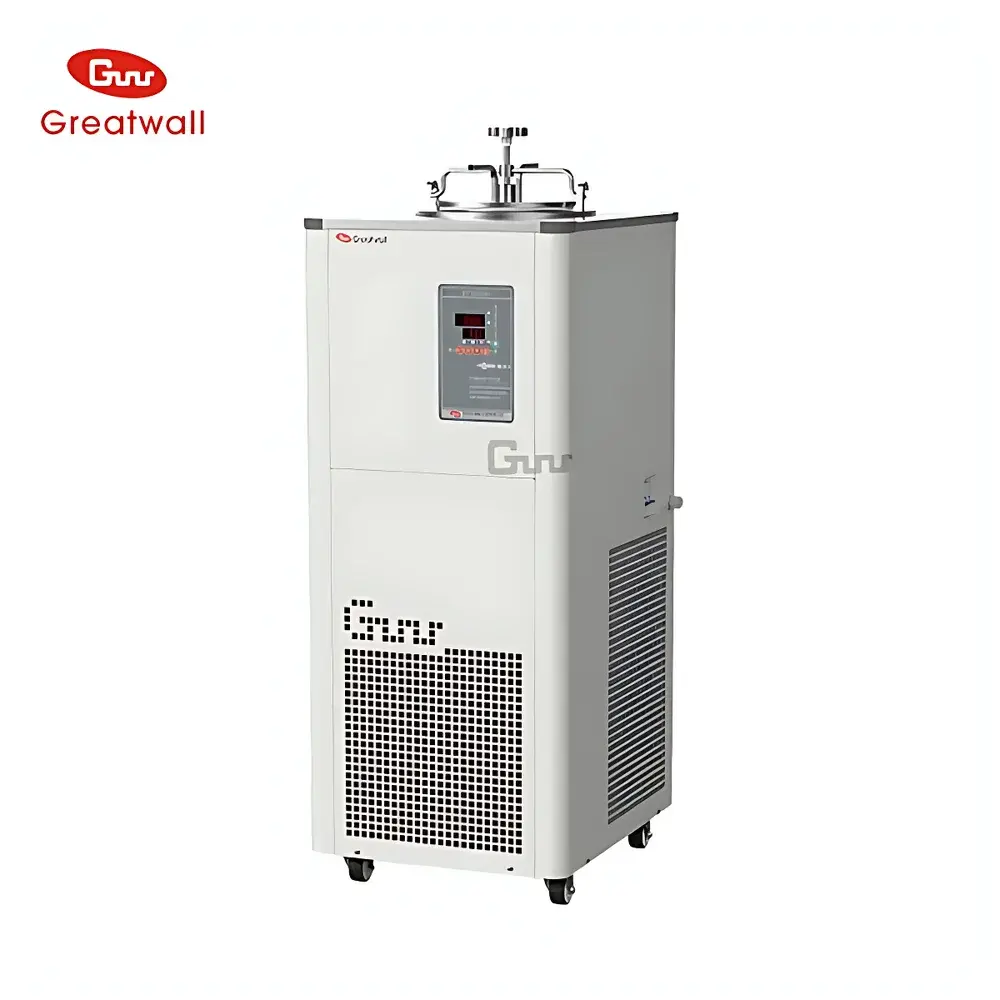
The Great Wall VT-2000L Cryogenic Vapor Trap
| Brand | The Great Wall |
|---|---|
| Origin | Henan, China |
| Manufacturer Type | Manufacturer |
| Model | VT-2000L |
| Cooling Capacity | 260 W at −40 °C / 110 W at −60 °C / 40 W at −80 °C |
| Minimum No-Load Temperature | −80 °C |
| Cooling Method | Direct refrigeration |
| Temperature Display | Digital (Pt100 sensor) |
| Temperature Setpoint Range | Adjustable within operational range |
| Safety Protections | Delayed start, overcurrent protection, overtemperature protection |
| Moisture Removal Capacity | ≤1 kg (water-based systems) |
| Refrigerants | R404A + R23 |
| Trap Chamber Dimensions | Ø160 × 240 mm |
| Chamber Material | 06Cr19Ni10 (AISI 304 stainless steel) |
| Condenser Interface | Flexible tubing connection, OD Ø12 mm |
| Ambient Operating Conditions | 5–35 °C, ≤70% RH |
| Power Supply | 220–240 V~, 50 Hz |
| Total Power Consumption | 1580 W |
| Input Current | 7.2 A |
| Overall Dimensions (W×D×H) | 520 × 528 × 1190 mm |
| Net Weight | 100 kg |
Overview
The Great Wall VT-2000L Cryogenic Vapor Trap is a high-capacity, dual-refrigerant (R404A/R23) condensation system engineered for reliable removal of water vapor and volatile organic compounds (VOCs) from vacuum lines in freeze-drying, rotary evaporation, solvent recovery, and battery electrode drying applications. Operating on the principle of cryogenic condensation—where vapors are thermodynamically driven to phase-change upon contact with sub-zero surfaces—the VT-2000L achieves a no-load minimum temperature of −80 °C, enabling efficient capture of low-volatility solvents including ethanol, acetone, ethyl acetate, and aqueous mixtures. Its stainless steel (AISI 304 / 06Cr19Ni10) trap chamber provides chemical resistance to water- and alcohol-based systems, while optional borosilicate glass condensers extend compatibility to acidic or halogenated media. Designed as a standalone vacuum-line safeguard, it reduces backstreaming, extends vacuum pump service intervals, and supports compliance with local emissions regulations by minimizing uncontrolled VOC release.
Key Features
- Two-stage cascade refrigeration architecture delivering stable −80 °C performance with verified cooling capacities of 260 W at −40 °C, 110 W at −60 °C, and 40 W at −80 °C
- Digital temperature monitoring via Pt100 RTD sensor with real-time display and user-defined setpoint control across the full operating range
- Robust 304 stainless steel trap chamber (Ø160 × 240 mm) rated for continuous exposure to water, ethanol, and mild organic solvents
- Modular interface design supporting both direct-chamber condensation and external glass cold-finger configurations via standardized Ø12 mm flexible hose ports
- Integrated safety suite including compressor delay logic, thermal cutoffs, and electronic overcurrent protection compliant with IEC 61000-4 immunity standards
- Low-noise, air-cooled condensing unit optimized for ambient operation between 5–35 °C and ≤70% relative humidity
Sample Compatibility & Compliance
The VT-2000L accommodates diverse sample matrices encountered in pharmaceutical lyophilization, R&D-scale solvent concentration, and lithium-ion battery manufacturing. Its AISI 304 chamber is validated for use with aqueous buffers, ethanol/water mixtures, and non-aggressive organics; when paired with optional borosilicate glass condensers, compatibility extends to hydrochloric acid solutions, acetonitrile, and chloroform. The system meets general-purpose laboratory equipment requirements per GB/T 20988-2007 (Chinese national standard for vacuum equipment safety) and incorporates design elements aligned with ISO 13850 (emergency stop principles) and IEC 61010-1 (safety requirements for electrical equipment). While not intrinsically rated for hazardous area use, its sealed refrigerant circuit and grounded chassis support integration into GMP-aligned facilities where documented risk assessments govern installation.
Software & Data Management
The VT-2000L operates as a stand-alone instrument with embedded microcontroller-based temperature regulation and status feedback—no external PC or proprietary software is required. All operational parameters (setpoint, actual temperature, compressor status, fault codes) are accessible via the front-panel LCD. For laboratories requiring audit-ready records, analog voltage output (0–5 V) is available for connection to third-party data loggers or SCADA systems. Though the device does not natively support FDA 21 CFR Part 11-compliant electronic signatures or user-access tiers, its deterministic thermal response and hardware-limited safety interlocks facilitate inclusion in GLP/GMP validation protocols when deployed alongside qualified data acquisition infrastructure.
Applications
- Vacuum drying of pharmaceutical intermediates and biologics in pilot-scale lyophilizers
- Solvent recovery during rotary evaporation of heat-sensitive natural product extracts
- Moisture and residual solvent removal from cathode/anode coatings in Li-ion battery electrode production lines
- Cryogenic pre-cooling of samples prior to transfer into ultra-high vacuum chambers
- Protection of oil-sealed and dry scroll vacuum pumps in analytical chemistry workflows involving volatile mobile phases
- Condensation-based gas scrubbing in small-scale chemical synthesis under reduced pressure
FAQ
Can the VT-2000L be used continuously at −80 °C?
Yes—its cascade refrigeration system is rated for continuous operation at −80 °C under nominal load conditions, provided ambient temperature remains ≤30 °C and ventilation is unobstructed.
Is the stainless steel chamber compatible with 1 M HCl?
No—06Cr19Ni10 (304 SS) is not resistant to prolonged exposure to concentrated mineral acids; use the optional glass condenser assembly for such applications.
What maintenance is required for long-term reliability?
Annual inspection of refrigerant charge integrity, condenser coil cleaning, and verification of Pt100 calibration traceability against NIST-traceable references are recommended.
Does the unit include vacuum gauge connectivity?
No—the VT-2000L lacks integrated pressure sensing; external vacuum gauges must be installed upstream or downstream per system design requirements.
Can it function as a cryogenic bath for sample pre-cooling?
Yes—when operated without vacuum load, the chamber serves as a stable −80 °C thermal sink suitable for pre-chilling flasks, cold fingers, or instrumentation components prior to vacuum transfer.



