
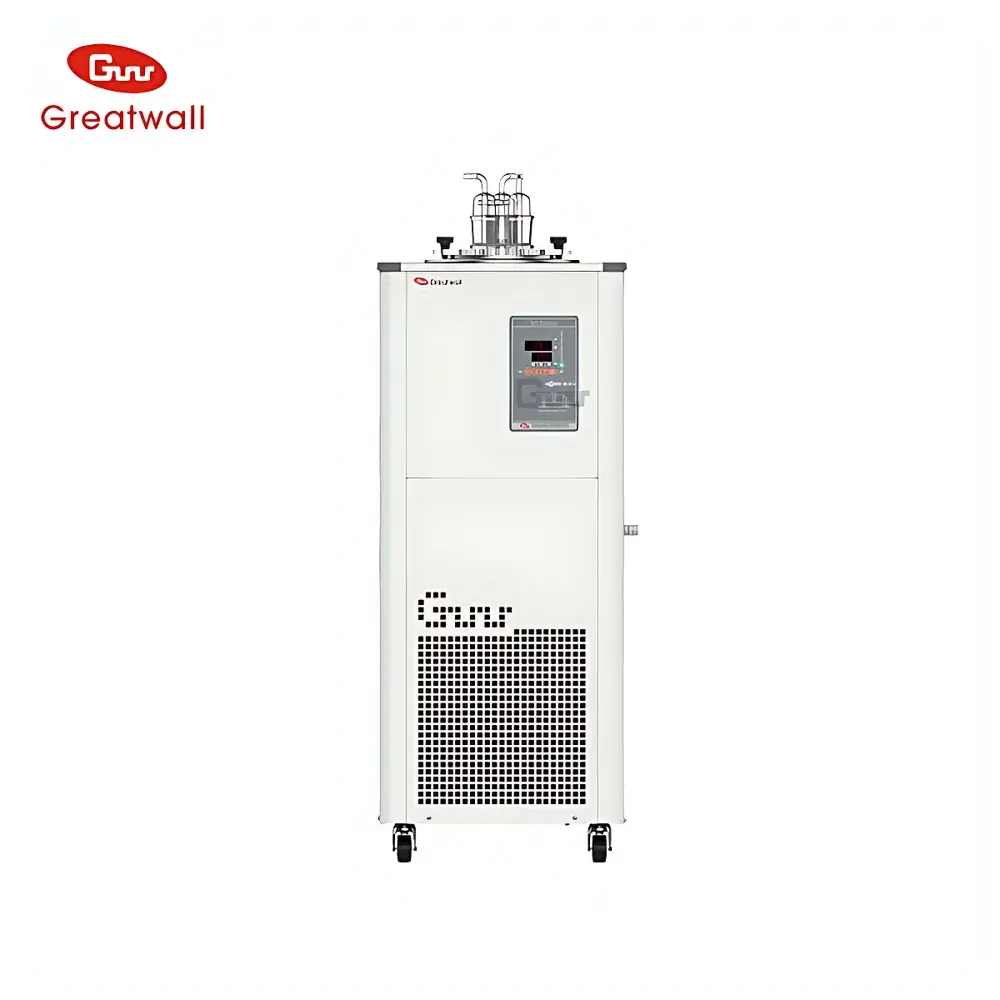
The Great Wall VT-2000LC Cryogenic Cold Trap
| Brand | The Great Wall |
|---|---|
| Origin | Henan, China |
| Manufacturer Type | Manufacturer |
| Model | VT-2000LC |
| Cooling Capacity | 260 W at −40 °C, 110 W at −60 °C, 40 W at −80 °C |
| Minimum No-Load Temperature | −80 °C |
| Cooling Method | Indirect refrigeration |
| Temperature Display | Digital, Pt100 sensor |
| Temperature Setpoint Range | Adjustable within operational range |
| Safety Protections | Delayed start, overcurrent protection, overtemperature protection |
| Refrigerants | R404A + R23 |
| Cold Trap Chamber Dimensions | Ø160 × 250 mm |
| Condenser Flask Dimensions | Ø50 × 300 mm |
| Chamber Material | 304 stainless steel |
| Condenser Flask Material | Borosilicate glass (Duran-type, 3.3 expansion coefficient) |
| Flask Quantity | 3 pcs |
| Vacuum Port | Flexible hose connector, OD Ø12 mm |
| Ambient Operating Conditions | 5–35 °C, ≤70% RH |
| Power Supply | 220–240 V~, 50 Hz |
| Total Power Consumption | 1580 W |
| Input Current | 7.2 A |
| Overall Dimensions (W×D×H) | 438 × 528 × 1210 mm |
| Net Weight | 100 kg |
Overview
The Great Wall VT-2000LC Cryogenic Cold Trap is an engineered vacuum accessory designed for high-efficiency condensate capture in low-pressure thermal processing systems. It operates on the principle of cryo-condensation—utilizing a closed-cycle dual-refrigerant system (R404A and R23) to achieve stable, no-load temperatures down to −80 °C. This enables selective phase transition of volatile species—including water vapor, low-boiling solvents (e.g., ethanol, acetone), and mildly corrosive vapors—into solid or liquid phases prior to reaching the primary vacuum pump. By intercepting condensables upstream, the VT-2000LC significantly extends pump service life, maintains ultimate vacuum integrity (<10−2 mbar typical), and reduces hydrocarbon backstreaming and oil contamination risks. Its architecture supports integration with vacuum drying ovens, rotary evaporators, lyophilizers, and industrial battery electrode drying lines where moisture and solvent removal under reduced pressure is critical to material stability and electrochemical performance.
Key Features
- Stainless steel cold trap chamber (AISI 304) rated for aqueous and ethanol-based applications; chemically resistant borosilicate glass (3.3 coefficient) condenser flasks compatible with acidic and organic solvent vapors
- Dual-mode operation: direct immersion trapping via internal chamber or modular glass flask assembly (3 × Ø50 × 300 mm) for flexible configuration and easy cleaning
- Pt100 precision temperature sensor with digital display panel enabling real-time monitoring and manual setpoint adjustment across the full operating range
- Multi-layer safety architecture including compressor delay start, thermal cut-off at critical junctions, and electronic overcurrent protection
- Optimized heat exchange design with indirect cooling circuit—minimizes thermal shock to refrigeration components and ensures long-term stability under continuous duty cycles
- Standardized Ø12 mm flexible vacuum port interface compatible with common PTFE and silicone vacuum tubing (ISO-KF adapters available separately)
Sample Compatibility & Compliance
The VT-2000LC accommodates a broad spectrum of volatile compounds encountered in laboratory and pilot-scale processing environments. Its 304 stainless steel chamber is suitable for water, methanol, ethanol, isopropanol, and ethyl acetate. The borosilicate glass flasks extend compatibility to HCl(aq), dilute HNO3, acetonitrile, THF, and DMF vapors—provided exposure duration and concentration remain within material endurance limits. While not certified to ISO/IEC 17025 or FDA 21 CFR Part 11 as a standalone analytical instrument, the unit complies with IEC 61000-6-3 (EMC emission standards) and IEC 61000-6-2 (immunity), and its electrical design meets GB 4793.1–2019 (equivalent to IEC 61010-1) for laboratory equipment safety. When deployed in GMP-aligned battery manufacturing lines, it supports documented process control when paired with external data loggers meeting ALCOA+ principles.
Software & Data Management
The VT-2000LC operates as a stand-alone hardware unit with no embedded firmware or network connectivity. Temperature readout is local only, displayed via integrated LED screen. For traceable process validation, users may integrate third-party USB or RS-485 temperature loggers (e.g., Omega OM-DAQPRO-5300 series) connected to the Pt100 output terminals. Such configurations support CSV export, audit trail generation, and alignment with 21 CFR Part 11-compliant electronic records when hosted on validated LIMS or MES platforms. No proprietary software is required or provided.
Applications
- Vacuum drying of hygroscopic materials (e.g., LiCoO2 cathode powders, polymer electrolytes) in battery R&D and production
- Solvent recovery and pump protection during rotary evaporation of heat-sensitive natural extracts
- Pre-freezing and low-temperature hold stages in freeze-drying cycle development
- Condensation of reaction byproducts (e.g., HCl gas from esterification) in Schlenk-line or vacuum manifold setups
- Moisture scavenging in glovebox antechambers and vacuum transfer lines for air-sensitive electrode fabrication
FAQ
Can the VT-2000LC be used continuously for >8 hours without performance degradation?
Yes—the unit is rated for continuous operation under ambient conditions ≤30 °C and ≤60% RH. Compressor duty cycle stabilizes after initial cooldown (~90 min to −80 °C), and thermal load management prevents sustained overheating.
Is the borosilicate glass condenser flask resistant to HF or concentrated sulfuric acid?
No. Type 3.3 borosilicate glass exhibits excellent resistance to most organic solvents and dilute mineral acids, but is incompatible with hydrofluoric acid, hot concentrated H2SO4, and strong alkalis above pH 12.
Does the unit include vacuum gauge or pressure control functionality?
No. The VT-2000LC is a passive condensation device only. Vacuum measurement and regulation must be implemented externally using compatible gauges (e.g., Pirani, capacitance manometer) and controllers.
What maintenance intervals are recommended for optimal refrigeration performance?
Compressor oil inspection every 12 months; condenser coil cleaning (non-abrasive brush + dry air) every 6 months; refrigerant leak check via halogen detector annually or after physical impact.
Can the cold trap chamber serve as a pre-chill bath for sample vials prior to lyophilization?
Yes—its stable −80 °C platform and uniform chamber geometry allow use as a low-temperature staging reservoir. However, direct immersion of samples into the chamber is not advised unless sealed in secondary containment to avoid frost accumulation on vial exteriors.



