
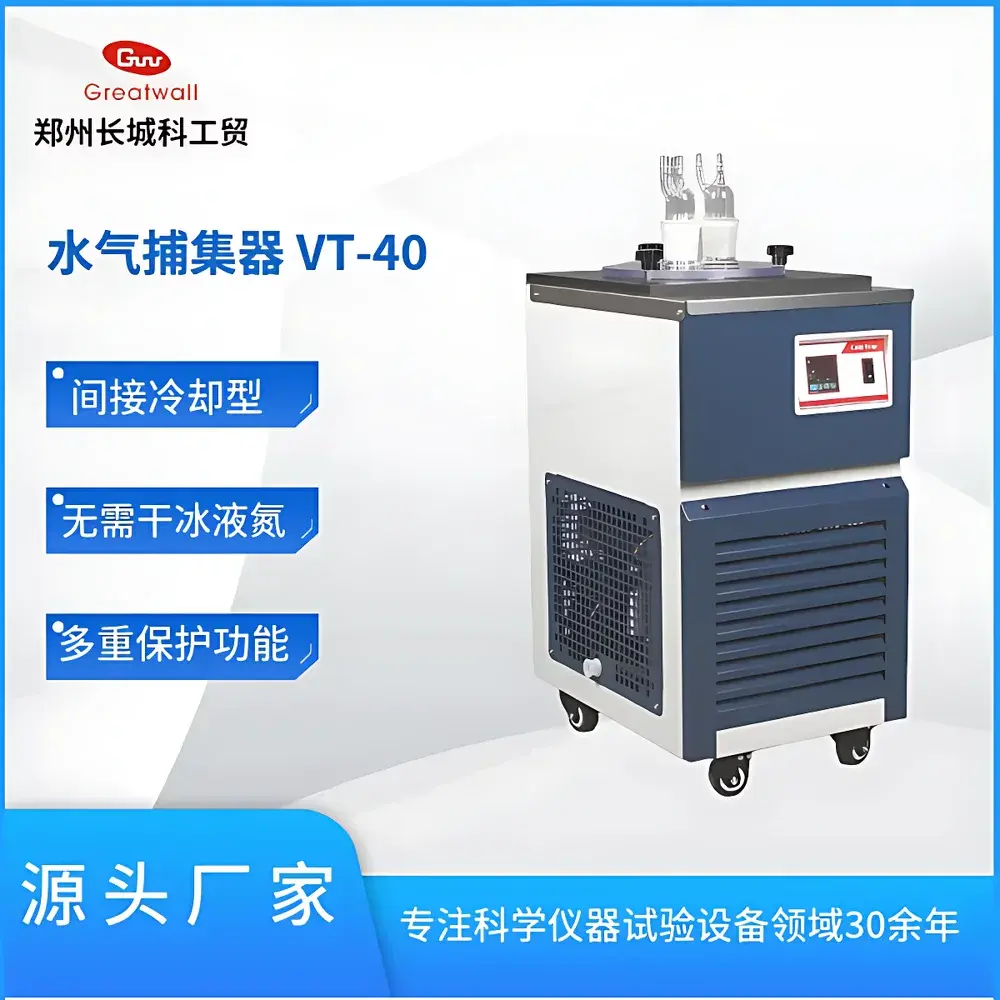
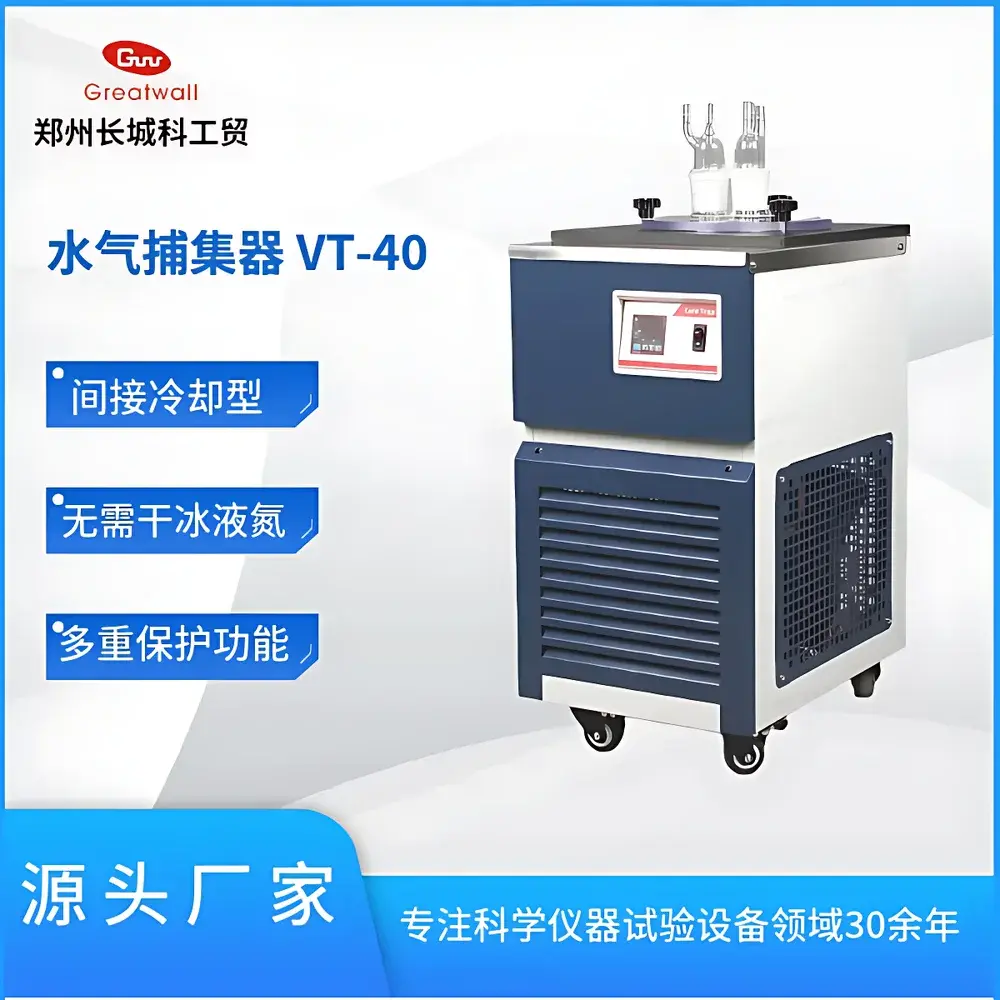
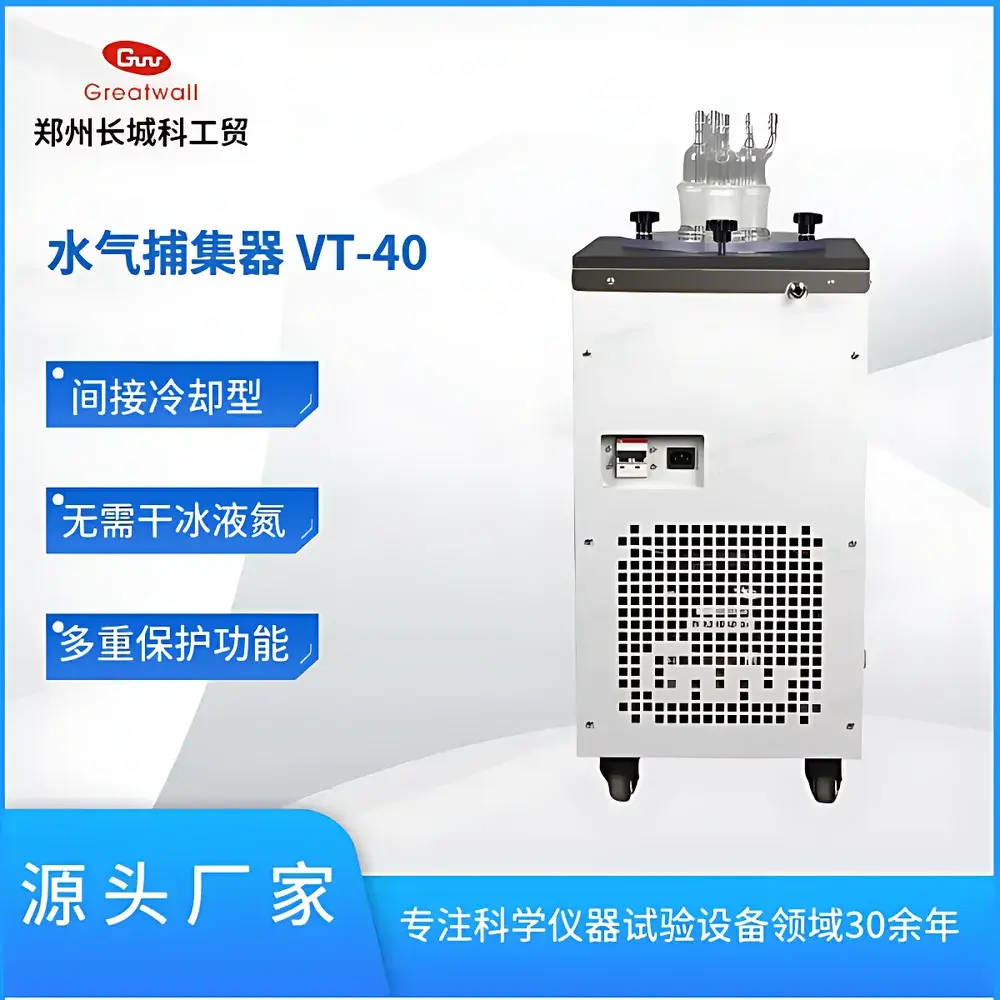
The Great Wall VT-40 Water Vapor Trap
| Brand | The Great Wall |
|---|---|
| Origin | Henan, China |
| Manufacturer Type | Direct Manufacturer |
| Country of Origin | China |
| Model | VT-40 |
| Price | USD 2,380 (approx.) |
| Minimum No-Load Temperature | −40 °C |
| Cooling Method | Indirect Refrigeration |
| Temperature Display | Digital, Pt100 Sensor |
| Temperature Setting Range | Adjustable Within Operating Range |
| Safety Protections | Delay Start, Overcurrent, Overheat, High-Pressure Cut-off |
| Refrigeration Capacity | 300 W at −10 °C, 250 W at −20 °C, 150 W at −30 °C, 50 W at −35 °C |
| Refrigerant | R404A |
| Cold Trap Chamber Dimensions | Ø160 × 250 mm |
| Condensation Flask Dimensions | Ø50 × 300 mm |
| Chamber Material | AISI 304 Stainless Steel |
| Flask Material | DIN 3.3 Borosilicate Glass (Grade ISO 3585) |
| Flask Quantity | 3 pcs |
| Vacuum Port Interface | Flexible Hose Fitting, OD 12 mm |
| Ambient Operating Temperature | 5–35 °C |
| Max. Relative Humidity | ≤70% RH |
| Total Power Consumption | 530 W |
| Rated Current | 2.9 A |
| Power Supply | 220 V~, 50 Hz |
| Unit Dimensions (W×D×H) | 350 × 470 × 805 mm |
| Net Weight | 45 kg |
Overview
The Great Wall VT-40 Water Vapor Trap is a purpose-engineered cold trap system designed for integration with vacuum drying ovens, rotary evaporators, freeze dryers, and low-pressure concentration setups. It operates on the principle of cryogenic condensation—utilizing a closed-cycle refrigeration system to chill the trap chamber or interchangeable glass flasks to sub-zero temperatures, thereby condensing water vapor, solvents, and volatile byproducts directly from the vacuum stream before they reach the primary vacuum pump. This not only extends pump service life and maintains ultimate vacuum integrity but also mitigates environmental release of hazardous vapors—including alcohols, acetone, ethyl acetate, and other common organic solvents—supporting laboratory compliance with occupational health and emissions control protocols.
Key Features
- Stainless steel trap chamber constructed from AISI 304 stainless steel—resistant to corrosion from aqueous and ethanol-based vapors, suitable for long-term operation in routine QC and R&D environments.
- Interchangeable DIN 3.3 borosilicate glass condensation flasks (Ø50 × 300 mm, pack of three)—chemically inert, transparent for real-time visual monitoring, and compatible with acidic, chlorinated, and polar aprotic solvent systems.
- Dual-mode operation: direct chamber trapping for high-volume water vapor removal; flask-based trapping for targeted solvent recovery and process observation.
- Precision digital temperature control with Pt100 resistance thermometer—enabling stable setpoint regulation across the full operating range (−40 °C to ambient), with resolution of ±0.1 °C and repeatability better than ±0.3 °C.
- Multi-layer safety architecture: integrated delay-start logic, overcurrent protection, thermal cutoff switches, and high-pressure sensor feedback to prevent compressor overload under abnormal load or ambient conditions.
- Optimized refrigeration design using R404A—azeotropic blend with zero ozone depletion potential (ODP = 0) and moderate global warming potential (GWP ≈ 3,922), compliant with current EU F-Gas Regulation Annex I restrictions for laboratory-scale equipment.
Sample Compatibility & Compliance
The VT-40 accommodates diverse sample matrices encountered in pharmaceutical lyophilization support, battery electrode drying (e.g., cathode/anode slurry pre-drying), capacitor moisture scavenging, and small-scale solvent recovery workflows. Its material compatibility aligns with USP , ISO 10993-5 (cytotoxicity screening), and ASTM D2671 (low-temperature seal performance). When deployed in GMP-aligned facilities, the unit supports audit-ready operation through stable thermal profiles, traceable calibration points (NIST-traceable Pt100), and consistent condensate retention—reducing cross-contamination risk between batches. While not intrinsically rated for Class I Div 1 hazardous locations, it may be installed in ventilated fume hoods per ANSI Z9.5 when handling flammable solvents.
Software & Data Management
The VT-40 operates as a standalone analog-digital hybrid instrument with no embedded firmware or network interface. Temperature data is displayed locally via a backlit LCD panel; no USB, RS-232, or Ethernet connectivity is provided. For laboratories requiring electronic recordkeeping, external data loggers (e.g., Omega OM-DAQPRO-5300 series) may be connected to the Pt100 output terminals for time-stamped acquisition. All operational parameters—including setpoint, actual temperature, power status, and fault codes—are retained in human-readable format for GLP-compliant manual entry into lab notebooks or LIMS templates. Calibration certificates are supplied with each unit, referencing ISO/IEC 17025-accredited third-party verification.
Applications
- Vacuum drying support for lithium-ion battery electrode coatings—removing residual NMP or DMF without thermal degradation of PVDF binders.
- Pre-freezing and low-temperature hold stages in pilot-scale lyophilization cycles, where precise condensate capture prevents ice migration into vacuum lines.
- Solvent recovery in small-batch API synthesis—capturing ethyl acetate or toluene vapors during reduced-pressure distillation.
- Moisture scavenging in ultra-high-vacuum (UHV) feedthroughs used in thin-film deposition systems (e.g., sputtering, e-beam evaporation).
- Backup cold trap for analytical instruments such as GC-MS or FTIR sampling interfaces where water interference must be minimized prior to detection.
FAQ
Can the VT-40 be used continuously at −40 °C?
Yes—provided ambient temperature remains ≤30 °C and relative humidity ≤60%. Sustained operation below −35 °C requires periodic defrosting if frost accumulation exceeds 3 mm on internal surfaces.
Is the glass condensation flask resistant to hydrofluoric acid?
No. DIN 3.3 borosilicate glass exhibits limited resistance to HF; use only with non-fluorinated acids (e.g., HCl, HNO₃) and organic solvents. For HF applications, stainless steel chamber mode is recommended with appropriate chemical compatibility review.
Does the unit comply with FDA 21 CFR Part 11 requirements?
No—the VT-40 lacks electronic audit trails, user authentication, or digital signature capability. It meets mechanical and electrical safety standards (IEC 61010-1), but electronic records require external validation per ALCOA+ principles.
What maintenance intervals are recommended?
Compressor oil inspection every 12 months; condenser coil cleaning every 6 months in dusty environments; Pt100 calibration verification annually or per internal SOP.
Can multiple VT-40 units be manifolded to a single vacuum line?
Yes—using Y-fittings and individual isolation valves. Ensure total conductance does not exceed 12 L/s at 10⁻² mbar to maintain effective trapping efficiency across all branches.



