
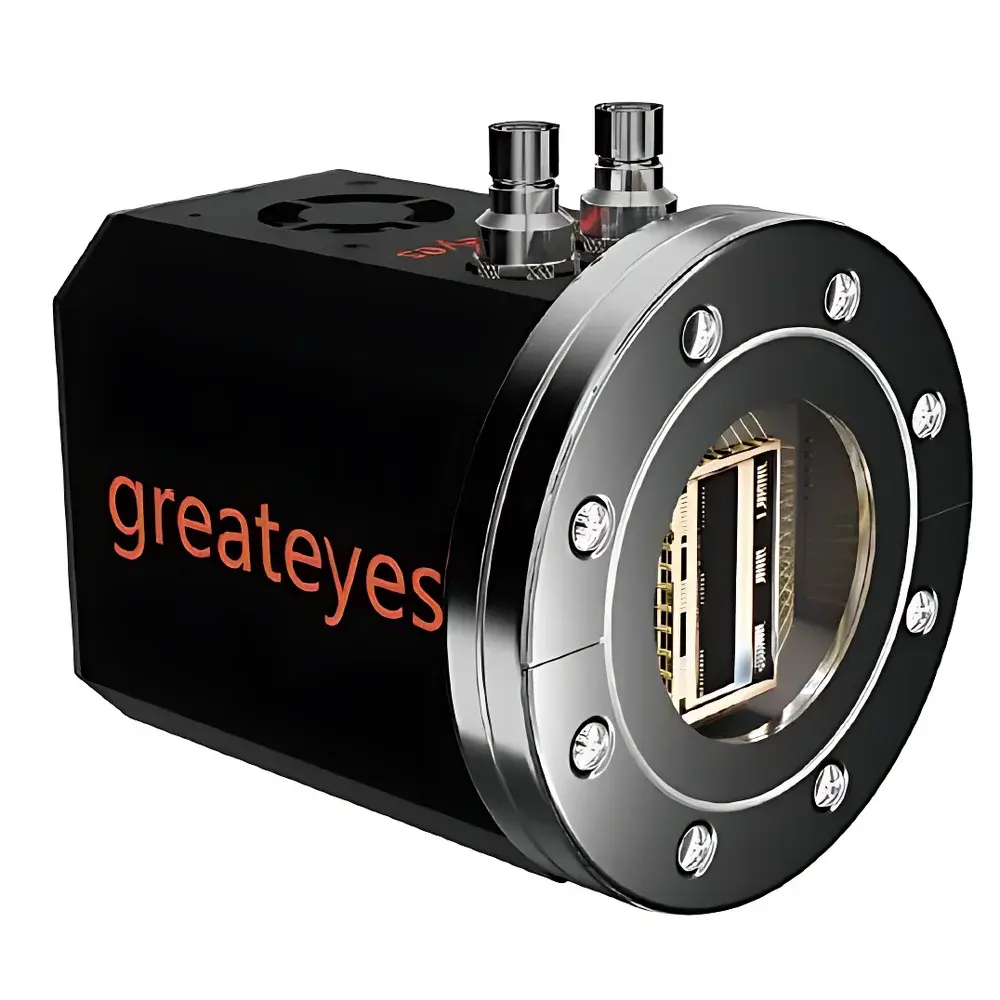
greateyes ALEX-s Series EUV and Soft X-ray Scientific CCD Camera
| Brand | greateyes |
|---|---|
| Origin | Germany |
| Model | ALEX-s 2k512 BI |
| Effective Pixels | 2048 × 512 |
| Pixel Size | 13.5 µm × 13.5 µm |
| Readout Speed | 50 kHz – 5 MHz |
| ADC Resolution | 18-bit |
| Operating Temperature | −100 °C |
| Quantum Efficiency | up to 98% |
| Full Well Capacity | 100 ke⁻ (BI) |
| Readout Noise | 6.0 e⁻ @ 50 kHz (BI), 7.2 e⁻ @ 1 MHz (BI DD), 13.2 e⁻ @ 3 MHz (BI DD) |
| Dark Current | 0.00025 e⁻/pixel/s @ −100 °C (BI DD) |
| Gain Modes | 0.34–1.0 counts/e⁻ |
Overview
The greateyes ALEX-s Series is a high-performance, back-illuminated scientific CCD camera engineered specifically for demanding applications in extreme ultraviolet (EUV), vacuum ultraviolet (VUV), and soft X-ray imaging and spectroscopy. Built upon deep-cooled, frame-transfer architecture and optimized for photon-starved environments, the ALEX-s leverages monolithic, thinned, and passivated silicon sensors with enhanced quantum efficiency across 10–200 nm — including critical spectral lines such as He II (30.4 nm), O VI (103.2 nm), and C IV (155 nm). Its core measurement principle relies on direct photoelectron generation in the depletion region of a back-illuminated sensor, followed by low-noise charge transfer and 18-bit digitization — enabling quantitative, linear response with high dynamic range and sub-electron read noise performance at cryogenic operating temperatures.
Key Features
- Ultra-deep thermoelectric cooling to −100 °C, minimizing dark current to <0.00025 e⁻/pixel/s (BI DD variant)
- 18-bit analog-to-digital conversion preserving full sensor dynamic range and maximizing signal fidelity
- Programmable readout speeds from 50 kHz to 5 MHz, supporting both high-sensitivity slow-scan and time-resolved fast-acquisition modes
- Back-illuminated (BI), front-illuminated (FI), and deep-depletion (DD) sensor options — each optimized for specific spectral responsivity and etaloning suppression
- Compact, modular mechanical design with integrated low-vibration cooling and EMI-shielded electronics for integration into vacuum chambers and synchrotron beamlines
- Quantum efficiency exceeding 95% at 50 nm and up to 98% in optimized UV bands — achieved via anti-reflection coatings and surface passivation technologies
- Standard Grade 0 or Grade 1 sensor selection per ASTM F1828-20 (standard for scientific CCD grading)
Sample Compatibility & Compliance
The ALEX-s series is compatible with ultra-high vacuum (UHV) environments (<10⁻⁹ mbar) and can be directly mounted to standard CF-63 or DN100 flanges. Its hermetically sealed, bakeable housing meets ISO 10110 optical cleanliness standards and supports in-situ calibration using certified radioactive sources (e.g., ⁵⁵Fe) or synchrotron white-beam line scans. The camera complies with CE marking requirements for electromagnetic compatibility (EN 61326-1) and safety (EN 61010-1). For regulated research environments, firmware supports audit-trail logging and user-access control aligned with GLP/GMP documentation workflows. While not FDA-certified, its data integrity features — including checksummed image headers, non-volatile configuration storage, and timestamped metadata — support compliance with 21 CFR Part 11 when deployed within validated laboratory information management systems (LIMS).
Software & Data Management
greateyes provides the cross-platform greateyes Control Center software (Windows/macOS/Linux), offering full hardware abstraction, real-time histogram analysis, region-of-interest (ROI) binning, and non-uniformity correction (NUC) via flat-field and dark-frame subtraction. All acquired images include embedded FITS-compliant headers containing exposure time, temperature, gain mode, bias level, and sensor identification — ensuring traceability and interoperability with IRAF, DS9, Python (Astropy), and MATLAB. Raw pixel data is stored in lossless 16- or 32-bit integer formats; metadata export supports CSV and JSON schemas for automated pipeline ingestion. Optional SDKs (C/C++, Python bindings) enable integration into custom acquisition frameworks, including EPICS IOC drivers for accelerator-based facilities.
Applications
- EUV lithography mask inspection and plasma source characterization
- Solar physics: high-resolution imaging of the solar corona and transition region using sounding rocket or spaceborne telescopes (e.g., TRACE heritage, Solar Orbiter/EUI alignment)
- Soft X-ray spectroscopy of laser-produced plasmas and Z-pinch sources
- Time-resolved studies of ultrafast molecular dynamics via pump-probe EUV/XUV setups
- VUV fluorescence lifetime imaging in atomic and molecular beam experiments
- Calibration reference for grating spectrometers operating below 200 nm
FAQ
What vacuum compatibility does the ALEX-s offer?
The ALEX-s 2k512 BI model is rated for continuous operation in UHV environments down to 1×10⁻⁹ mbar. Optional feedthroughs support differential pumping for integration with beamline end stations.
Can the camera operate in photon-counting mode?
No — the ALEX-s is an integrating CCD, not a photon-counting detector. However, its sub-electron read noise and deep cooling enable single-photon-level detection via statistical thresholding in post-processing.
Is there support for external triggering and synchronization?
Yes — TTL-compatible trigger input and output ports support master-slave timing, delay-adjustable gating, and lock-in acquisition synchronized to pulsed lasers or RF sources.
How is sensor uniformity corrected?
Factory-measured pixel response non-uniformity (PRNU) and fixed-pattern noise (FPN) are delivered as calibration frames. Users apply them via the Control Center or third-party tools using standard flat-field and dark-frame correction protocols.
What is the typical lead time for Grade 0 sensor delivery?
Grade 0 sensors require additional screening and certification; standard lead time is 12–16 weeks from order confirmation, subject to wafer fabrication cycle scheduling.




