
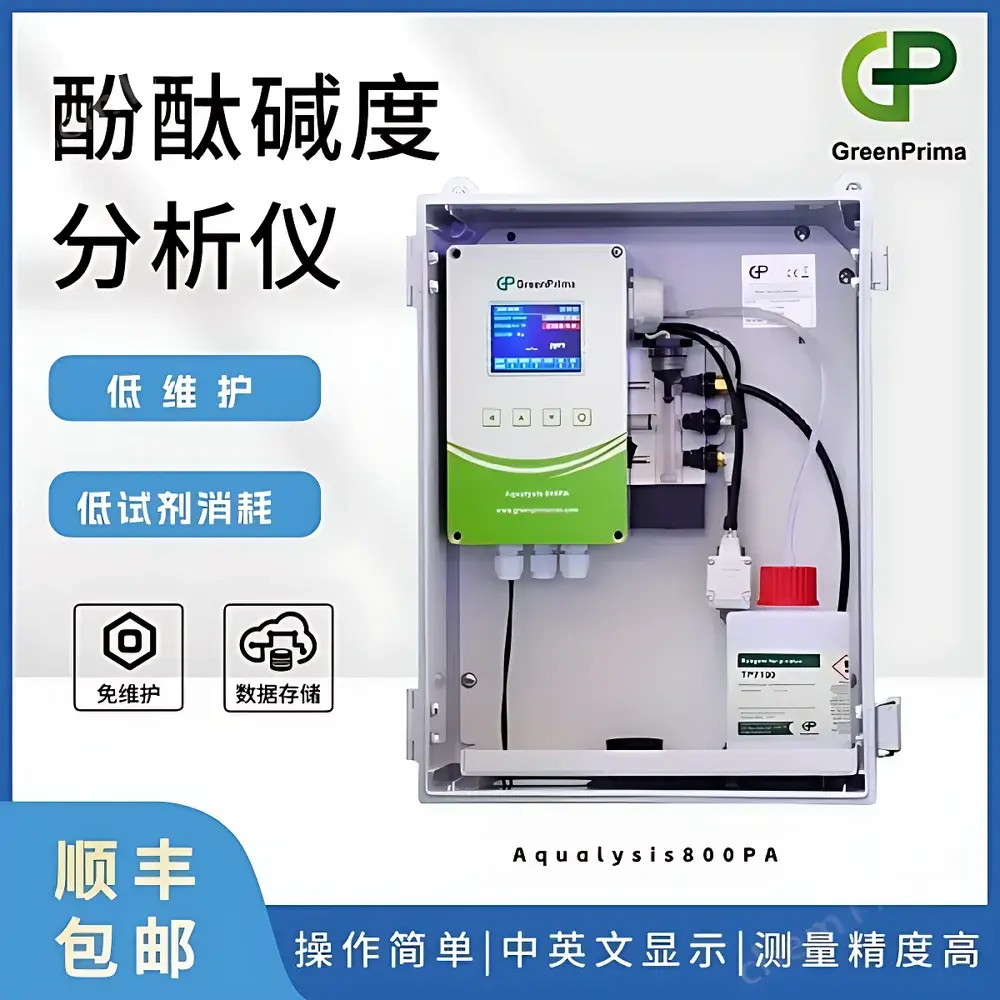
GreenPrima Aqualys is800PA Phenolphthalein Alkalinity Analyzer for Boiler Feedwater
| Brand | GreenPrima |
|---|---|
| Origin | United Kingdom |
| Manufacturer Type | Manufacturer |
| Origin Category | Imported |
| Model | Aqualys is800PA |
| Price | Upon Request |
Overview
The GreenPrima Aqualys is800PA Phenolphthalein Alkalinity Analyzer is a fully automated, benchtop-to-wall-mountable process analyzer engineered for continuous or interval-based monitoring of phenolphthalein alkalinity (P-alkalinity) in industrial water streams—particularly boiler feedwater, cooling tower makeup, blast furnace gas scrubber effluent, and turbid recirculating systems. It operates on the principle of potentiometrically guided acid–base titration coupled with photometric endpoint detection: a precisely metered volume of standardized hydrochloric acid is added to the sample until the pH drops below ~8.3, at which point phenolphthalein transitions from pink to colorless. The instrument quantifies the acid volume required to reach this stoichiometric endpoint using high-stability peristaltic dosing pumps and a dual-wavelength photometer calibrated for robust colorimetric discrimination—even in moderately turbid or colored samples. Unlike manual titration or single-point pH-based estimations, the is800PA delivers traceable, ISO/IEC 17025-aligned alkalinity values expressed in standardized units (mmol/L, ppm CaCO₃, °dH, °f), supporting compliance with ASME B31.1, ASTM D1066, EN 1489, and internal boiler water treatment protocols.
Key Features
- Automated titration with integrated photometric endpoint recognition—eliminates subjectivity and operator dependency
- Microprocessor-controlled sequence management with self-diagnostic routines for pump performance, valve actuation, optical path integrity, and reagent depletion alerts
- Compact footprint (400 × 300 × 180 mm; 4 kg) and IP65-rated enclosure suitable for semi-outdoor installation in utility corridors or chemical dosing rooms
- Low-reagent consumption design: typical reagent usage ≤ 1.2 mL per analysis cycle; standard reagent kit supports ≥ 30 days of continuous operation at 15-min intervals
- Configurable measurement frequency: 1–360 minute intervals, external pulse-triggered analysis (e.g., flow-proportional sampling), or on-demand start via digital input
- Full-color LCD interface with intuitive touch navigation, multilingual support (English & Chinese), real-time trend graphs, and embedded event log (≥ 10,000 entries)
- Comprehensive I/O architecture: four programmable relay outputs (250 VAC / 4 A), two opto-isolated digital inputs (start/stop), one isolated 4–20 mA analog output (750 Ω max load), and RS485 Modbus RTU for SCADA integration
- Onboard data storage with timestamped results, calibration history, fault codes, and maintenance reminders—exportable via USB or Modbus
Sample Compatibility & Compliance
The Aqualys is800PA is validated for use with low-turbidity, non-oily aqueous streams meeting specified matrix constraints: pH 4–10, Fe < 3 mg/L, Cu < 0.2 mg/L, Al < 0.1 mg/L, Mn < 0.2 mg/L. Sample temperature must remain between 5°C and 40°C; inlet pressure should be maintained at 1–2 bar (0.2–5 bar operational range). The analyzer conforms to electromagnetic compatibility standards (EN 61326-1), functional safety principles per IEC 61508 SIL1, and carries UKCA marking for deployment in Great Britain. Its measurement methodology aligns with ASTM D1066 (Standard Test Method for Alkalinity of Water) and supports GLP-compliant audit trails when configured with time-stamped calibration records and user-access logs.
Software & Data Management
Firmware v3.2+ includes embedded audit-trail functionality compliant with FDA 21 CFR Part 11 requirements—including electronic signatures, immutable event logging, and role-based access control (Operator, Technician, Administrator). All calibration events, reagent lot tracking, and system diagnostics are timestamped and stored locally. Data export options include CSV via USB mass storage or real-time streaming over Modbus RTU to DCS/PLC systems. Optional cloud-connectivity modules enable remote firmware updates, predictive maintenance alerts, and centralized fleet monitoring across multi-site boiler plants.
Applications
- Real-time P-alkalinity control in high-pressure boiler feedwater circuits to prevent caustic embrittlement and under-deposit corrosion
- Automated dosing feedback for sodium hydroxide or soda ash addition in closed-loop cooling systems
- Monitoring of scrubber water alkalinity in integrated steelworks to ensure optimal sulfur capture efficiency
- Quality gate verification for make-up water entering thermal power plant condensate polishing trains
- Regulatory reporting support for ISO 5667-3 (water sampling) and EN ISO 9001-certified water treatment operations
FAQ
What is the difference between phenolphthalein alkalinity (P-alkalinity) and total alkalinity (M-alkalinity)?
Phenolphthalein alkalinity measures hydroxide (OH⁻) and half the carbonate (CO₃²⁻) contribution, titrated to pH ≈ 8.3. Total alkalinity (methyl orange alkalinity) includes all buffering species (OH⁻, CO₃²⁻, HCO₃⁻) down to pH ≈ 4.5. The is800PA measures P-alkalinity specifically; M-alkalinity requires a second titration step not supported by this model.
Can the is800PA operate unattended for extended periods?
Yes—designed for >30 days of uninterrupted operation at 30-minute intervals with standard reagent kits. Scheduled maintenance (e.g., tubing replacement, optical window cleaning) is recommended every 90 days per ISO 17025 preventive maintenance guidelines.
Is third-party certification available for method validation?
GreenPrima provides application-specific validation packages including IQ/OQ documentation, certified reference material testing reports (NIST-traceable Na₂CO₃ standards), and interlaboratory comparison data upon request.
How does the instrument handle sample carryover or cross-contamination?
Each analysis cycle includes a configurable post-measurement flush (15–1800 s), with dedicated waste evacuation and air-purge steps. Flow-path materials (PTFE, borosilicate glass, EPDM-free fluidics) minimize adsorption and biofilm formation.
Does the analyzer support custom alarm thresholds and hysteresis logic?
Yes—up to four independent relay outputs can be assigned to user-defined P-alkalinity limits, rate-of-change alarms, or maintenance timers, with adjustable hysteresis and delay settings to suppress nuisance tripping.
Related Products







