
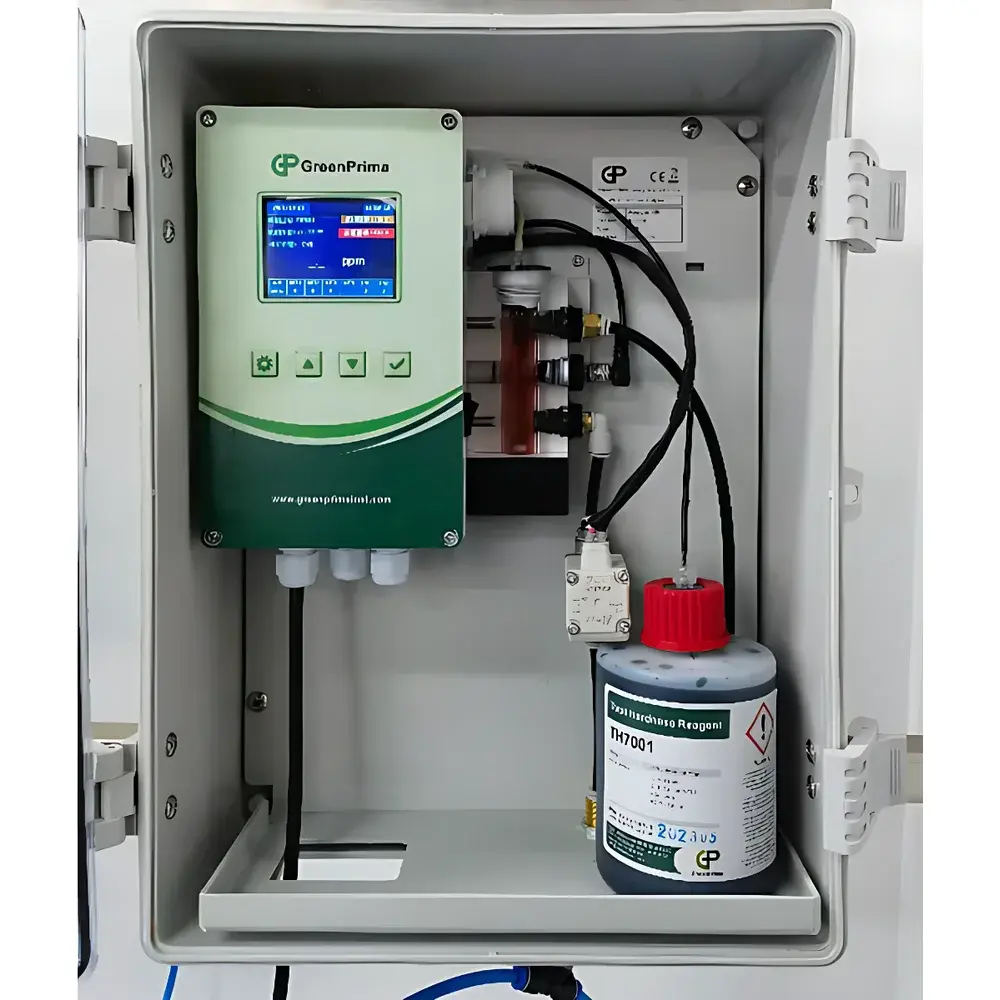
GreenPrima Aqualysis 800 Total Hardness Analyzer
| Brand | GreenPrima |
|---|---|
| Origin | Shanghai, China |
| Manufacturer Type | Manufacturer |
| Country of Origin | China |
| Model | Aqualysis 800 |
| Instrument Type | Online Water Quality Analyzer |
| Measured Parameter | Calcium and Magnesium Hardness (as CaCO₃) |
| Measurement Method | Titrimetric Colorimetry (Photometric Endpoint Detection) |
| Measurement Range | 0.447–625.8 ppm as CaCO₃ (configurable via reagent kits TH7001–TH7100) |
| Accuracy | ±2% of selected reagent’s upper limit |
| Repeatability | ±1% of selected reagent’s upper limit |
| Cycle Time | ~3 minutes (hardness-dependent) |
| Display | Color LCD with bilingual (English/Chinese) interface |
| Dimensions | 400 × 300 × 180 mm (W×H×D) |
| Weight | 4 kg |
| Enclosure Rating | IP65 |
| Power Supply | 85–265 VAC, 47–63 Hz |
| Power Consumption | 25 VA (operational), 3.5 VA (standby) |
| Outputs | 4 programmable relay contacts (250 VAC, 4 A), 1 isolated 4–20 mA analog output (max. 750 Ω), 1 RS485 Modbus RTU port |
| Inputs | 2 programmable digital inputs (IN1: start analysis |
| IN2 | stop analysis) |
| Data Logging | Internal storage for time-stamped measurement records |
| Sample Requirements | pH 4–10 |
| Sample Temp. | 5–40 °C |
| Operating Ambient Temp. | 10–40 °C |
| Sample Pressure | 0.2–6 bar (recommended: 1–2 bar) |
| Mounting | Wall-mounted |
Overview
The GreenPrima Aqualysis 800 Total Hardness Analyzer is an industrial-grade online water quality instrument engineered for continuous, unattended monitoring of total calcium and magnesium hardness in process and utility water streams. It operates on the principle of photometric titrimetric analysis—specifically, a standardized EDTA-based colorimetric titration where the endpoint is detected optically via absorbance change at a defined wavelength (typically 550–620 nm). This method conforms to established analytical frameworks referenced in ISO 6059, ASTM D1126, and USP & EP monographs for purified water and water for injection (WFI). Unlike conductivity-based proxies, the Aqualysis 800 delivers true hardness quantification traceable to gravimetric CaCO₃ standards, making it suitable for regulatory-critical applications including boiler feedwater control, steam-cycle chemistry management, and pharmaceutical water system validation.
Key Features
- Compact, wall-mountable enclosure (400 × 300 × 180 mm; IP65-rated) optimized for integration into mechanical rooms, skids, and sampling panels.
- Bilingual (English/Chinese) full-color LCD interface with intuitive menu navigation, real-time trend graphs, and diagnostic status indicators.
- Modular reagent kit compatibility—supports seven standardized hardness ranges (0.447–625.8 ppm as CaCO₃) via interchangeable reagent cartridges (TH7001 through TH7100), enabling application-specific calibration without hardware modification.
- Programmable measurement interval (0–360 minutes) and configurable sample flush duration (15–1800 seconds) to accommodate variable flow dynamics and fouling-prone matrices.
- Dual digital inputs (IN1/IN2) for external synchronization—e.g., triggering analysis upon pump activation or integrating with PLC-controlled sampling valves.
- Four independently programmable relay outputs supporting alarm staging, soft-start dosing control, or maintenance alerts; all configured with hysteresis and delay logic to prevent chatter.
- Isolated 4–20 mA output with user-selectable scaling (e.g., 4 mA = 0 ppm, 20 mA = 625.8 ppm), compliant with standard DCS/SCADA signal acquisition protocols.
Sample Compatibility & Compliance
The Aqualysis 800 is validated for use with low-turbidity, non-oily aqueous samples meeting specified matrix constraints: pH 4–10, iron < 3 ppm, copper < 0.2 ppm, aluminum < 0.1 ppm, and manganese < 0.2 ppm. These limits align with typical pretreatment requirements for high-purity water systems per ASTM D511 and ISO 14687. The analyzer supports direct connection to pressurized sample lines (0.2–6 bar, optimal 1–2 bar) and accommodates inlet temperatures from 5 °C to 40 °C. For pharmaceutical applications—including USP Purified Water, WFI, and clean-steam condensate—the device meets functional requirements for continuous hardness surveillance under GMP Annex 1 and EU GMP Chapter 5. While not intrinsically certified for hazardous locations, its IP65 rating ensures reliable operation in humid, non-explosive environments such as boiler houses and central utility plants.
Software & Data Management
Data integrity is maintained through timestamped internal logging of all measurements, system events (e.g., reagent low, calibration overdue, sensor fault), and operational states. Logs are retained for ≥30 days (circular buffer) and exportable via RS485 using Modbus RTU protocol for integration into LIMS, MES, or historian platforms (e.g., Siemens Desigo, Rockwell FactoryTalk, or Emerson DeltaV). The device supports audit-trail-enabling configurations when deployed with external supervisory software compliant with FDA 21 CFR Part 11—specifically, electronic signatures, user access levels, and immutable record retention. No proprietary cloud service or vendor-hosted platform is required; all configuration and diagnostics occur locally via front-panel interface or serial command set.
Applications
- Real-time hardness monitoring of boiler feedwater to prevent scale formation and optimize phosphate/polymer dosing strategies.
- Verification of softener breakthrough in ion exchange and membrane-based water treatment trains (e.g., RO permeate polishing).
- Continuous surveillance of cooling tower make-up and recirculating water to support cycles-of-concentration calculations and corrosion inhibition programs.
- Final quality verification for purified water distribution loops in biopharmaceutical manufacturing facilities.
- Automated hardness trending in municipal water reclamation and industrial effluent compliance reporting (e.g., NPDES discharge permits).
FAQ
What hardness units does the Aqualysis 800 support?
The instrument displays results in ppm as CaCO₃, °dH (German degrees), °f (French degrees), and mmol/L—user-selectable per installation requirement.
Can the Aqualysis 800 be integrated with a multi-channel sampler?
Yes—it is fully compatible with GreenPrima’s MCS series multi-channel distribution modules (2–8 channels), enabling sequential analysis across multiple sample points without additional analyzers.
Does the analyzer require daily manual intervention?
No. With standard reagent kits (e.g., TH7030), typical reagent consumption is ≤1.2 mL per analysis, supporting >30 days of continuous operation at 1-hour intervals; only periodic cartridge replacement and quarterly optical path inspection are recommended.
Is calibration traceable to national standards?
Calibration is performed using NIST-traceable CaCO₃ standard solutions; certificate of analysis is provided with each reagent batch, and field verification procedures follow ISO/IEC 17025-aligned practices.
What maintenance is required beyond reagent replacement?
Annual verification of photometer zero/span stability, tubing integrity check, and cleaning of the reaction cuvette and flow cell with dilute citric acid solution—no optical alignment or electronics recalibration is needed under normal operating conditions.
Related Products







