
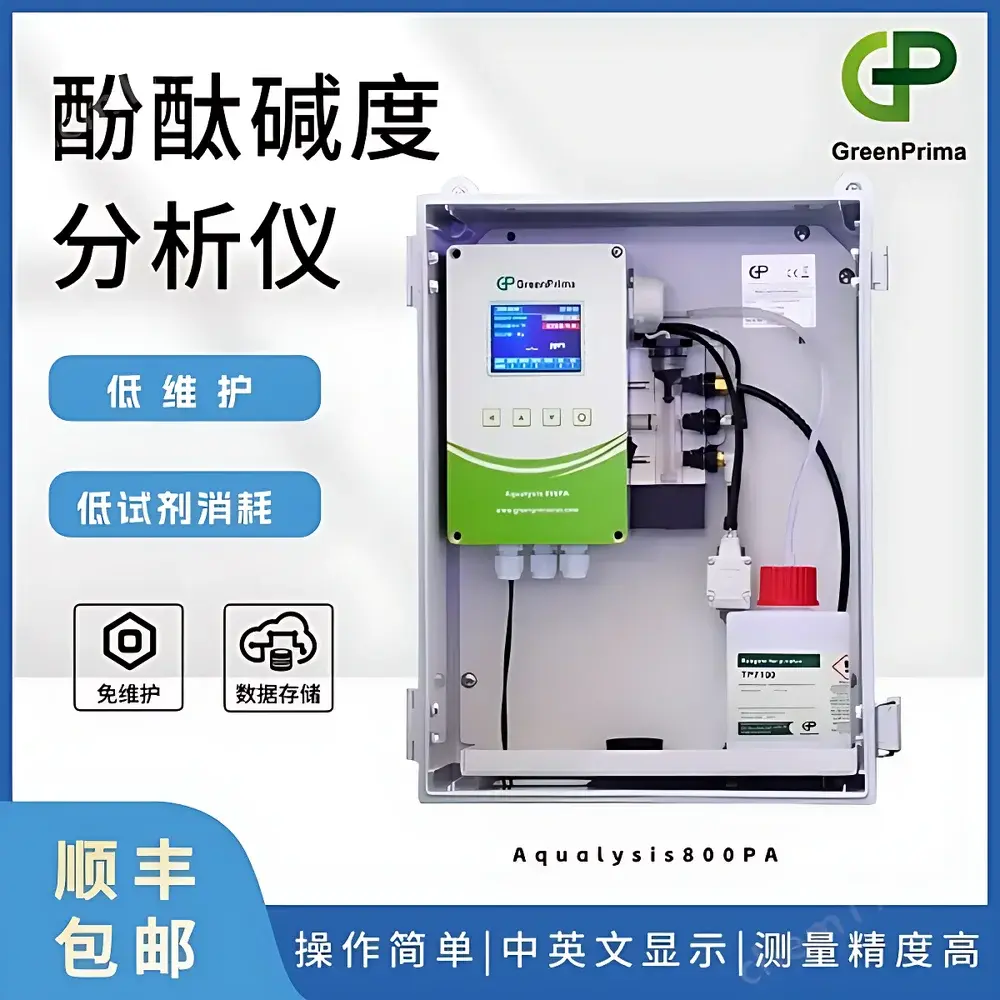
GreenPrima Aqualysis 800PA Phenolphthalein Alkalinity Analyzer
| Brand | GreenPrima |
|---|---|
| Origin | United Kingdom |
| Manufacturer Type | Manufacturer |
| Origin Category | Imported |
| Model | Aqualysis 800PA |
| Price | Upon Request |
Overview
The GreenPrima Aqualysis 800PA Phenolphthalein Alkalinity Analyzer is a fully automated, benchtop-to-industrial inline analyzer engineered for continuous or interval-based determination of phenolphthalein alkalinity (P-alkalinity) in process and environmental water streams. It operates on the principle of potentiometrically assisted acid–base titration coupled with photometric endpoint detection: a precisely metered volume of standardized hydrochloric acid is dosed into the sample until the pH drops below ~8.3, at which point phenolphthalein transitions from pink to colorless; this spectral shift is quantified via dual-wavelength photometry (typically 540 nm and reference wavelength), enabling high-reproducibility endpoint recognition. Unlike manual titrations or pH-metric systems vulnerable to carbonate/bicarbonate interference, the Aqualysis 800PA implements a rigorously controlled reagent delivery sequence—acid titrant followed by indicator injection—ensuring selective detection of OH⁻ and CO₃²⁻ contributions only, excluding HCO₃⁻. This makes it especially suitable for high-turbidity, variable-hardness, or iron-rich industrial waters where conventional pH electrodes exhibit drift or fouling.
Key Features
- Automated titration–photometry hybrid methodology compliant with ISO 9963-1 and ASTM D1067 for phenolphthalein alkalinity determination
- Integrated microprocessor-controlled fluidic system featuring peristaltic metering pumps, solenoid valves, and optical flow cell with temperature-stabilized LED光源 and silicon photodiode detector
- Compact footprint (400 × 300 × 180 mm) and IP65-rated enclosure for deployment in utility corridors, cooling towers, or steel plant wet scrubber control rooms
- Low reagent consumption: ≤1.2 mL HCl (0.1 mol/L) and ≤0.8 mL phenolphthalein indicator per analysis cycle; typical reagent cartridge life exceeds 30 days at 15-min intervals
- Self-diagnostic routines including air bubble detection, valve response verification, photometric baseline validation, and acid concentration drift compensation
- Configurable measurement intervals from 1 to 360 minutes; external trigger via dry-contact input (IN1/IN2) or pulse-modulated flow signal
- Four programmable relay outputs (250 VAC / 4 A) for alarm staging, pump interlock, or PLC handshake; two digital inputs support cascade synchronization with multi-channel MCS-series distributors
Sample Compatibility & Compliance
The Aqualysis 800PA is validated for use with raw and treated waters exhibiting turbidity up to 200 NTU, provided suspended solids are non-abrasive and settleable. Sample compatibility requires pH 4–10, Fe < 3 mg/L, Cu < 0.2 mg/L, Al < 0.1 mg/L, Mn < 0.2 mg/L—conditions routinely met in blast furnace gas scrubber effluents, recirculating cooling systems, and low-pressure boiler feedwater. The analyzer meets IEC 61326-1 (EMC for industrial environments) and carries UKCA marking. Its firmware architecture supports audit-trail logging aligned with GLP requirements, and data export formats (CSV via RS485 or SD card) are compatible with LIMS integration under ISO/IEC 17025-accredited laboratories.
Software & Data Management
The embedded Linux-based controller features a 7-inch capacitive touchscreen interface with multilingual support (English, Chinese, Spanish, German). All calibration parameters—including acid normality, indicator blank offset, and photometric gain—are stored with timestamped versioning. Measurement history retains ≥10,000 records with full metadata (sample ID, operator tag, ambient temperature, reagent lot number, diagnostic flags). RS485 Modbus RTU protocol enables bidirectional communication with SCADA or DCS platforms; optional OPC UA gateway firmware upgrade supports IIoT-ready data streaming. 4–20 mA analog output is linearly scaled to user-defined alkalinity range (e.g., 0–200 mg/L as CaCO₃), with NIST-traceable calibration certificate available upon request.
Applications
Primary deployment domains include metallurgical off-gas treatment (e.g., basic oxygen furnace scrubber water where P-alkalinity correlates directly with caustic carryover and scaling risk), closed-loop cooling circuits (monitoring carbonate precipitation potential), low-pressure steam generation (feedwater alkalinity control per ASME B31.1 and EN 12952-12), and municipal wastewater neutralization basins. Secondary applications encompass lime softening optimization, desalination pretreatment monitoring, and regulatory compliance reporting for discharge permits requiring phenolphthalein alkalinity limits (e.g., EU Industrial Emissions Directive Annex I).
FAQ
What standard methods does the Aqualysis 800PA comply with?
It implements procedures equivalent to ISO 9963-1, ASTM D1067, and APHA Standard Method 2320 B.
Can it distinguish between total alkalinity and phenolphthalein alkalinity?
Yes—the instrument is configured exclusively for phenolphthalein endpoint detection (pH ≈ 8.3); total alkalinity requires separate configuration or a dual-mode analyzer.
Is remote calibration possible?
Field calibration must be performed using certified standard solutions (e.g., Na₂CO₃/NH₄Cl buffer); remote parameter adjustment is supported, but physical verification remains mandatory per ISO/IEC 17025.
What maintenance schedule is recommended?
Daily visual inspection of tubing and optical window; quarterly replacement of reagent tubing and photometer cleaning; annual verification of pump accuracy and photodiode linearity.
Does it support GMP/21 CFR Part 11 compliance?
Electronic records meet ALCOA+ principles; full 21 CFR Part 11 functionality (electronic signatures, role-based access, immutable audit trail) requires optional validation package and IQ/OQ documentation.
Related Products







