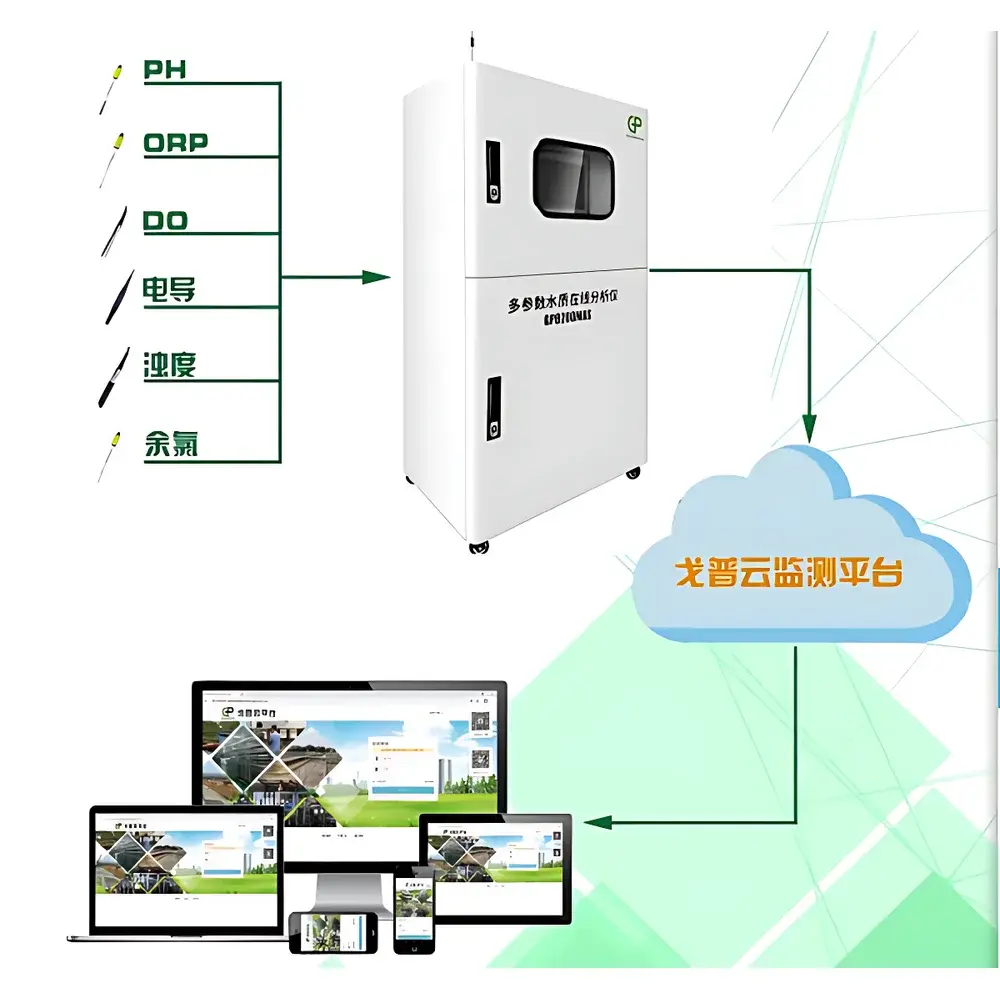
GreenPrima GP8200MAS Multi-Parameter Online Water Quality Analyzer for Secondary Water Supply
| Brand | GreenPrima |
|---|---|
| Origin | Shanghai, China |
| Manufacturer Type | OEM/ODM Manufacturer |
| Country of Origin | China |
| Model | GP8200MAS |
| Pricing | Upon Request |
| pH Range | -2.00–16.00 pH, Res: 0.01 pH, Acc: ±0.01 pH |
| Temperature Compensation | -10–130 °C (NTC10K/PT1000, manual/auto) |
| Free Chlorine Range | 0–2.000 / 0–20.00 ppm, Res: 0.001 / 0.01 ppm, Acc: ±0.001 / ±0.01 ppm |
| Turbidity Range | 0–1000 NTU, Res: 0.0001 NTU (adjustable), Acc: ±2% FS (≤40 NTU) or ±0.02 NTU |
| Conductivity Range | 0.00–2000 mS/cm, Res: 0.01 mS/cm, Acc: ±1% FS |
| Dissolved Oxygen Range | 0.00–20.00 ppm, Res: 0.01 ppm, Acc: ±0.01 ppm |
| ORP Range | -2000–2000 mV, Res: 1 mV, Acc: ±1 mV |
| Temperature Range | 0–100 °C, Res: 0.1 °C, Acc: ±0.1 °C |
| Analog Outputs | Up to 8 configurable 4–20 mA channels (optional) |
| Digital Interfaces | RS485 (Modbus RTU), Ethernet (optional), GPRS (China Mobile/Unicom/Telecom, optional), Wi-Fi (optional) |
| Relay Outputs | 8 SPST relays, 5 A @ 250 VAC / 30 VDC |
| Display | 10-inch capacitive touchscreen, Chinese UI |
| Enclosure Rating | IP65 |
| Dimensions | 1300 × 600 × 400 mm (customizable) |
| Power | AC 200 V / 20 W or DC 24 V / 15 W (solar-compatible) |
| Remote Monitoring | Cloud-based GoPu Cloud Platform via web, mobile app, WeChat Mini Program, or responsive HTML5 interface with SMS/app/WeChat alerting |
Overview
The GreenPrima GP8200MAS is a modular, multi-parameter online water quality analyzer engineered specifically for continuous monitoring of secondary water supply systems in municipal distribution networks, high-rise building water tanks, and centralized water treatment booster stations. It employs electrochemical, optical, and conductometric sensing principles—pH and ORP via solid-state or gel-filled reference electrodes; free chlorine via amperometric membrane sensors with selective catalytic membranes; turbidity via 90° scattered-light detection compliant with ISO 7027; conductivity via four-electrode AC excitation to minimize polarization effects; dissolved oxygen via Clark-type polarographic or optical luminescence (configurable); and temperature via integrated Pt1000 or NTC10K thermistors. All sensor modules operate on independent signal conditioning circuits, eliminating cross-parameter interference and enabling true simultaneous measurement without time-multiplexing artifacts. The system is designed for unattended operation in ambient environments ranging from 0 °C to 50 °C, with an IP65-rated enclosure suitable for indoor control rooms or semi-outdoor pump station enclosures.
Key Features
- True modular architecture: Each parameter (pH, ORP, free chlorine, turbidity, conductivity, DO, temperature) uses a dedicated, hot-swappable sensor channel with isolated analog front-end and digital calibration storage—no shared amplifiers or ADC resources.
- Reagent-free operation: Eliminates consumables, chemical waste, and associated maintenance downtime—critical for remote or unmanned installations where service intervals exceed 6 months.
- Intelligent electrode compensation: Automatic temperature compensation (ATC) with selectable sensor types (NTC10K or PT1000), plus optional pH-dependent correction algorithms for free chlorine measurements per ASTM D6503 guidelines.
- Configurable output flexibility: Standard RS485 Modbus RTU interface; optional 4–20 mA analog outputs (up to 8 channels); relay logic outputs for pump control, alarm staging, or valve actuation; and dual-band Wi-Fi + tri-carrier GPRS (China Mobile/Unicom/Telecom) for redundant telemetry.
- Local HMI and remote interoperability: 10-inch industrial-grade capacitive touchscreen with intuitive Chinese-language interface; supports export of CSV logs and real-time data streaming to SCADA via Modbus TCP when Ethernet is enabled.
- Self-diagnostics and predictive maintenance: Continuous sensor health monitoring—including electrode impedance tracking, membrane integrity checks, and zero-point drift alerts—with configurable thresholds and event logging traceable to ISO/IEC 17025-compliant audit trails.
Sample Compatibility & Compliance
The GP8200MAS is validated for use with potable water streams meeting WHO Guidelines for Drinking-water Quality and China’s GB 5749–2022 “Hygienic Standard for Drinking Water”. Sensor modules comply with relevant international test standards: pH/ORP electrodes conform to ISO 10523 and ASTM D1293; turbidity sensors meet ISO 7027–1:2016 optical performance criteria; free chlorine sensors satisfy EPA Method 334.0 sensitivity requirements (LOD ≤ 0.001 ppm). The analyzer’s firmware architecture supports GLP/GMP-aligned data integrity protocols—including user-level access control, electronic signature capability (via optional PKI module), and immutable audit logs compliant with FDA 21 CFR Part 11 Annex 11 requirements when deployed in regulated utility infrastructure.
Software & Data Management
Data acquisition and visualization are managed through the GoPu Cloud Platform—a secure, ISO 27001-certified SaaS environment hosted in Tier-III data centers within mainland China. The platform provides role-based dashboards (operator, engineer, regulator), time-series trend analysis with configurable averaging windows (1-min to 24-h), automated report generation (daily compliance summaries, monthly QA/QC reviews), and configurable alarm escalation trees (SMS → WeChat → email → voice call). Raw sensor data is timestamped with microsecond precision using internal RTC synchronized via NTP or LTE-based time broadcast. Historical datasets are retained for ≥18 months with optional cold-archive integration to object storage (e.g., Alibaba Cloud OSS). API endpoints (RESTful JSON over HTTPS) enable integration with municipal GIS platforms, asset management systems (CMMS), or national water safety surveillance networks.
Applications
- Real-time verification of disinfectant residual at secondary water supply tank outlets to ensure regulatory compliance with GB 5749–2022 free chlorine limits (≥0.05 ppm at point-of-use).
- Early detection of biofilm formation or sediment resuspension events via correlated turbidity–conductivity–DO anomalies in elevated tanks.
- Automated feedback control of booster pump speed or chlorine dosing rate based on dynamic pH–chlorine interaction models.
- Long-term trend analysis of water aging indicators (e.g., rising conductivity + falling DO + stable pH) to inform tank cleaning schedules per CJJ 140–2010 technical specifications.
- Remote commissioning and diagnostics for distributed installations across multi-building campuses or regional water districts—reducing field technician dispatch frequency by >65% (based on pilot deployments in Shanghai and Shenzhen).
FAQ
Is the GP8200MAS certified for use in drinking water applications under Chinese regulatory frameworks?
Yes—the analyzer and its individual sensor modules are type-approved per GB/T 30200–2013 (Online Water Quality Analyzers) and registered with the China National Certification and Accreditation Administration (CNCA) for potable water monitoring.
Can sensor modules be calibrated remotely?
Zero and span calibration for pH, ORP, conductivity, and DO can be initiated remotely via GoPu Cloud; however, free chlorine and turbidity require on-site standard solution verification per JJG 880–2019 metrological verification规程.
What cybersecurity measures are implemented in the cloud platform?
End-to-end TLS 1.3 encryption, OAuth 2.0 authentication, RBAC with least-privilege enforcement, quarterly penetration testing reports, and SOC 2 Type II attestation for data processing operations.
Does the system support integration with existing SCADA or BMS platforms?
Yes—native Modbus RTU/ASCII/TCP, OPC UA (via optional gateway), and MQTT v3.1.1 publishing modes are supported; pre-built drivers available for Siemens Desigo, Honeywell Experion, and Schneider EcoStruxure platforms.
How often does the system require preventive maintenance?
Sensor cleaning interval is typically 3–6 months depending on water quality; full functional verification recommended annually per JJF 1033–2023 metrological standard.
Related Products