
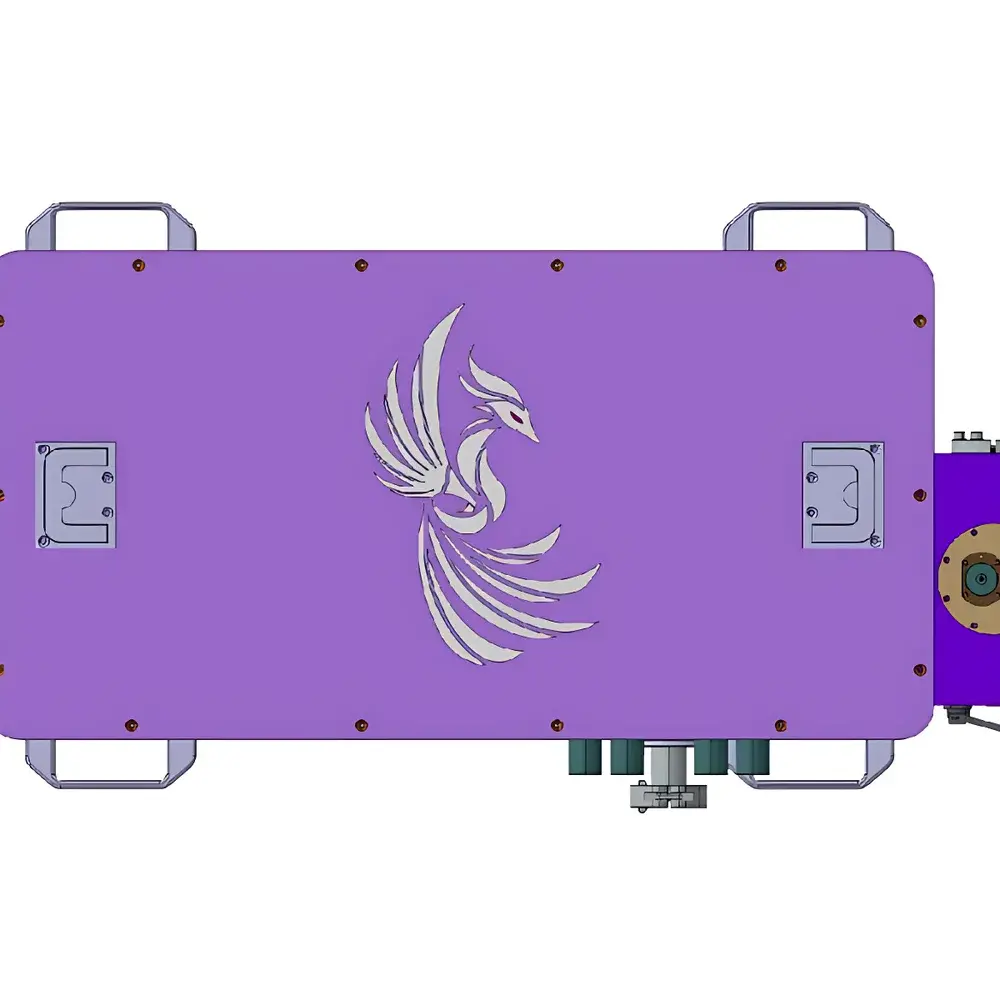
Honghu High-Harmonic Generation (HHG) Light Source for Soft X-ray and Attosecond Science — 1–10 nm
| Brand | Lumi-Universe |
|---|---|
| Origin | Anhui, China |
| Manufacturer Type | Authorized Distributor |
| Product Origin | Domestic (China) |
| Model | Honghu |
| Light Source Type | High-Harmonic Generation (HHG) Laser Source |
| Illumination Mode | Internal Illumination |
| Wavelength Range | 1–10 nm |
| Output Harmonic Energy | 1 nW – 1 µW |
| Pulse Duration | < 1 fs |
| Repetition Rate | 1–10 kHz |
| Dimensions | 855 mm × 420 mm × 233 mm |
| Weight | 55 kg |
Overview
The Honghu High-Harmonic Generation (HHG) Light Source is a compact, table-top extreme ultraviolet (EUV) to soft X-ray (SXR) laser system engineered for ultrafast science applications requiring simultaneous attosecond temporal resolution and nanometer-scale spatial coherence. Based on the non-linear optical process of high-harmonic generation in noble gases driven by intense few-cycle near-infrared (NIR) or mid-infrared (MIR) femtosecond pulses, the Honghu source produces coherent, narrow-bandwidth radiation across the 1–10 nm spectral range—spanning the biologically critical “water window” (2.3–4.4 nm) and adjacent SXR region. This enables element-specific, radiation-damage-mitigated imaging of organic and hydrated specimens without heavy-metal staining. The system operates with sub-femtosecond pulse durations (<1 fs), enabling time-resolved studies of electron dynamics, core-level excitations, and valence-shell rearrangements in atoms, molecules, and condensed-phase materials. Its architecture integrates a vacuum-compatible HHG gas cell, phase-matched harmonic generation optics, differential pumping stages, and beam transport components—all aligned and pre-characterized for immediate integration into end-station experimental chambers.
Key Features
- Compact footprint (855 × 420 × 233 mm) optimized for university laboratories and industrial R&D cleanrooms
- Full spectral tunability across 1–10 nm via driver laser wavelength adjustment and gas medium selection (e.g., Ar, Ne, He)
- Sub-fs pulse duration with intrinsic synchronization to the driving laser’s carrier-envelope phase (CEP), supporting CEP-stable attosecond pulse trains
- Integrated differential vacuum system with base pressure <1×10⁻⁷ mbar in the HHG interaction region
- Optomechanically rigid platform with active thermal stabilization and low-vibration mounting
- Native compatibility with OPCPA-based driver lasers (e.g., Ti:sapphire, Yb:fiber, or OPA systems) operating at 1–10 kHz repetition rates
- Modular beamline interface supporting direct coupling to spectrometers, velocity map imagers (VMI), zone-plate microscopes, or photoelectron spectrometers
Sample Compatibility & Compliance
The Honghu HHG source is designed for use in ultra-high vacuum (UHV) and high-vacuum (HV) experimental end stations compliant with ISO 8573-1 Class 2 air purity standards for optical path integrity. It meets mechanical and electromagnetic compatibility requirements per IEC 61326-1 for laboratory measurement equipment. While not certified to FDA 21 CFR Part 11, its software control layer supports audit-trail logging and user-access controls suitable for GLP/GMP-aligned research environments. The system is compatible with standard UHV flanges (CF-63, CF-100), allowing seamless integration into existing beamlines used for time-of-flight mass spectrometry, angle-resolved photoemission spectroscopy (ARPES), and ptychographic coherent diffractive imaging (CDI). Radiation safety design complies with IEC 60825-1:2014 (Class 4 laser product) and includes interlocked vacuum shutoffs and beam containment housings rated for 100 eV–1.2 keV photon energies.
Software & Data Management
Control is executed via a Linux-based real-time embedded system with deterministic timing for harmonic selection, gas flow regulation, and motorized mirror positioning. A Python API (PyHonghu) enables script-driven experiment sequencing—including automated wavelength scans, pump-probe delay sweeps, and intensity normalization routines. All operational parameters (gas pressure, laser energy, harmonic order selection, vacuum status) are timestamped and logged in HDF5 format with metadata compliant with NeXus standards. Optional integration with EPICS IOC allows remote orchestration within larger synchrotron or FEL facility control frameworks. Data export supports NIST-traceable calibration files for photon flux and spectral responsivity, facilitating quantitative cross-laboratory comparison.
Applications
- Attosecond transient absorption spectroscopy (ATAS) of valence and core-electron dynamics
- Time-resolved photoelectron spectroscopy (TR-PES) with elemental and orbital specificity
- Coherent diffraction imaging (CDI) and ptychography of nanostructures and biological specimens
- Resonant inelastic X-ray scattering (RIXS) at the carbon K-edge (4.4 nm) and oxygen K-edge (2.3 nm)
- Ultrafast magnetization dynamics probing via XMCD (X-ray magnetic circular dichroism)
- Development and metrology of next-generation EUV lithography masks and multilayer optics
FAQ
What vacuum level is required for optimal HHG output stability?
A base pressure ≤5×10⁻⁸ mbar in the HHG chamber is recommended; the integrated differential pumping system maintains this during continuous operation with Ar or Ne gas flow.
Can the Honghu source be synchronized to an external RF reference?
Yes—the internal repetition rate controller accepts external 10 MHz TTL or sine-wave references for lock-in detection and multi-laser synchronization.
Is spectral calibration traceable to NIST standards?
Calibration data for central wavelength and bandwidth are provided using calibrated grating spectrometers referenced to He I (58.4 nm) and Ne I (13.9 nm) emission lines.
Does the system support single-harmonic selection?
Yes—motorized toroidal gratings and slit-based monochromators enable isolation of individual harmonics with Δλ/λ < 10⁻³ resolution.
What maintenance intervals are recommended for long-term operation?
Optical components require inspection every 6 months; gas nozzles and vacuum seals are rated for ≥10,000 hours under nominal operating conditions.





