
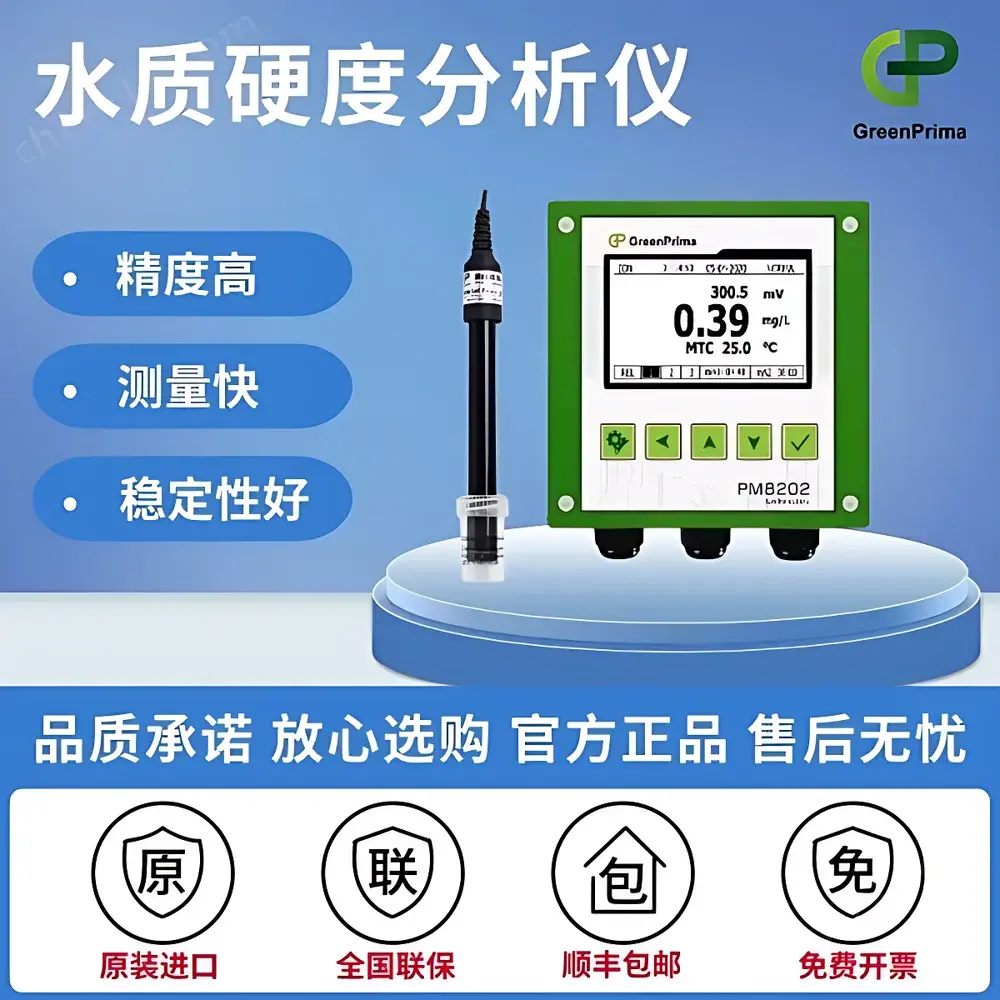
GreenPrima PM 820 2I Surface Water Hardness Analyzer
| Brand | GreenPrima |
|---|---|
| Origin | United Kingdom |
| Manufacturer Type | Manufacturer |
| Origin Category | Imported |
| Model | PM 820 2I |
| Price | Upon Request |
| Measurement Range | 0.00–20,000 ppm Ca²⁺ (as CaCO₃ equivalent) |
| Resolution | 0.0 / 0.1 / 1 ppm (user-selectable) |
| Accuracy | ±0.01 / ±0.1 / ±1 ppm (depending on range) |
| Temperature Compensation | –10 to 130 °C (manual or automatic |
| Operating Temperature | –10 to 70.0 °C |
| Storage Temperature | –20 to 70.0 °C |
| Display | Backlit large-dot-matrix LCD |
| Language | English & Chinese |
| Data Storage | 600,000 records |
| Power Supply | 90–260 VAC, 50/60 Hz or optional 24 VDC |
| Isolated Analog Outputs | Two 4–20 mA outputs (max. loop resistance 500 Ω, accuracy ±0.1 % FS) |
| Communication | RS485 Modbus RTU |
| Cleaning Cycle | 0.1–1000 h (adjustable) |
| cleaning duration | 1–1000 s (adjustable) |
| Alarm Outputs | Two independent Hi/Lo relay outputs (5 A / 250 VAC / 30 VDC, with hysteresis setting) |
| Enclosure Rating | IP65 |
| Mounting Options | Wall-mounted, pipe-mounted, panel-mounted |
| Dimensions (W×H×D) | 144 × 144 × 108 mm |
| Panel Cutout | 138 × 138 mm |
| Weight | 0.87 kg |
Overview
The GreenPrima PM 820 2I Surface Water Hardness Analyzer is a dedicated online calcium hardness monitoring system engineered for continuous, reagent-free measurement in natural and industrial water streams. It operates on the principle of ion-selective electrode (ISE) potentiometry, utilizing a high-stability BSENS740 calcium-specific composite electrode paired with an intelligent controller. Unlike colorimetric or titrimetric methods, this ISE-based architecture eliminates consumables, optical path fouling, and fluidic maintenance—making it especially suitable for long-term unattended operation in remote or harsh environmental monitoring stations. The instrument reports total calcium hardness as ppm CaCO₃ equivalent, conforming to standard interpretation frameworks used in water treatment compliance and regulatory reporting (e.g., WHO Guidelines for Drinking-water Quality, EU Directive 2020/2184). Its dual-channel analog output and Modbus RTU interface support seamless integration into SCADA, DCS, or PLC-based infrastructure for real-time process control and data logging.
Key Features
- Ion-selective electrode (ISE) technology for direct, selective calcium ion activity measurement—no chemical reagents, no sample digestion, no waste generation
- IP65-rated robust enclosure with full sealing against dust and water ingress, enabling outdoor or semi-outdoor deployment near rivers, reservoirs, or intake channels
- Large backlit dot-matrix LCD display showing real-time Ca²⁺ concentration (ppm), temperature, timestamp, relay status, and system diagnostics
- User-configurable resolution (0.0 / 0.1 / 1 ppm) and accuracy tiers aligned with application-specific QA/QC requirements—from regulatory-grade surface water surveillance to industrial boiler feedwater control
- Integrated temperature compensation using either NTC30k or PT1000 sensors, supporting both manual and automatic modes across –10 to 130 °C
- Two fully isolated 4–20 mA analog outputs assignable to measured hardness value and/or temperature—calibrated to ±0.1 % full scale with loop resistance up to 500 Ω
- Two independent programmable relay outputs for alarm (Hi/Lo), system fault, or automated electrode cleaning cycles—with adjustable hysteresis and time-delay logic
- Onboard data logger storing up to 600,000 timestamped records (Ca²⁺, temperature, relay states), accessible via front-panel navigation or export-ready via Modbus
Sample Compatibility & Compliance
The PM 820 2I is validated for use with low- to medium-conductivity aqueous matrices typical of surface water (rivers, lakes, reservoirs), groundwater, and treated industrial process streams—including pharmaceutical purified water (PW), boiler feedwater, electroplating rinse baths, semiconductor ultrapure water (UPW) recirculation loops, and food-grade cooling circuits. It complies with CE marking requirements for electromagnetic compatibility (EMC Directive 2014/30/EU) and low-voltage safety (LVD Directive 2014/35/EU). While not certified under FDA 21 CFR Part 11, its audit-trail-capable data storage and configurable user access levels support GLP/GMP-aligned operational procedures when deployed in regulated environments. Calibration traceability follows ISO/IEC 17025 principles through documented two-point calibration using NIST-traceable Ca²⁺ standards (e.g., 50 ppm and 500 ppm CaCO₃ equivalents).
Software & Data Management
Data acquisition and configuration are managed entirely through the embedded firmware—no external PC software required. All parameters—including measurement range, alarm thresholds, cleaning intervals, relay logic, and communication settings—are adjustable via intuitive menu navigation with bilingual (English/Chinese) prompts. Timestamped measurements are stored locally with millisecond precision and can be reviewed chronologically or filtered by event type (e.g., alarm triggers, calibration actions). The RS485 Modbus RTU interface supports read/write access to all operational registers—including live values, historical logs, and diagnostic flags—enabling interoperability with third-party historian systems (e.g., Ignition, Siemens Desigo, Honeywell Experion). Optional 24 VDC power input facilitates integration into solar-powered telemetry nodes or explosion-proof enclosures in hazardous area applications.
Applications
- Real-time hardness monitoring at municipal surface water intakes and raw water abstraction points
- Early-warning detection of calcium scaling risk in cooling tower make-up water and HVAC condenser loops
- Boiler feedwater quality assurance in thermal power plants and industrial steam generation facilities
- Process water hardness verification in pharmaceutical clean utilities (PW, WFI) per USP and EP 2.2.41
- Electroplating bath stability control where Ca²⁺ accumulation impairs coating adhesion and uniformity
- Environmental compliance reporting for river basin management authorities under national water framework directives
FAQ
Does the PM 820 2I measure total hardness or only calcium hardness?
It measures calcium-specific ion activity via ISE and reports results as calcium hardness expressed in ppm CaCO₃ equivalent. Magnesium contribution is not detected; for total hardness estimation, a separate Mg²⁺ analyzer or laboratory titration is recommended.
Can the instrument operate continuously in submerged or high-humidity conditions?
The analyzer’s IP65-rated housing permits wall or panel mounting in damp indoor or sheltered outdoor locations—but the electrode itself must remain immersed in flowing or static water; submersion of the controller unit is not permitted.
Is calibration traceable to international standards?
Yes—calibration uses NIST-traceable calcium standard solutions, and certificate documentation aligns with ISO/IEC 17025 calibration record requirements when performed by accredited service providers.
What maintenance is required beyond routine calibration?
The BSENS740 electrode requires periodic cleaning (automated or manual) and occasional reference electrolyte replenishment every 6–12 months depending on water matrix; no pump, tubing, or optical components require servicing.
How does temperature compensation affect measurement accuracy?
Automatic temperature compensation corrects for solution resistivity and electrode potential drift using built-in NTC30k or external PT1000 sensors—ensuring stable readings across seasonal variations from –10 to 70 °C ambient operating range.







