
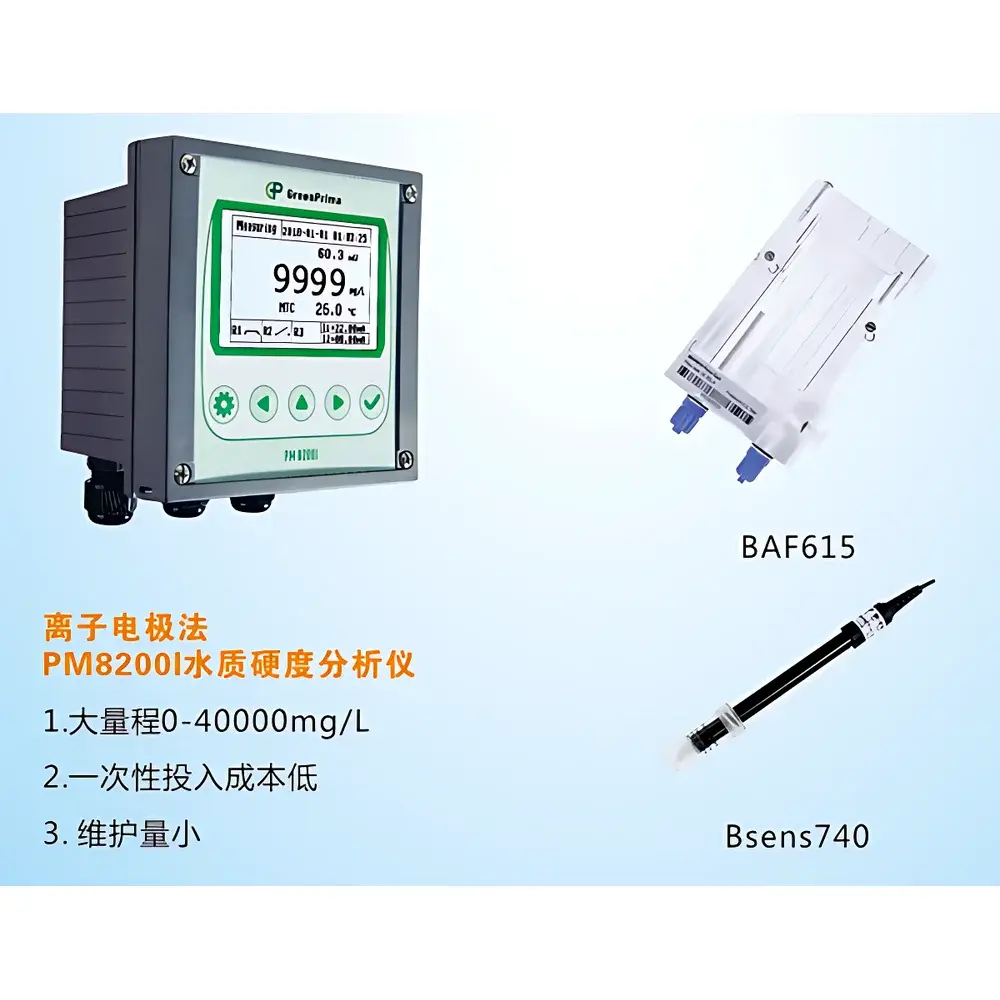
GreenPrima PM 8200I Online Water Hardness Analyzer
| Brand | GreenPrima |
|---|---|
| Origin | United Kingdom |
| Manufacturer Type | Original Equipment Manufacturer (OEM) |
| Product Category | Imported Instrument |
| Model | PM 8200I |
| Measurement Principle | Ion-Selective Electrode (Ca²⁺/Mg²⁺) |
| Range | 0.00–20,000 ppm as CaCO₃ |
| Resolution | 0.01 / 0.1 / 1 ppm |
| Accuracy | ±0.01 / ±0.1 / ±1 ppm (depending on range) |
| Temperature Compensation | -10 to 130 °C (NTC10K or PT1000 sensor) |
| Operating Temp. | 0–70 °C |
| Storage Temp. | -20 to 70 °C |
| Display | Backlit dot-matrix LCD |
| Data Storage | 600,000 records |
| Output | Dual isolated 4–20 mA (max. 500 Ω, 0.1% FS) |
| Communication | RS485, MODBUS RTU protocol |
| Cleaning Control | Adjustable interval (0.1–1000 h) and duration (1–1000 s) |
| Enclosure Rating | IP65 |
| Power Supply | 90–260 VAC, 50/60 Hz or optional 24 VDC |
| Dimensions | 144 × 144 × 106 mm |
| Panel Cutout | 138 × 138 mm |
| Weight | 0.86 kg |
| Sensor Model | Bsens740 |
| Sensor Range | 0–40,000 mg/L as CaCO₃ |
| Sensor Resolution | 0.01 mg/L |
| Sensor Accuracy | ±3% FS |
| Sensor Material | Polyphenylsulfone (PPS) |
| Max. Pressure | 3.5 bar |
| Cable Length | 5 m |
| Mounting Options | Wall-mount, pipe-mount, panel-mount |
Overview
The GreenPrima PM 8200I Online Water Hardness Analyzer is an industrial-grade, continuous-monitoring instrument engineered for precise, real-time quantification of total water hardness—expressed as calcium carbonate (CaCO₃) equivalence—in process and utility water streams. It operates on the ion-selective electrode (ISE) principle, utilizing a dual-ion sensitive membrane optimized for selective detection of Ca²⁺ and Mg²⁺ cations in aqueous solution. Unlike colorimetric or titrimetric methods, the ISE-based approach eliminates reagent consumption, optical interference, and mechanical complexity associated with peristaltic pumps or flow cells. The analyzer is designed for long-term unattended operation in demanding environments including boiler feedwater circuits, cooling tower recirculation systems, pharmaceutical purified water (PW) loops, and semiconductor ultrapure water (UPW) distribution networks. Its robust architecture supports stable performance across wide temperature gradients (–10 to 130 °C with automatic compensation), making it suitable for both low-temperature HVAC condensate monitoring and high-temperature steam-cycle applications.
Key Features
- Ion-selective electrode technology enables direct, reagent-free measurement—no chemical dosing, no tubing fouling, and minimal maintenance intervention.
- Dual isolated 4–20 mA analog outputs support integration into DCS, PLC, or SCADA systems with full scalability and loop diagnostics.
- RS485 interface compliant with MODBUS RTU protocol ensures interoperability with third-party data historians and supervisory control platforms.
- IP65-rated sealed enclosure with polyphenylsulfone (PPS) sensor housing guarantees operational integrity in humid, dusty, or splash-prone industrial zones.
- Backlit dot-matrix LCD display provides simultaneous visualization of hardness value, temperature, timestamp, relay status, and system diagnostics—accessible via intuitive bilingual (English/Chinese) menu navigation.
- Configurable cleaning cycle management allows automated electrode surface maintenance with user-defined frequency (0.1–1000 hours) and duration (1–1000 seconds).
- Onboard data logging stores up to 600,000 timestamped records with retrieval capability for trend analysis, compliance reporting, and root-cause investigation.
Sample Compatibility & Compliance
The PM 8200I is validated for use in non-aggressive aqueous matrices with total dissolved solids (TDS) < 5,000 ppm and pH 5.0–9.0. It is routinely deployed in GMP-regulated environments—including USP purified water systems and EU Annex 1 critical utilities—where hardness control directly impacts scale formation risk in heat exchangers, steam generators, and membrane filtration units. While not intrinsically certified to ATEX or IECEx, its design conforms to IEC 61000-6-2 (immunity) and IEC 61000-6-4 (emissions) standards. For FDA-regulated facilities, audit-ready data integrity is supported through time-stamped logs, configurable relay event logging (e.g., alarm activation, cleaning initiation), and deterministic communication response times compatible with 21 CFR Part 11-aligned validation protocols when integrated with validated host software.
Software & Data Management
Data acquisition and configuration are managed locally via the front-panel interface; remote access is enabled through MODBUS RTU-compatible SCADA clients or custom OPC UA gateways. All logged entries include UTC-synchronized timestamps, hardness value, compensated temperature, and system status flags (e.g., sensor fault, calibration overdue, cleaning active). The 600,000-point memory buffer retains data at user-selectable intervals (1 sec to 24 h), supporting ISO 5667-3-compliant sampling frequency alignment. Export is facilitated via serial dump or MODBUS register polling; no proprietary drivers or cloud dependencies are required. Firmware updates are performed via secure UART bootloading—eliminating network exposure vectors while maintaining traceability per ICH Q9 quality risk management principles.
Applications
- Real-time hardness surveillance in closed-loop cooling water systems to prevent CaCO₃ scaling on condenser tubes and heat transfer surfaces.
- Continuous verification of softener effluent quality in central water treatment plants serving pharmaceutical manufacturing sites.
- Boiler feedwater monitoring in thermal power generation to ensure compliance with ASME PTC 19.11 and ASTM D1066 guidelines for suspended solids and hardness limits.
- In-line verification of reverse osmosis (RO) reject stream hardness to optimize antiscalant dosing and membrane cleaning cycles.
- Process water qualification in food & beverage production lines where hardness affects cleaning-in-place (CIP) efficacy and product stability.
- Marine engineering applications, including shipboard steam boiler feedwater and desalination plant permeate monitoring.
FAQ
Does the PM 8200I require daily calibration or standardization?
No. The Bsens740 electrode exhibits excellent long-term drift stability (<0.5% FS/month under typical operating conditions); calibration is recommended quarterly or after sensor replacement, using NIST-traceable CaCO₃ standards.
Can the analyzer operate in high-pressure piping systems?
Yes—the sensor housing is rated to 3.5 bar static pressure; for pressures exceeding this, a pressure-reducing bypass assembly must be installed upstream per ISO 5667-14 sampling guidelines.
Is temperature compensation mandatory for accurate readings?
Yes. Hardness solubility and electrode potential are temperature-dependent; the unit supports both automatic (via integrated NTC10K or PT1000) and manual temperature input modes.
How is electrode fouling mitigated during extended operation?
The programmable cleaning output drives external solenoid valves or ultrasonic transducers; combined with hydrophobic PPS sensor material, this reduces biofilm adhesion and inorganic precipitation.
What documentation is provided for regulatory validation?
Factory calibration certificates, electrical safety reports (EN 61010-1), EMC test summaries (IEC 61000 series), and firmware revision history are supplied with each unit; IQ/OQ templates are available upon request for GxP implementation.







