
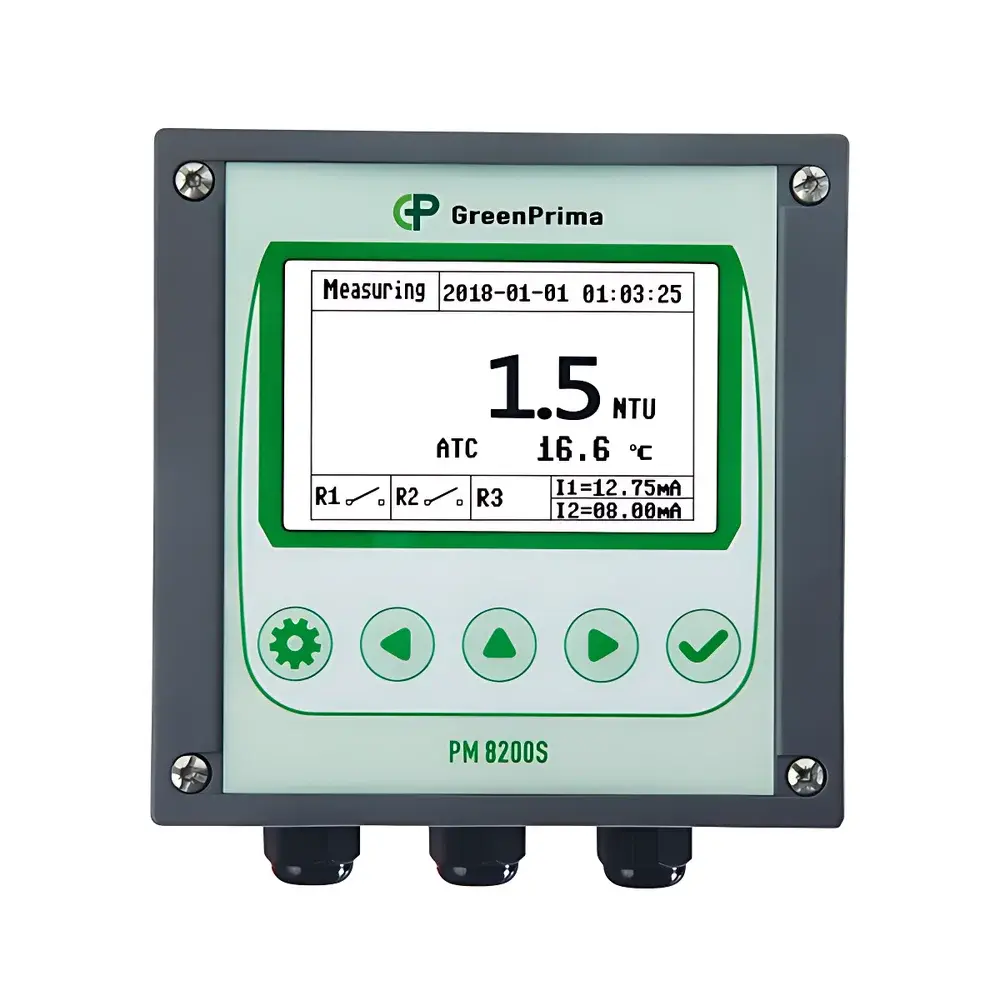
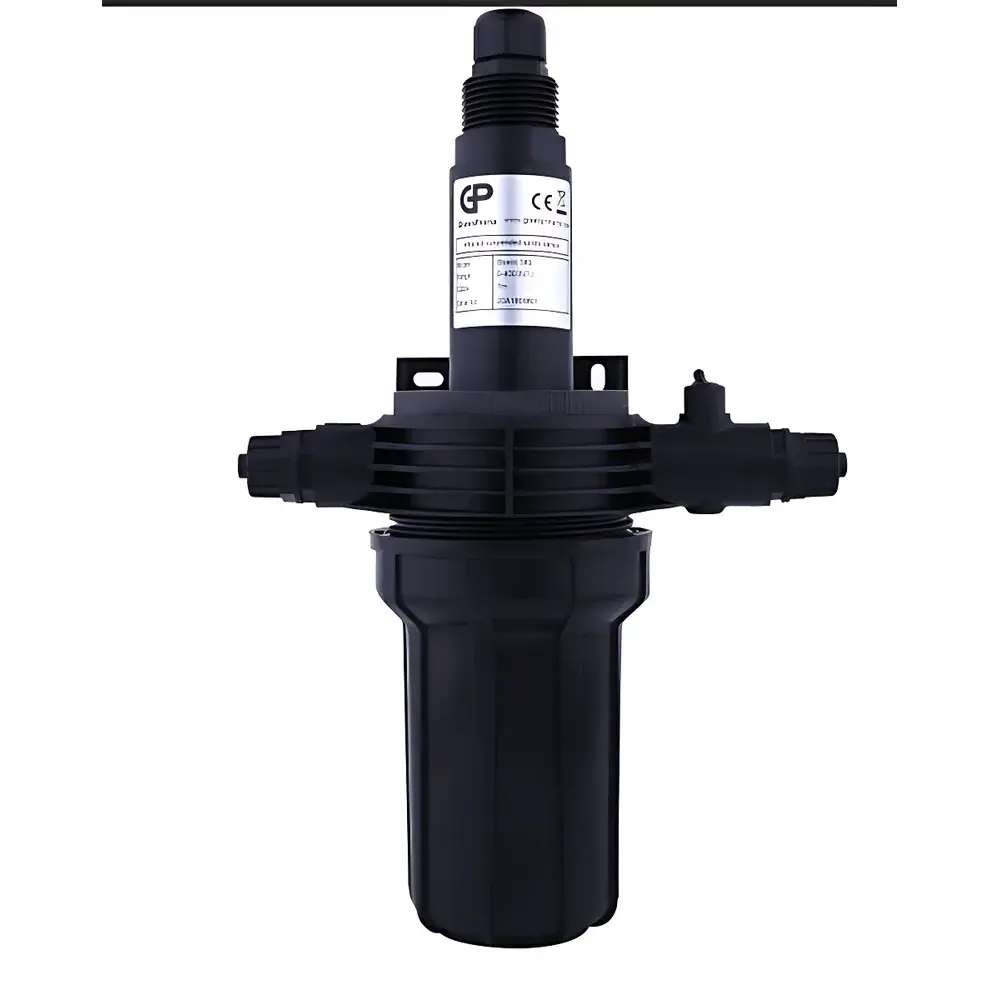
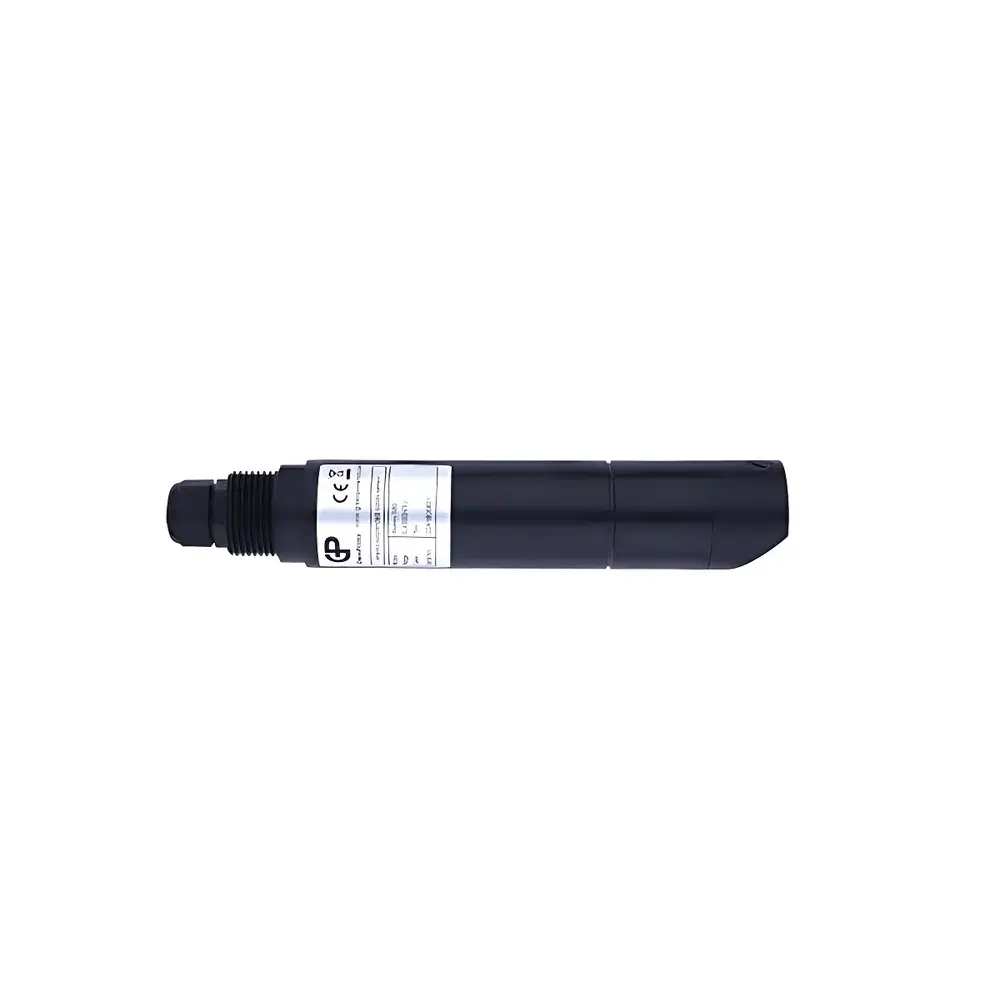
GreenPrima PM 8200S Online Turbidimeter & Suspended Solids Analyzer
| Brand | GreenPrima |
|---|---|
| Model | PM 8200S |
| Measurement Principle | Infrared Monochromatic Light Scattering |
| Range | 0.00–4000.00 NTU / 0.00–4500.00 mg/L |
| Resolution | 0.1 NTU (display), 0.01–1 NTU/mg/L (sensor) |
| Accuracy | ±2% F.S. |
| Operating Temperature | 0–70.0 °C |
| Storage Temperature | −20–70.0 °C |
| Display | Backlit Graphic LCD |
| Data Storage | 600,000 records |
| Output | Dual isolated 4–20 mA (max 500 Ω, 0.1% F.S.) |
| Communication | RS485, MODBUS RTU protocol |
| Relay | 1 multifunctional relay (cleaning, periodic alarm, fault alarm) |
| Enclosure Rating | IP65 |
| Power Supply | 90–260 VAC, 50/60 Hz or 24 VDC optional |
| Mounting | Wall-mount, pole-mount, panel-mount |
| Dimensions (H×W×D) | 144 × 144 × 106 mm |
| Panel Cutout | 138 × 138 mm |
| Weight | 0.86 kg |
| Sensor Model | Bsens580 |
| Sensor Material | PVC & Delrin |
| Max Pressure | 5 bar |
| Cable Length | 7 m |
| Response Time | <1 s |
Overview
The GreenPrima PM 8200S is an industrial-grade online turbidimeter and suspended solids (SS) analyzer engineered for continuous, real-time water quality monitoring in demanding process environments. It operates on the principle of infrared monochromatic light scattering—emitting a stable 850 nm IR beam into the sample stream and detecting scattered light intensity at a fixed angle (typically 90° or forward-scatter configuration, per ISO 7027-1:2016 compliance). Unlike broadband white-light systems, the narrow-band IR source minimizes interference from coloration, dissolved organics, and ambient light, delivering high reproducibility in colored or variable-composition effluents. The instrument integrates a reference photodetector channel to dynamically compensate for LED aging, optical window fouling, and spectral drift—ensuring long-term calibration stability without manual intervention. Designed for permanent installation in wastewater treatment plants, drinking water distribution networks, pulp & paper process streams, coal washing circuits, and power plant cooling water systems, the PM 8200S meets the operational rigor required under GLP-aligned monitoring protocols and supports traceable data acquisition per ISO/IEC 17025 documentation frameworks.
Key Features
- Reference-light compensation architecture for drift-free measurement across extended deployment cycles
- IP65-rated hermetically sealed enclosure with corrosion-resistant housing, suitable for outdoor, humid, or chemically aggressive locations
- Backlit high-contrast graphic LCD with adjustable brightness and contrast—optimized for low-visibility control rooms or field cabinets
- Dual isolated 4–20 mA analog outputs, each configurable for turbidity (NTU), SS concentration (mg/L), temperature, or status flags
- RS485 serial interface compliant with MODBUS RTU protocol—enabling seamless integration into SCADA, DCS, and PLC-based supervisory systems
- Multifunction relay with programmable logic: auto-triggered cleaning cycles, scheduled maintenance alerts, and hardware fault detection (e.g., signal loss, sensor timeout)
- Onboard non-volatile memory storing up to 600,000 timestamped records—including NTU, mg/L, temperature, relay state, and system diagnostics
- Three-minute keyless backlight timeout and adaptive power management extend display lifespan and reduce energy consumption
Sample Compatibility & Compliance
The PM 8200S is compatible with aqueous matrices ranging from clarified potable water (0.01–10 NTU) to highly turbid industrial slurry streams (up to 4000 NTU or 4500 mg/L SS). Its Bsens580 submersible sensor—constructed from FDA-compliant PVC and Delrin—resists biofouling and chemical erosion in pH 4–10 environments. The sensor’s 5-bar pressure rating allows direct insertion into pressurized pipelines or open-channel flumes with flow velocity up to 3 m/s. Calibration follows ISO 7027-1:2016 methodology using formazin or AMCO AEPA standards; factory calibration certificates are traceable to NIST-maintained reference materials. The device supports audit-ready operation under 21 CFR Part 11 when deployed with validated MODBUS logging software and user-access controls.
Software & Data Management
Data retrieval is performed via MODBUS register mapping—allowing third-party historians (e.g., Ignition, Siemens Desigo, Wonderware) to poll live values and historical archives. The internal data logger stores measurements with millisecond-resolution timestamps, enabling trend analysis of diurnal load variations or storm-event response profiles. Export functionality supports CSV dump via USB service port (optional adapter) or remote polling. Configuration parameters—including range scaling, relay hysteresis, alarm thresholds, and language selection (English/Chinese)—are retained in EEPROM and survive power interruption. Firmware updates are delivered via secure binary upload through the RS485 port, preserving configuration integrity during version upgrades.
Applications
- Primary and secondary clarifier effluent monitoring in municipal wastewater treatment
- Filter performance validation and backwash optimization in drinking water facilities
- Fiber suspension consistency control in pulp & paper machine chest systems
- Sediment load tracking in coal preparation plant dewatering circuits
- Cooling tower blowdown control and corrosion inhibitor dosing feedback in thermal power generation
- Regulatory compliance reporting for EPA NPDES permits and EU Urban Wastewater Treatment Directive (91/271/EEC)
FAQ
Does the PM 8200S require periodic recalibration?
Yes—annual verification against certified standard suspensions is recommended per ISO 7027-1:2016. The reference-light system reduces frequency but does not eliminate the need for traceable calibration.
Can the Bsens580 sensor be installed in a flowing pipe without bypass?
Yes—it supports direct insertion in pipes ≥ DN50 with minimum straight-run requirements (5D upstream, 2D downstream) and nominal flow velocities between 0.3–3.0 m/s.
Is MODBUS register mapping documentation available?
Yes—full register tables, including holding registers for measured values, status bits, and configuration parameters, are provided in the technical manual and upon request.
What maintenance is required for the optical window?
With optional automatic wiper or ultrasonic cleaning modules, maintenance intervals extend to 3–6 months. Manual cleaning with lint-free cloth and isopropyl alcohol is sufficient for low-fouling applications.
Does the device support Modbus TCP or only RTU?
The standard interface is RS485 MODBUS RTU. MODBUS TCP requires an external protocol converter or gateway device.







