
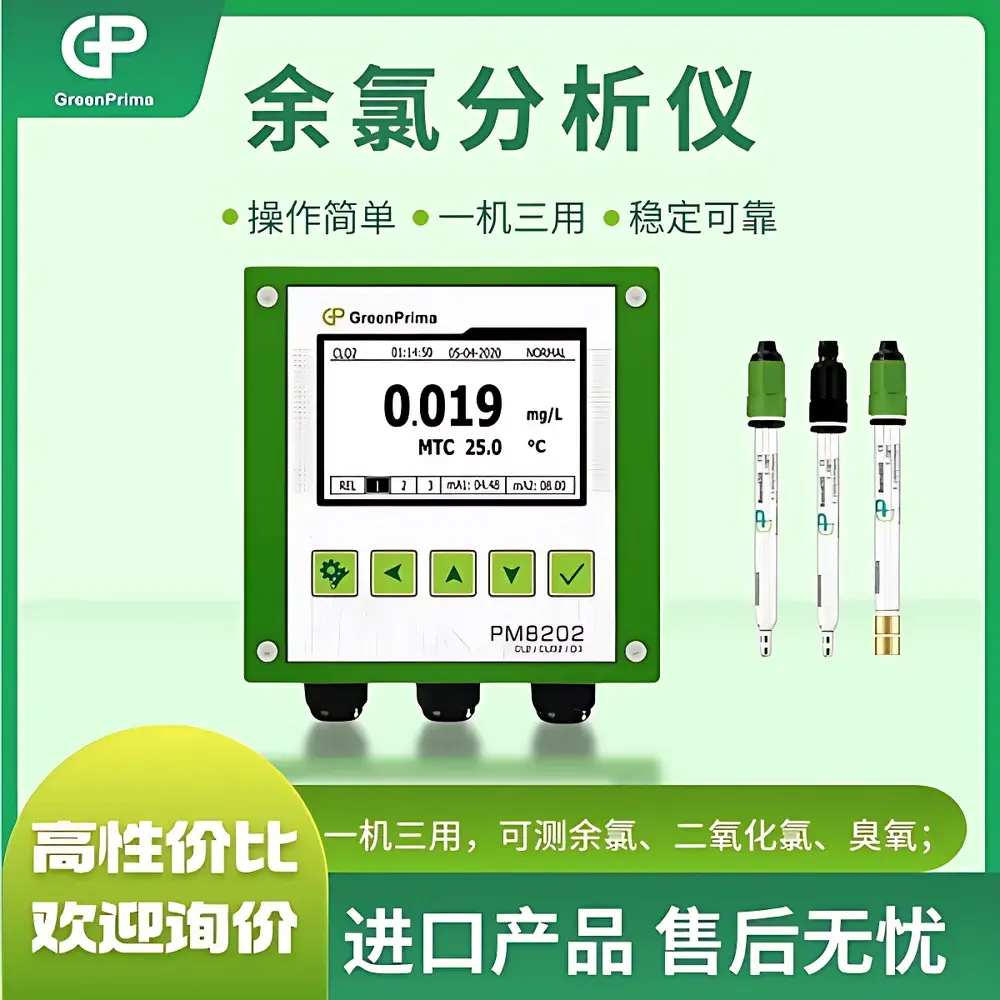
GreenPrima PM820 2CL Residual Chlorine and Chlorine Dioxide Analyzer
| Brand | GreenPrima |
|---|---|
| Origin | United Kingdom |
| Manufacturer Type | Original Equipment Manufacturer (OEM) |
| Product Category | Imported Instrument |
| Model | PM820 2CL |
| Instrument Type | Online Analyzer |
| Measurement Principle | Amperometric Detection at Fixed Potential (Constant Voltage Method) |
| Measured Parameters | Free Chlorine, Combined Chlorine, Chlorine Dioxide, Ozone |
| Range | 0.00–20.00 ppm / 0.00–200.00 ppb |
| Accuracy | ±2% of Full Scale |
| Resolution | 0.001 ppm / 0.01 ppm |
| Temperature Compensation | -10 to 130 °C (NTC10K or PT1000 sensor compatible) |
| Operating Temperature | -10 to 70.0 °C |
| Storage Temperature | -20 to 70.0 °C |
| Display | Backlit Graphic LCD (Chinese/English Switchable) |
| Data Storage | 600,000 records |
| Power Supply | 90–260 VAC, 50/60 Hz or 24 VDC optional |
| Output | Dual isolated 4–20 mA (0.1% FS, max loop resistance 500 Ω), RS485 Modbus RTU |
| Relay Outputs | Two programmable Hi/Lo alarms (5 A / 250 VAC / 30 VDC) |
| Cleaning Control | Adjustable interval (0.1–1000 h) and duration (1–1000 s) |
| Enclosure Rating | IP65 |
| Dimensions | 144 × 144 × 108 mm |
| Panel Cutout | 138 × 138 mm |
| Weight | 0.87 kg |
Overview
The GreenPrima PM820 2CL is an online amperometric analyzer engineered for continuous, reagent-free monitoring of residual chlorine (free and combined), chlorine dioxide, and ozone in aqueous systems. It operates on the constant-voltage amperometric principle—applying a stable polarization potential across a dual-platinum (Bsens650) or gold (Bsens660) working electrode assembly housed within the BAF615 flow-through cell. This electrochemical architecture enables selective oxidation of target oxidants at defined potentials, generating a current proportional to analyte concentration. Unlike colorimetric or titrimetric methods, the PM820 2CL eliminates dependence on chemical reagents, membrane replacement, or electrolyte refilling—reducing operational overhead and long-term drift. Its integrated temperature compensation (via NTC10K or PT1000 probe) ensures measurement stability across wide thermal gradients (-10 to 130 °C), critical for applications ranging from cold distribution networks to hot water recirculation loops.
Key Features
- Triple-analyte capability: Simultaneous or configurable single-parameter measurement of free chlorine, combined chlorine, chlorine dioxide, and ozone—without hardware modification.
- Reagent-free and maintenance-minimized design: No chemical dosing, no membrane replacement, no internal electrolyte replenishment—lowering total cost of ownership and calibration frequency.
- Dual-platinum amperometric sensor (Bsens650): Engineered for high selectivity and interference rejection in complex matrices including wastewater and chloraminated drinking water.
- BAF615 precision flow cell: Maintains laminar, constant-flow hydrodynamics to ensure consistent mass transport to the electrode surface—critical for reproducible amperometric response.
- Configurable dual 4–20 mA outputs: Independently assignable to measured parameter and temperature; fully isolated with 0.1% full-scale accuracy and 500 Ω maximum loop resistance.
- Robust industrial interface: Backlit graphic LCD with bilingual (English/Chinese) menu navigation, password-protected configuration access, and audit-ready parameter change logging.
- Flexible installation: Supports wall-mount, panel-mount, and direct pipe-thread (NPT/G) configurations; IP65-rated enclosure suitable for indoor and sheltered outdoor deployment.
Sample Compatibility & Compliance
The PM820 2CL is validated for use in potable water distribution, hospital effluent treatment, secondary water supply systems, and industrial process water where regulatory compliance with disinfectant residual requirements is mandatory. It meets mechanical and electrical safety standards aligned with IEC 61000-6-2 (immunity) and IEC 61000-6-4 (emissions). While not certified to a specific ISO or ASTM standard as a complete system, its amperometric methodology conforms to the technical basis of ISO 7393-2 (electrochemical determination of free chlorine) and EPA Method 334.0 (amperometric titration for chlorine species). When deployed under GLP or GMP frameworks, the instrument supports traceability via timestamped data logging (600,000 entries), Modbus-accessible diagnostics, and programmable cleaning cycles—facilitating alignment with FDA 21 CFR Part 11 requirements when paired with compliant SCADA or LIMS platforms.
Software & Data Management
Data acquisition and configuration are managed locally via the front-panel interface or remotely through Modbus RTU over RS485. The embedded firmware stores all measurements—including raw current values, compensated concentration, temperature, and system status—with millisecond-level timestamps. Internal memory retains up to 600,000 records with automatic overwrite policy. Cleaning intervals and durations are fully programmable (0.1–1000 hours / 1–1000 seconds), enabling adaptive fouling mitigation in turbid or organic-rich streams. Alarm thresholds include independent hysteresis settings per relay output, preventing chatter during transient fluctuations. All configuration changes are logged with user ID (if enabled) and timestamp, supporting audit readiness in regulated environments.
Applications
- Drinking water treatment plants: Real-time verification of post-disinfection residual levels prior to distribution.
- Hospital wastewater systems: Monitoring chlorine residuals in sterilization effluents to meet local environmental discharge limits.
- Secondary water supply tanks and rooftop reservoirs: Ensuring sustained biocidal protection throughout building-wide plumbing networks.
- Pharmaceutical process water loops: Continuous surveillance of sanitizing agent concentrations (e.g., chlorine dioxide) during periodic system sanitization.
- Food & beverage production lines: Verification of rinse water disinfectant levels to satisfy HACCP and SQF requirements.
FAQ
What electrochemical principle does the PM820 2CL employ?
It uses constant-potential amperometry—applying a fixed bias voltage between working and reference electrodes to drive selective oxidation of target oxidants, generating a diffusion-limited current linearly proportional to concentration.
Can the same sensor measure chlorine, chlorine dioxide, and ozone interchangeably?
Yes—the Bsens650/Bsens660 electrode pair and BAF615 flow cell are chemically inert and electrically tunable; measurement mode is selected via software configuration without hardware changes.
Is temperature compensation automatic or manual?
Both options are supported: automatic compensation using integrated NTC10K or PT1000 probes, or manual offset entry for fixed-temperature installations.
Does the analyzer support regulatory data integrity requirements?
It provides time-stamped data logging, parameter-change history, and Modbus-accessible diagnostic registers—enabling integration into 21 CFR Part 11–compliant infrastructure when paired with validated host systems.
What maintenance is required beyond routine cleaning?
None—no membrane replacement, no electrolyte refills, and no reagent consumption. Electrode passivation is mitigated by programmable automated cleaning pulses and optimized flow dynamics in the BAF615 cell.







