
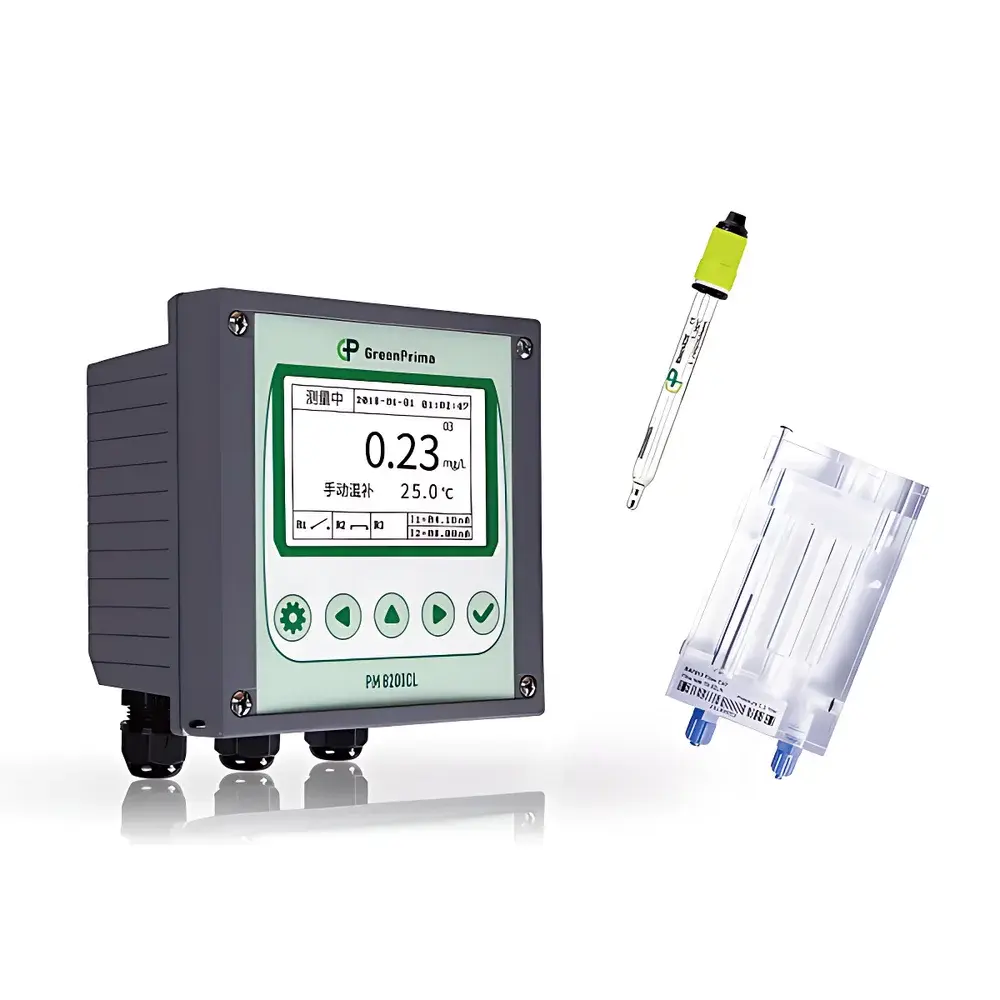
GreenPrima PM8200CL Electrochemical Residual Chlorine Analyzer
| Brand | GreenPrima |
|---|---|
| Origin | United Kingdom |
| Manufacturer Type | Original Equipment Manufacturer (OEM) |
| Product Category | Imported Instrument |
| Model | PM8200CL |
| Instrument Type | Online Analyzer |
| Measurement Principle | Amperometric Electrochemical Sensor |
| Measured Parameter | Free Residual Chlorine (Cl₂) |
| Range | 0–2.000 ppm / 0–20.00 ppm |
| Accuracy | ±0.001 ppm / ±0.01 ppm |
| Repeatability | ±0.001 ppm / ±0.01 ppm |
| Resolution | 0.001 ppm / 0.01 ppm |
| LOD | 0.001 ppm |
| Temperature Compensation | –10 to 130 °C (NTC10K or PT1000, manual/auto) |
| Operating Temp. | 0–70.0 °C |
| Storage Temp. | –20 to 70.0 °C |
| Display | Backlit dot-matrix LCD |
| Language | English & Chinese selectable |
| Data Storage | 600,000 records |
| Power Supply | 90–260 VAC, 50/60 Hz or 24 VDC optional |
| Enclosure Rating | IP65 |
| Communications | RS485 Modbus RTU |
| Analog Outputs | Two isolated 4–20 mA outputs (max. loop resistance 500 Ω, accuracy 0.1% FS) |
| Cleaning Output | Adjustable interval (0.1–1000 h) and duration (1–1000 s) |
| Mounting Options | Wall-mount, pole-mount, panel-mount |
| Dimensions | 144 × 144 × 106 mm |
| Panel Cutout | 138 × 138 mm |
| Weight | 0.86 kg |
| Sensor | Bsens650 amperometric chlorine electrode (dual Pt ring working electrodes, Ag/AgCl reference, ceramic frit membrane, gel electrolyte, glass body, PG13.5 connector, 3 m cable, Ø12 mm × 120 mm, min. immersion depth 25 mm, max. pressure 6 bar, temp. range –5 to 100 °C) |
Overview
The GreenPrima PM8200CL is an online electrochemical residual chlorine analyzer engineered for continuous, real-time monitoring of free chlorine (Cl₂) in potable water, wastewater effluent, and process streams across municipal, industrial, and regulated pharmaceutical environments. It operates on the amperometric principle: a constant potential is applied between dual platinum working electrodes and an Ag/AgCl reference electrode within the Bsens650 sensor. Free chlorine molecules diffusing through a ceramic frit membrane undergo reduction at the cathode surface, generating a current linearly proportional to concentration. This three-electrode configuration—comprising two identical Pt rings and a stable Ag/AgCl reference—minimizes polarization drift and enhances long-term signal stability. Unlike colorimetric or DPD-based methods, the PM8200CL requires no reagents, membranes, or liquid electrolyte replenishment, eliminating consumables and reducing calibration frequency. Its gel-filled electrolyte and solid-state reference ensure consistent performance under variable flow, temperature, and pH conditions typical in chlorinated distribution systems.
Key Features
- True amperometric detection with dual-Pt ring electrode architecture for high reproducibility and extended sensor service life (>24 months typical in municipal applications)
- Integrated BAF615 laminar flow cell ensures stable sample delivery and eliminates flow-dependent measurement variance
- Two fully isolated 4–20 mA analog outputs configurable for primary chlorine reading and auxiliary parameter (e.g., temperature or fault status)
- RS485 interface compliant with standard Modbus RTU protocol for seamless integration into SCADA, DCS, or PLC-based control infrastructures
- Onboard data logging capacity of 600,000 timestamped records with automatic overwrite management
- Auto-temperature compensation using either NTC10K or PT1000 sensors; user-selectable manual or automatic mode
- Configurable cleaning output to trigger external solenoid valves or air-pulse systems at programmable intervals and durations
- IP65-rated enclosure suitable for indoor or sheltered outdoor installation; multiple mounting options including panel, wall, and pipe clamp
Sample Compatibility & Compliance
The PM8200CL is validated for use in drinking water (per WHO Guidelines for Drinking-water Quality and EU Directive 98/83/EC), secondary-treated wastewater (EPA Method 334.0), and purified water loops in pharmaceutical manufacturing (USP , EP 2.2.43). It maintains accuracy across pH 4.0–8.5 and turbidity ≤10 NTU without pretreatment. The Bsens650 electrode’s ceramic frit membrane resists fouling from organic particulates and biofilm formation common in raw or filtered water. All firmware and data handling routines support audit-trail requirements aligned with FDA 21 CFR Part 11 when deployed with compliant host systems. Calibration verification logs, sensor diagnostics, and event-triggered alerts are retained with full time/date stamping and user ID attribution.
Software & Data Management
The embedded firmware provides intuitive navigation via backlit dot-matrix LCD with bilingual (English/Chinese) menu structure. Configuration parameters—including range selection (0–2.000 ppm or 0–20.00 ppm), zero/span calibration points, temperature compensation type, and alarm thresholds—are accessible without proprietary software. Logged data can be exported via Modbus polling or local USB-to-serial adapter (optional). When integrated with GreenPrima’s CloudLink Gateway or third-party historian platforms (e.g., Ignition, Siemens Desigo CC), the device supports automated report generation, trend visualization, and deviation alerting based on configurable statistical limits (e.g., ±2σ from moving average). Firmware updates are performed via secure HTTPS-based OTA mechanism with SHA-256 signature validation.
Applications
- Municipal water treatment: Real-time monitoring at chlorine contact tanks, clearwells, and distribution system entry points
- Wastewater disinfection: Post-secondary effluent verification prior to discharge or reuse
- Healthcare facilities: Continuous surveillance of sterilization rinse water and dialysis feed lines
- Pharmaceutical utilities: Monitoring of purified water (PW) and water-for-injection (WFI) distribution loops per GMP Annex 1 and ISO 14644-1
- Power plant cooling water: Prevention of under-chlorination (biofouling risk) and over-chlorination (corrosion acceleration)
- Food & beverage processing: Sanitizer concentration control in CIP rinse cycles
FAQ
Does the PM8200CL require daily maintenance or reagent addition?
No. The system operates reagent-free and membrane-free. Routine maintenance is limited to quarterly sensor inspection and annual zero calibration verification.
Can the same sensor measure chlorine dioxide and dissolved ozone?
Yes. The Bsens650 electrode supports multi-analyte operation via firmware-selectable measurement modes—free chlorine, chlorine dioxide, and dissolved ozone—each with dedicated calibration protocols.
Is temperature compensation mandatory for accurate readings?
Yes. Free chlorine amperometry exhibits inherent temperature dependence (~2.1% per °C near 25 °C). The PM8200CL mandates temperature input (via built-in or external probe) for all measurements; auto-compensation is enabled by default.
What is the recommended calibration frequency under continuous operation?
Initial calibration upon installation, followed by verification every 7–14 days in critical applications (e.g., PW loops) or monthly in stable municipal systems. Calibration uses standardized DPD-based reference methods (e.g., Hach DR3900) traceable to NIST SRM.
How does the BAF615 flow cell improve measurement reliability?
It enforces laminar, bubble-free flow across the electrode surface at a fixed velocity (0.3–1.2 L/min), eliminating turbulence-induced noise and ensuring consistent diffusion layer thickness—critical for amperometric precision.
Related Products







