
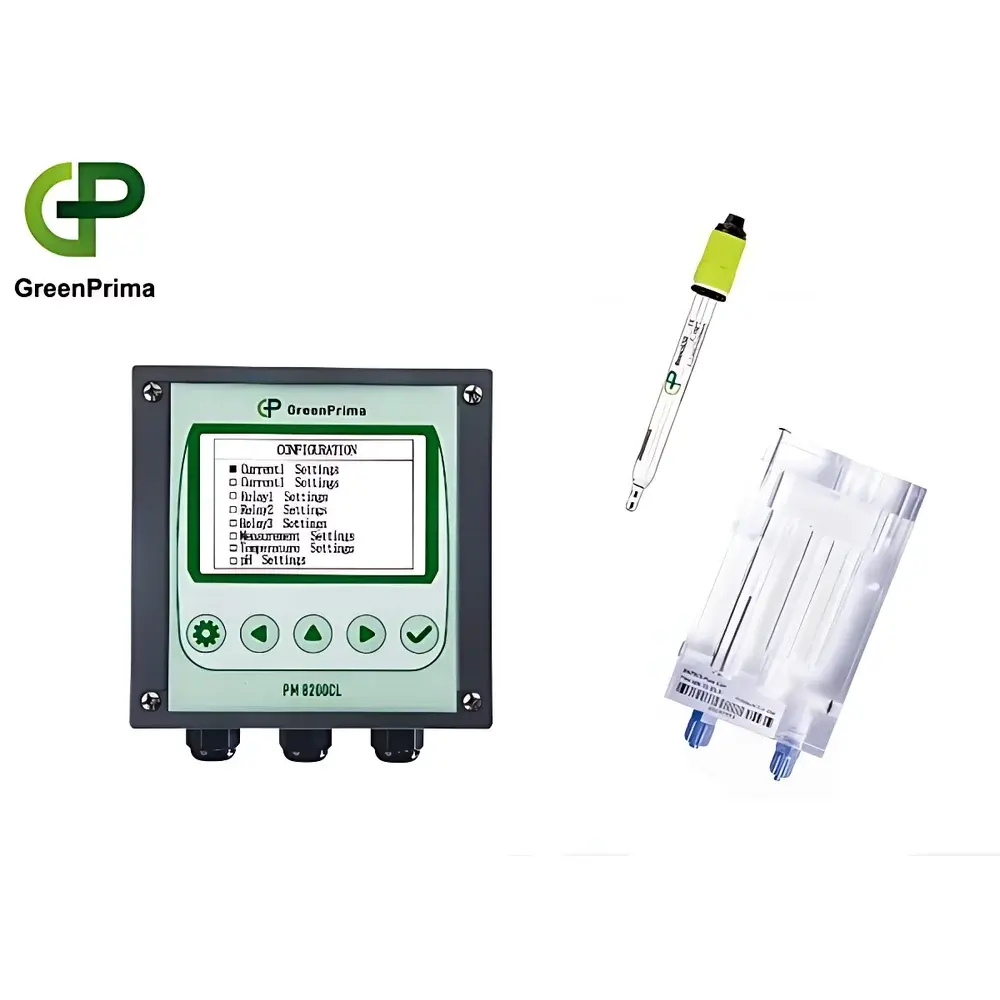
GreenPrima PM8200CL Online Dissolved Ozone Analyzer
| Brand | GreenPrima |
|---|---|
| Origin | Switzerland |
| Manufacturer Type | Original Equipment Manufacturer (OEM) |
| Product Category | Imported Instrument |
| Model | PM8200CL |
| Instrument Type | Online Analyzer |
| Measurement Principle | Amperometric Electrochemical Sensor (Constant-Potential Method) |
| Measured Parameter | Dissolved Ozone (O₃) |
| Range | 0–2.000 ppm and 0–20.00 ppm |
| Accuracy | ≤ ±2% of Full Scale |
| Repeatability | ±0.001 ppm / ±0.01 ppm |
| Resolution | 0.001 ppm / 0.01 ppm |
| Detection Limit | 0.001 ppm / 0.01 ppm |
| Temperature Compensation | –10 to 130 °C (manual/automatic) |
| Operating Temperature | 0–70.0 °C |
| Storage Temperature | –20 to 70 °C |
| Display | Backlit Graphic LCD |
| Language Support | English & Chinese |
| Data Storage Capacity | 600,000 records |
| Power Supply | 90–260 VAC, 50/60 Hz or 24 VDC (optional) |
| Analog Outputs | Dual 4–20 mA (O₃ concentration + temperature), max. loop resistance 500 Ω, accuracy 0.1% FS |
| Cleaning Output | Adjustable cleaning interval (0.1–1000 h) and duration (1–1000 s) |
| Enclosure Rating | IP65 |
| Controller Dimensions | 144 × 144 × 106 mm |
| Electrode Dimensions | Ø12 × 120 mm |
| Controller Mounting | Wall-mount, panel-mount, or pole-mount |
| Electrode Mounting | PG13.5 thread, compatible with BAF615 flow cell |
Overview
The GreenPrima PM8200CL is a high-stability, online dissolved ozone analyzer engineered for continuous, real-time monitoring of aqueous ozone concentrations in municipal drinking water distribution systems, potable water treatment plants, hospital wastewater disinfection units, and swimming pool circulation circuits. It operates on the amperometric electrochemical principle—specifically, the constant-potential (galvanic) method—where a fixed bias voltage is applied between a gold-ring working electrode (Bsens660 sensor) and a stable reference electrode. Dissolved ozone molecules undergo selective reduction at the polarized gold surface, generating a diffusion-controlled current proportional to ozone concentration. This electrochemical architecture eliminates dependence on chemical reagents, optical path length, or membrane permeation kinetics—offering inherent immunity to turbidity, color, and organic interferences commonly encountered in raw or treated water matrices.
Key Features
- Gold-ring amperometric sensor (Bsens660) optimized for low-range ozone detection (down to 0.001 ppm), delivering superior signal-to-noise ratio and long-term baseline stability.
- Integrated BAF615 constant-flow cell ensures laminar, pressure-independent sample delivery—critical for minimizing flow-induced measurement drift and enabling robust calibration traceability.
- No consumables required: no replacement membranes, electrolyte refills, or colorimetric reagents—reducing total cost of ownership and operational downtime.
- Zero-prep sampling: direct insertion into pressurized or gravity-fed water lines without filtration, pH adjustment, or dechlorination pretreatment.
- Dual-range auto-ranging capability (0–2.000 ppm and 0–20.00 ppm) with automatic range switching and seamless resolution scaling (0.001 ppm in low range; 0.01 ppm in high range).
- Comprehensive temperature compensation algorithm (–10 to 130 °C), supporting both manual input and integrated Pt1000 RTD input for accurate thermal correction across diverse process conditions.
- Industrial-grade controller with IP65-rated enclosure, dual isolated 4–20 mA outputs (O₃ + temperature), RS485 Modbus RTU interface, and programmable cleaning control logic.
Sample Compatibility & Compliance
The PM8200CL is validated for use in potable water applications compliant with WHO Guidelines for Drinking-water Quality and EU Directive 98/83/EC. Its electrochemical design meets the functional requirements of ASTM D6508-22 (Standard Test Method for Determination of Dissolved Ozone in Water by Electrochemical Probe) and supports adherence to ISO 15839:2019 (Water quality — On-line analyzers for measuring physical and chemical characteristics). The instrument’s zero-reagent operation and absence of hazardous chemicals facilitate compliance with EPA Method 334.0 (for ozone quantification in disinfection validation studies) and aligns with GLP/GMP documentation standards when paired with audit-trail-enabled data loggers. No regulatory approval is required for installation in non-GLP environments; however, IQ/OQ protocols are available upon request for regulated utilities.
Software & Data Management
The embedded firmware supports time-stamped data logging of up to 600,000 records—including ozone concentration, temperature, sensor status flags, and calibration timestamps—with configurable sampling intervals (1 s to 60 min). All stored data are retrievable via USB flash drive export (CSV format) or real-time streaming through Modbus RTU over RS485. Optional PC-based configuration software provides remote setup of alarm thresholds (HI/LO), cleaning schedules, analog output mapping, and language selection (English or Chinese UI). Audit trail functionality includes user login history, parameter change logs, and calibration event records—supporting FDA 21 CFR Part 11 readiness when deployed with external secure authentication infrastructure.
Applications
- Municipal drinking water treatment: Continuous verification of ozone dose upstream of biological filters and post-ozonation contact chambers.
- Drinking water distribution networks: Monitoring residual ozone at booster pump stations and critical junction points to ensure microbial inactivation efficacy.
- Hospital wastewater disinfection: Real-time control of ozone injection for pathogen reduction prior to discharge or reuse.
- Swimming pool & spa recirculation systems: Maintaining safe, effective disinfectant residuals while minimizing bromate formation risk.
- Pharmaceutical purified water (PW) loops: Supporting ozone sanitization cycle validation and routine system integrity checks per USP .
- Food & beverage process water: Ensuring microbiological safety of rinse water and CIP final rinses without chlorine-derived organohalide byproducts.
FAQ
Does the PM8200CL require periodic recalibration?
Yes—initial factory calibration is traceable to NIST-certified ozone standards. Field recalibration is recommended every 3–6 months depending on water matrix fouling potential; a two-point aqueous standard protocol (zero air-saturated water and certified ozone standard) is supported.
Can the sensor be used in seawater or high-TDS water?
The Bsens660 electrode is not rated for seawater due to chloride-induced passivation risk. It is validated for freshwater applications with TDS ≤ 1,000 mg/L and chloride < 200 mg/L.
Is the BAF615 flow cell included with the analyzer?
Yes—the PM8200CL system ships as a complete assembly including controller, Bsens660 sensor, BAF615 constant-flow cell, mounting hardware, and installation manual.
What maintenance does the electrode require?
No membrane or electrolyte replacement is needed. Routine maintenance consists of periodic visual inspection, gentle mechanical cleaning of the gold ring with soft lint-free cloth, and verification of flow cell integrity and seal integrity every 12 months.
How is temperature measured and compensated?
An integrated Pt1000 RTD probe mounted within the BAF615 flow cell provides direct water temperature measurement. The controller applies a polynomial-based compensation model aligned with ozone solubility thermodynamics per ISO 15839 Annex B.







