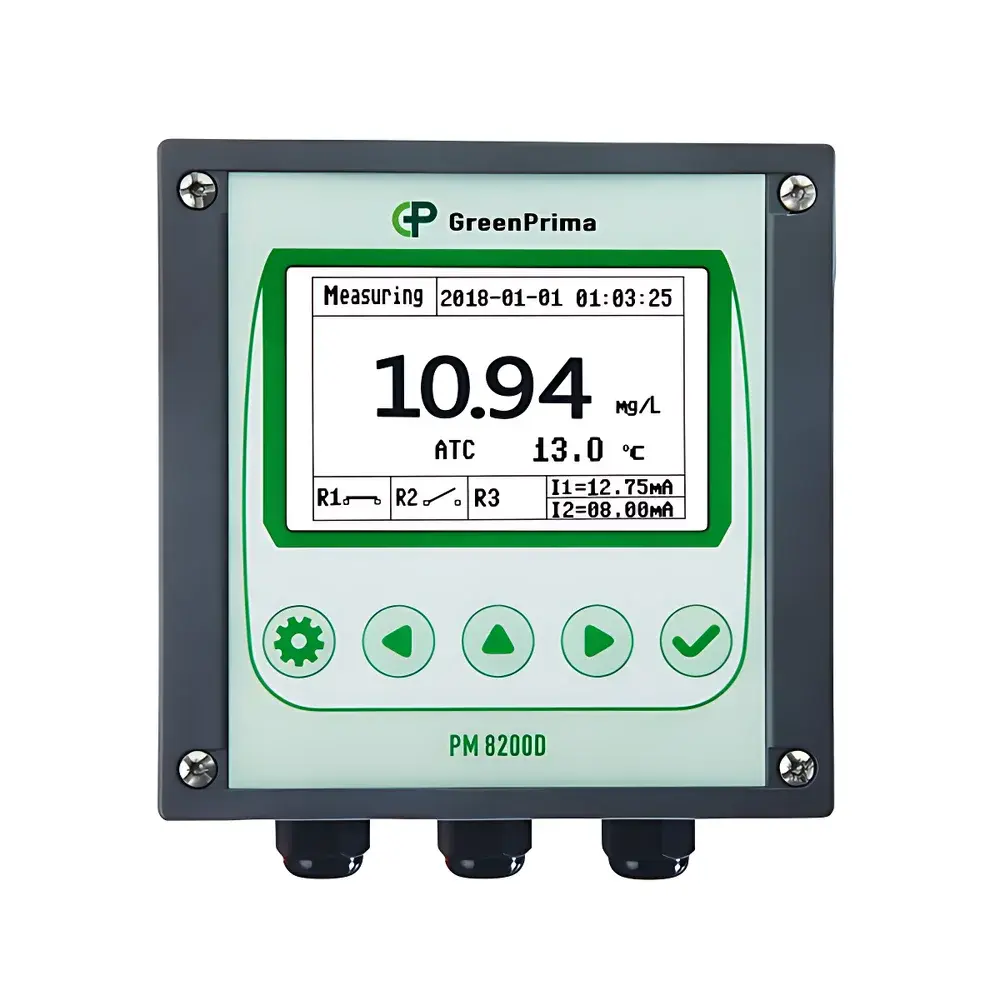
GreenPrima PM8200D Online Dissolved Oxygen Analyzer – Polarographic Type
| Brand | GreenPrima |
|---|---|
| Origin | United Kingdom |
| Manufacturer | GreenPrima Ltd. |
| Model | PM8200D |
| Measurement Range | 0–20 ppm (0–200% saturation, 0–200 ppb optional) |
| Resolution | 0.01 ppm |
| Repeatability | ±0.01 ppm |
| Stability | ±0.5% FS |
| Temperature Compensation | −10 to +130 °C |
| Output Interfaces | Dual isolated 4–20 mA, RS485 Modbus RTU (HART optional) |
| Enclosure Dimensions | 144 × 144 × 108 mm |
| IP Rating | IP65 (controller), IP68 (sensor) |
| Operating Ambient Temperature | 0–60 °C |
| Power Supply | 90–260 VAC / 50–60 Hz or 24 VDC optional |
Overview
The GreenPrima PM8200D Online Dissolved Oxygen Analyzer is a precision-engineered polarographic sensor system designed for continuous, real-time monitoring of dissolved oxygen (DO) concentration in industrial aqueous process streams. Based on the Clark-type amperometric principle, the analyzer employs a three-electrode polarographic cell—comprising a gold cathode, silver/silver chloride reference, and stainless steel counter electrode—immersed behind an oxygen-permeable polytetrafluoroethylene (PTFE) membrane. Molecular oxygen diffuses through the membrane and is electrochemically reduced at the cathode surface under a fixed polarizing voltage (typically −0.7 V vs. Ag/AgCl), generating a current linearly proportional to the partial pressure of dissolved O₂. This fundamental electrochemical response enables high reproducibility and long-term stability across diverse water matrices—including wastewater, potable water, boiler feedwater, fermentation broths, pharmaceutical rinse solutions, and aquaculture systems—without interference from redox-active species commonly present in biological or chemical processes.
Key Features
- Robust dual-channel analog output: Two fully isolated 4–20 mA current loops configurable for DO concentration and temperature, each with ≤0.1% FS linearity and max. 500 Ω loop resistance.
- Modbus RTU over RS485 interface supporting standard register mapping for integration into DCS, SCADA, and PLC-based control architectures; optional HART protocol available for enhanced diagnostics and configuration flexibility.
- IP65-rated controller housing with backlit high-contrast dot-matrix LCD display showing real-time DO value (ppm or % saturation), temperature (°C), relay status, and timestamped event logs.
- Programmable cleaning cycle: Adjustable cleaning interval (0.1–1000 h) and duration (1–1000 s) to mitigate biofouling and particulate deposition on the sensor membrane—critical for long-term reliability in raw sewage or algae-rich aquaculture applications.
- Dual independent alarm relays (5 A / 250 VAC / 30 VDC) with user-defined setpoints, hysteresis control, and latching/non-latching modes compliant with IEC 61508 functional safety principles.
- Temperature compensation using either NTC10K or PT1000 sensors with automatic or manual selection; supports full-range compensation from −10 °C to +130 °C—enabling accurate measurements in sterilization-grade hot water loops (e.g., SIP cycles in bioreactors).
Sample Compatibility & Compliance
The PM8200D system accommodates interchangeable polarographic sensors (Bsens420, Bsens430, Bsens440), each optimized for specific operational demands: Bsens420 for general-purpose municipal and industrial water; Bsens430 for high-pressure steam condensate and boiler feed lines (rated to 6 bar); and Bsens440 for ultra-trace oxygen detection down to 200 ppb in ultrapure water used in semiconductor rinse stages or pharmaceutical WFI distribution systems. All sensors feature PPS or 316L stainless steel bodies and IP68-rated submersion capability. The analyzer meets CE marking requirements per EN 61326-1 (EMC) and EN 61010-1 (safety), and its measurement traceability aligns with ISO 5814:2012 (electrochemical determination of dissolved oxygen) and ASTM D888-12 (standard test methods for dissolved oxygen in water). When deployed with audit-trail-enabled software and password-protected calibration (default codes: 1100/1200), the system supports GLP/GMP documentation workflows and FDA 21 CFR Part 11 compliance for regulated biopharmaceutical manufacturing environments.
Software & Data Management
Configuration, calibration, and diagnostic functions are accessible via front-panel keypad navigation or remote serial communication using GreenPrima’s proprietary PC-based configuration utility (Windows-compatible, no runtime dependencies). The controller stores up to 32,000 timestamped data points (DO + temperature) in non-volatile memory with circular buffer logic. All calibration events—including zero and span adjustments, membrane replacement logs, and electrolyte refill timestamps—are recorded with operator ID and digital signature fields where enabled. Optional Modbus TCP gateway modules allow seamless integration with cloud-based IIoT platforms for predictive maintenance analytics, including drift trend analysis and membrane lifetime estimation based on polarization current decay profiles.
Applications
- Wastewater treatment: Activated sludge aeration basin control, denitrification optimization, and effluent compliance monitoring per EU Urban Wastewater Treatment Directive (91/271/EEC).
- Power generation: Monitoring dissolved oxygen in turbine condensate and boiler feedwater to prevent corrosion-induced pitting and stress cracking (ASME B31.1, EPRI guidelines).
- Biopharmaceutical manufacturing: Real-time DO feedback control in mammalian cell culture bioreactors and downstream purification skids, meeting USP water quality specifications.
- Aquaculture and fish farming: Closed-loop dissolved oxygen regulation in recirculating aquaculture systems (RAS) to maintain optimal metabolic conditions for high-density stocking.
- Fermentation process control: Precise O₂ dosing in aerobic yeast propagation, antibiotic synthesis, and enzyme production fermenters per cGMP Annex 11 requirements.
FAQ
What measurement principle does the PM8200D employ?
It uses the polarographic (Clark-type) amperometric method, relying on diffusion-controlled electrochemical reduction of dissolved oxygen at a polarized noble metal cathode.
How often must the electrolyte be replaced?
Typical replacement interval is every 3–6 months under continuous operation; frequency increases in high-temperature or high-fouling environments.
Is temperature compensation automatic?
Yes—configurable as either automatic (using integrated NTC10K or external PT1000) or manual input, with compensation range spanning −10 °C to +130 °C.
Can the PM8200D interface with legacy DCS systems?
Yes—via isolated 4–20 mA analog outputs or RS485 Modbus RTU, both widely supported in industrial automation infrastructures.
Does the system support regulatory audit trails for pharmaceutical use?
When paired with validated configuration software and enabled password protection, it supports electronic record retention, user access logging, and change history tracking aligned with 21 CFR Part 11 expectations.