
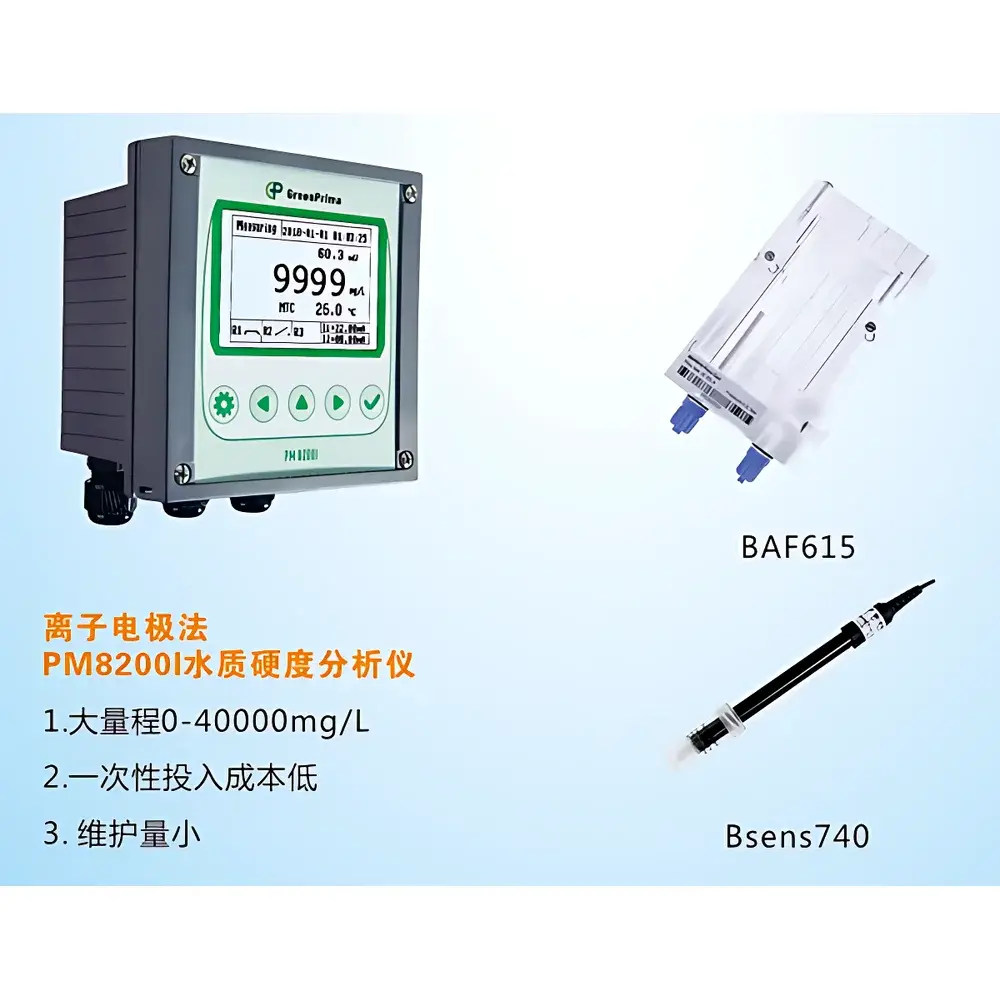
GreenPrima PM8200I Online Water Hardness Analyzer for Pharmaceutical Applications
| Brand | GreenPrima |
|---|---|
| Origin | United Kingdom |
| Manufacturer Type | Original Equipment Manufacturer (OEM) |
| Origin Category | Imported |
| Model | PM8200I |
| Pricing | Upon Request |
| Measurement Principle | Ion-Selective Electrode (ISE) Method |
| Range | 0.00–20,000 ppm CaCO₃ equivalent |
| Resolution | 0.01 / 0.1 / 1 ppm |
| Accuracy | ±0.01 / ±0.1 / ±1 ppm (depending on range) |
| Temperature Compensation | –10 to 130 °C (NTC10K or PT1000 sensor, manual/automatic) |
| Operating Temperature | 0 to 70.0 °C |
| Storage Temperature | –20 to 70.0 °C |
| Display | Backlit graphical LCD |
| Data Storage | 600,000 records |
| Communication | RS485 MODBUS RTU |
| Analog Outputs | Dual isolated 4–20 mA (max. 500 Ω, 0.1% FS) |
| Relay Output | 1 multifunctional relay (cleaning, periodic alarm, fault alarm) |
| Cleaning Control | Adjustable interval (0.1–1000 h) and duration (1–1000 s) |
| Enclosure Rating | IP65 |
| Power Supply | 90–260 VAC, 50/60 Hz or optional 24 VDC |
| Dimensions | 144 × 144 × 106 mm |
| Panel Cutout | 138 × 138 mm |
| Weight | 0.86 kg |
| Sensor Model | Bsens740 |
| Sensor Range | 0–40,000 mg/L as CaCO₃ |
| Sensor Resolution | 0.01 mg/L |
| Sensor Accuracy | ±3% FS |
| Sensor Material | Polyphenylsulfone (PPS) |
| Sensor Max. Pressure | 3.5 bar |
| Sensor Connection | PG13.5 threaded fitting |
| Sensor Cable Length | 5 m |
Overview
The GreenPrima PM8200I Online Water Hardness Analyzer is an industrial-grade, continuous-monitoring instrument engineered for real-time measurement of total water hardness—expressed as calcium carbonate (CaCO₃) equivalents—in critical process water streams. Designed specifically for regulated environments including pharmaceutical manufacturing, power generation, boiler feedwater systems, and high-purity industrial cooling circuits, the PM8200I employs a robust ion-selective electrode (ISE) sensing principle. Unlike colorimetric or titrimetric methods requiring reagents, consumables, or complex fluidic handling, this analyzer delivers stable, drift-resistant measurements directly in-line or at-stream via a maintenance-optimized solid-state sensor. Its architecture supports long-term deployment in wet, chemically aggressive, or temperature-variable installations—common in steam generation, reverse osmosis permeate monitoring, softener effluent verification, and HVAC condensate return loops.
Key Features
- Reagent-free operation using a calibrated calcium/magnesium ISE sensor (model Bsens740), eliminating tubing clogs, chemical waste, and calibration drift associated with wet-chemistry analyzers
- Dual isolated 4–20 mA analog outputs with 0.1% full-scale accuracy, configurable for hardness value and temperature or secondary status signals
- RS485 interface compliant with MODBUS RTU protocol for seamless integration into SCADA, DCS, or MES platforms—enabling centralized data logging and remote configuration
- IP65-rated sealed enclosure with backlit graphical LCD display supporting both English and Chinese language menus; intuitive navigation without physical keypads
- Onboard data historian storing up to 600,000 timestamped readings—including hardness, temperature, and system status—with query-by-date-range functionality
- Programmable cleaning cycle control (interval: 0.1–1000 hours; duration: 1–1000 seconds) to maintain sensor surface integrity in suspended-solids-rich applications
- Auto-ranging resolution (0.01 / 0.1 / 1 ppm) and selectable temperature compensation (NTC10K or PT1000) ensure metrological consistency across diverse thermal regimes (–10 to 130 °C)
Sample Compatibility & Compliance
The PM8200I is validated for use with low-conductivity purified water (PW), water-for-injection (WFI), softened municipal supply, boiler blowdown, and closed-loop cooling tower make-up. It meets mechanical and environmental requirements per IEC 60529 (IP65), IEC 61000-4 electromagnetic compatibility standards, and RoHS Directive 2011/65/EU. While not certified under FDA 21 CFR Part 11 out-of-the-box, its audit-trail-capable data storage, user-access-controlled configuration, and time-stamped event logging support validation protocols required by GMP Annex 11, ISO 9001:2015, and EU GMP guidelines for water system monitoring. The PPS-bodied Bsens740 sensor exhibits chemical resistance to chlorine, chloramines, and common antiscalants—making it suitable for continuous duty in chlorinated distribution networks and membrane pretreatment stages.
Software & Data Management
Data from the PM8200I is accessible via MODBUS RTU registers mapped to hardness value (in ppm), temperature (°C), sensor status flags (e.g., “calibration due”, “cleaning overdue”), and relay activation states. Third-party HMI or historian software (e.g., Ignition SCADA, Siemens Desigo CC, or custom Python-based loggers) can poll these registers at user-defined intervals (default: 10-second cycles). Internal memory retains all values with microsecond-accurate timestamps; retrieval occurs via serial command or through optional USB-to-RS485 adapter. No proprietary software is required—configuration parameters (e.g., damping factor, alarm thresholds, output scaling) are modified directly on-device or remotely via MODBUS write commands. For regulated facilities, raw data exports (CSV format) may be generated post-retrieval to satisfy ALCOA+ data integrity principles.
Applications
- Pharmaceutical water systems: Continuous monitoring of PW/WFI hardness pre- and post-distribution loop to verify softener performance and prevent scale formation in sterilization equipment
- Power plant boiler feedwater: Early detection of hardness breakthrough in demineralized water trains, supporting ASME PTC 19.11 and EPRI guidelines for cycle chemistry control
- Industrial HVAC: Real-time tracking of hardness accumulation in chilled water and condenser water circuits to optimize antiscalant dosing and extend heat exchanger service life
- Food & beverage processing: Verification of hardness compliance in CIP rinse water and final product contact streams per NSF/ANSI Standard 61
- Electronics ultrapure water (UPW): Spot-checking hardness residuals downstream of mixed-bed polishers where sub-ppb sensitivity is not required but ppm-level trend analysis is critical
FAQ
Does the PM8200I require routine calibration? How often should it be performed?
Calibration is recommended every 30 days for GMP-compliant operations or after sensor cleaning events. A two-point calibration (zero and span) using NIST-traceable hardness standards (e.g., 100 ppm and 1000 ppm CaCO₃) is supported via the front-panel menu.
Can the Bsens740 sensor be used in pressurized pipelines?
Yes—the sensor is rated for continuous operation at up to 3.5 bar (50 psi) static pressure when installed with appropriate PG13.5 compression fittings and isolation valves.
Is temperature compensation mandatory for accurate hardness readings?
Yes. Hardness ion activity varies significantly with temperature; the PM8200I supports automatic compensation using either built-in NTC10K or external PT1000 sensors, ensuring traceable results across operating ranges from –10 to 130 °C.
What maintenance tasks are required beyond scheduled cleaning?
No routine consumables or fluidics servicing are needed. Annual verification of sensor slope (>95% of initial mV/ppm response) and zero offset (<±5 mV) is advised to confirm electrochemical stability.
How does the PM8200I handle particulate-laden water samples?
The Bsens740 sensor’s flat, chemically inert PPS surface resists fouling. When installed upstream of filtration (e.g., 5 µm cartridge), or paired with optional wiper-based mechanical cleaning kits, it maintains accuracy in turbidities up to 50 NTU.
Related Products







