
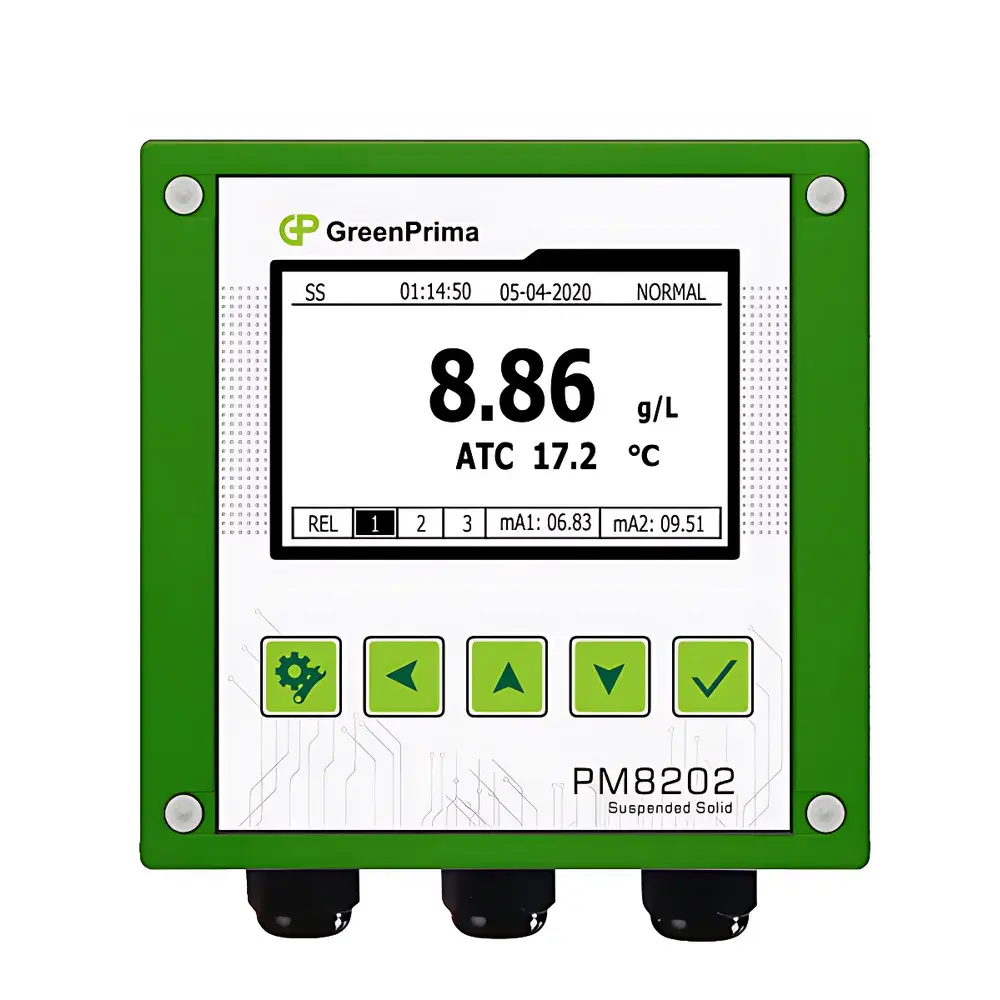
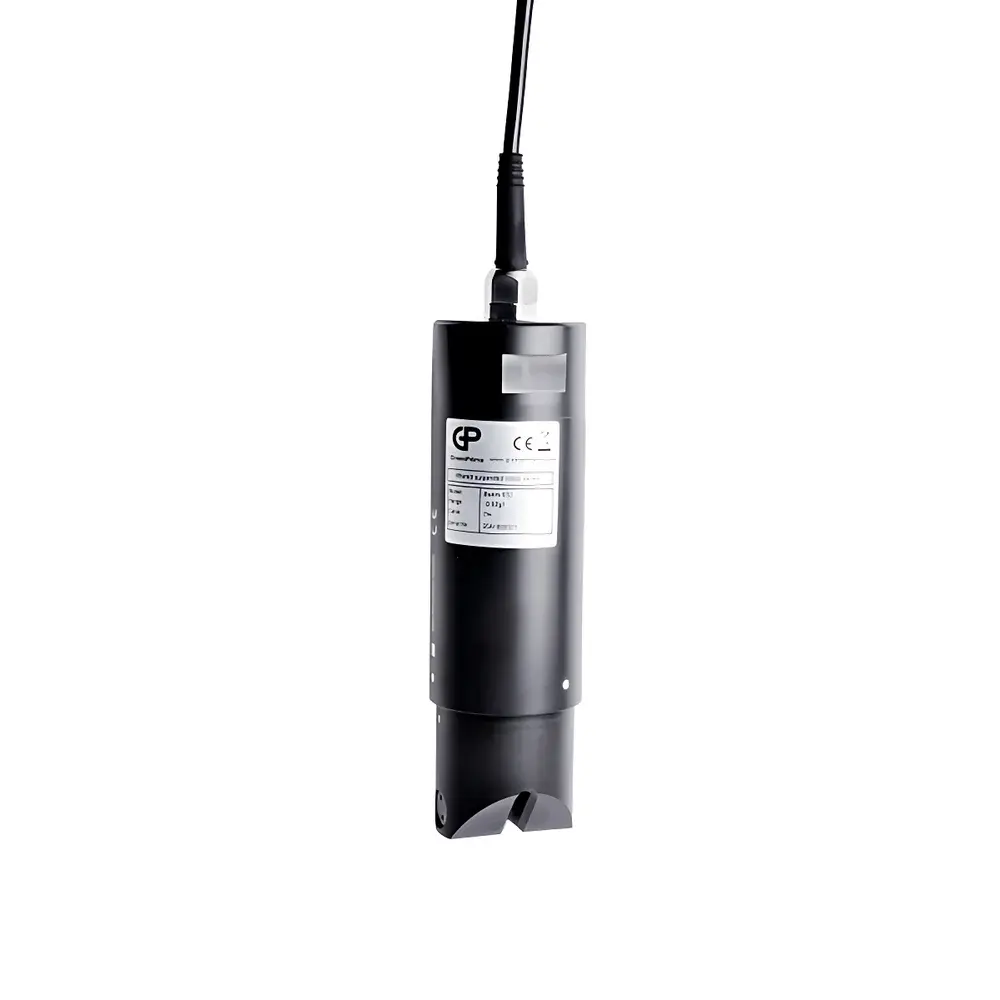
GreenPrima PM8200S+BSens550 Online Suspended Solids Analyzer
| Brand | GreenPrima |
|---|---|
| Origin | UK |
| Manufacturer Type | Manufacturer |
| Origin Category | Imported |
| Model | PM 8200S+BSens550 |
| Instrument Type | Online |
| Measurement Principle | 90° Light Scattering (EN ISO 7027 Compliant) |
| Controller Display | Sludge Concentration, Relay Status, Sensor Model |
| Language | English/Chinese |
| Power Supply | 90–260 VAC, 50/60 Hz |
| Analog Outputs | Two 4–20 mA (Concentration & Temperature), Max. Load 600 Ω |
| Digital Output | RS485 Modbus RTU |
| Alarm Outputs | Two Independent Hi/Lo Setpoints with Hysteresis, 5 A / 250 VAC |
| Cleaning Interval | Field-Configurable (1–999 hours) |
| Operating Temperature (Controller) | −10 to +60 °C |
| Enclosure Rating (Controller) | IP65 / NEMA 4X |
| Mounting | Wall-Mount |
| Dimensions (Controller) | 144 × 144 × 108 mm |
| Sensor Model | innoSens 550 |
| Sensor Measurement Range | 0–50 g/L |
| Resolution | 0.1 NTU / 0.1 mg/L |
| Accuracy | ±2% of Full Scale |
| Sensor Housing Material | Delrin® |
| Cable Length | Standard 7 m |
| Max. Pressure Rating (Sensor) | 5 bar |
| Sensor Operating Temperature | 0–60 °C |
| Sensor Enclosure Rating | IP68 |
Overview
The GreenPrima PM8200S+BSens550 is a continuous online suspended solids (SS) and activated sludge concentration analyzer engineered for robust, long-term deployment in municipal wastewater treatment plants, industrial effluent streams, and tertiary clarification basins. It operates on the 90° light scattering principle—strictly compliant with EN ISO 7027 for turbidity and suspended solids quantification—ensuring metrological traceability and inter-laboratory comparability. Unlike nephelometric systems optimized solely for low-concentration clarity assessment, this analyzer is calibrated and validated across an extended dynamic range (0–50 g/L), making it suitable for mixed liquor suspended solids (MLSS) monitoring in aeration tanks, return activated sludge (RAS) lines, and waste activated sludge (WAS) streams. Its dual-sensor architecture integrates the BSens550 optical probe—hermetically sealed in IP68-rated Delrin® housing—with the PM8200S controller featuring ARM-based embedded processing, enabling deterministic real-time response and immunity to electromagnetic interference common in pump stations and SCADA environments.
Key Features
- 90° light scattering detection per EN ISO 7027, validated for turbidity and suspended solids correlation in heterogeneous wastewater matrices
- Field-configurable automatic cleaning interval (1–999 hours) via integrated solenoid-driven wiper or optional ultrasonic cleaning module
- Dual 4–20 mA analog outputs assignable to primary measurement (e.g., g/L SS) and auxiliary parameter (e.g., temperature compensation signal)
- RS485 Modbus RTU interface supporting integration into DCS, PLC, and SCADA systems without protocol translation hardware
- Two independent relay outputs with programmable hysteresis for process control (e.g., sludge wasting initiation) and alarm escalation
- High-contrast dot-matrix display with bilingual (English/Chinese) menu navigation—designed for multilingual operator environments without requiring firmware reflash
- Wide-input AC power supply (90–260 VAC, 50/60 Hz) eliminating need for external transformers in global installations
Sample Compatibility & Compliance
The BSens550 sensor exhibits minimal fouling susceptibility due to its smooth Delrin® optical window and non-contact measurement geometry. It is compatible with raw sewage, primary effluent, secondary clarifier underflow, and digested sludge—provided flow velocity exceeds 0.3 m/s to prevent sedimentation at the sensing zone. The system meets CE marking requirements for electromagnetic compatibility (EMC Directive 2014/30/EU) and low-voltage safety (LVD Directive 2014/35/EU). While not certified for SIL2 or ATEX Zone 1, its IP65/NEMA 4X controller and IP68 sensor are rated for outdoor mounting adjacent to open channels, wet wells, and grit chambers. Data integrity aligns with GLP-aligned operational practices; audit trails for calibration events, cleaning cycles, and alarm acknowledgments are retained in non-volatile memory.
Software & Data Management
The PM8200S does not rely on proprietary PC software for basic operation—configuration, calibration, and diagnostics are performed locally via front-panel navigation. However, Modbus register mapping enables full remote supervision using standard industrial HMI platforms (e.g., Ignition, Siemens WinCC, Rockwell FactoryTalk). All analog and digital outputs support linear scaling with user-defined engineering units (g/L, mg/L, NTU). Calibration verification is supported via dry-cell zero check and factory-certified reference slurries traceable to NIST SRM 2102a. No cloud connectivity or subscription services are embedded—data sovereignty and network segmentation requirements typical in municipal utility IT policies are inherently satisfied.
Applications
- Real-time MLSS monitoring in aerobic and anoxic bioreactors to optimize dissolved oxygen setpoints and nutrient dosing
- Return activated sludge (RAS) concentration feedback control for clarifier hydraulic loading management
- Waste activated sludge (WAS) flow proportional control to maintain target F/M ratios
- Tertiary filtration influent screening to detect upsets from clarifier breakthrough
- Industrial pretreatment compliance reporting for TSS discharge limits per local environmental permits
- Performance validation of membrane bioreactor (MBR) backwash cycles via post-backwash SS rebound profiling
FAQ
Does the BSens550 require periodic recalibration in situ?
No—calibration is performed during factory commissioning using gravimetrically prepared standards. Field verification is recommended every 6 months using zero-check solution and one-point span check; full recalibration requires return to authorized service center.
Can the PM8200S operate in sub-zero ambient conditions?
The controller is rated for −10 °C minimum; however, sensor operation below 0 °C is not supported due to risk of ice formation on optical surfaces and potential cable jacket brittleness.
Is the 4–20 mA output intrinsically safe for hazardous area installation?
No—the analog outputs are non-IS and must be isolated via approved signal conditioners if routed into classified zones.
What maintenance intervals are specified for the self-cleaning function?
Cleaning frequency is application-dependent; typical settings range from 4–24 hours in high-fouling RAS lines to 168 hours (weekly) in clarified effluent streams. The system logs each cleaning event with timestamp for maintenance trending.
How is temperature compensation applied to the scattering signal?
The integrated Pt1000 RTD in the BSens550 provides real-time thermal data; the PM8200S applies a polynomial correction algorithm derived from empirical wastewater temperature–viscosity–scattering relationships, improving accuracy across seasonal variations.
Related Products







