
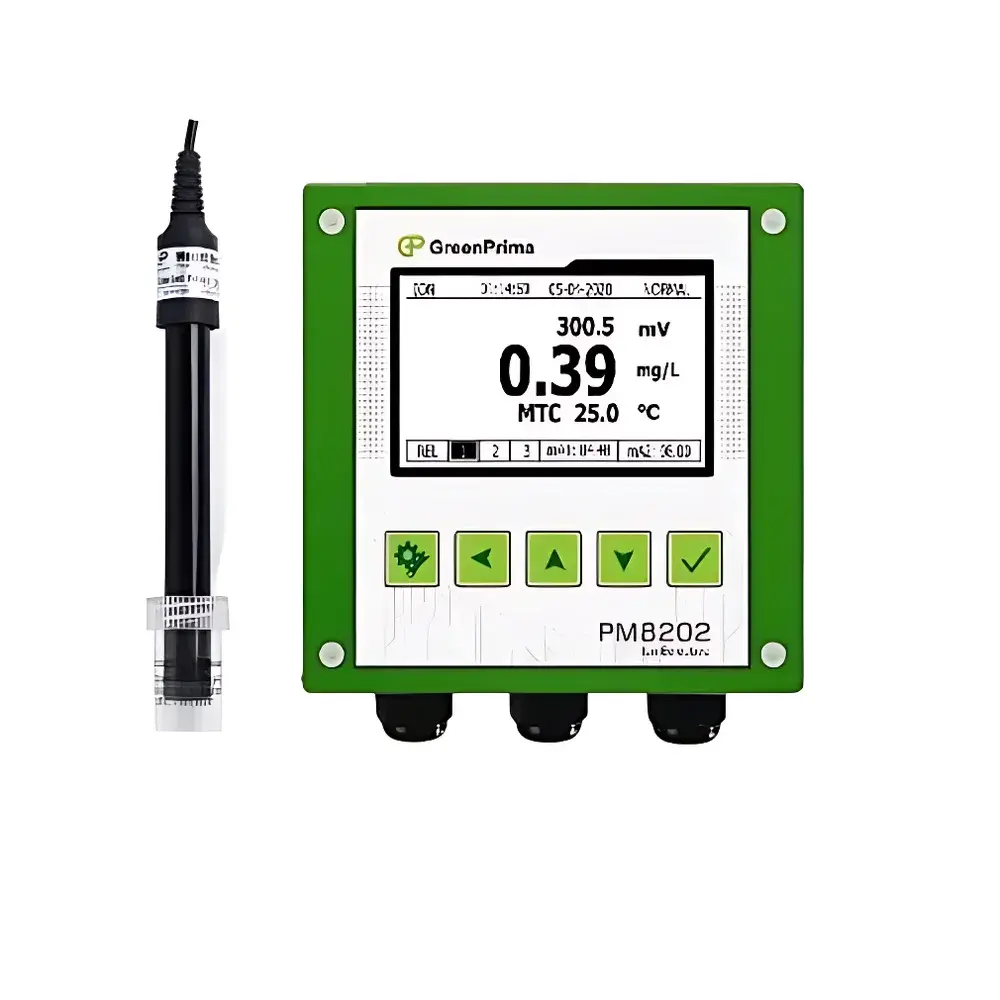
GreenPrima PM8202 I Calcium Hardness Analyzer
| Brand | GreenPrima |
|---|---|
| Origin | United Kingdom |
| Manufacturer Type | Original Equipment Manufacturer (OEM) |
| Product Category | Imported Instrument |
| Model | PM8202 I |
| Pricing | Available Upon Request |
| Measurement Principle | Potentiometric Ion-Selective Electrode (ISE) for Calcium²⁺ |
| Range | 0.00–20,000 ppm CaCO₃ equivalent |
| Resolution | 0.01 / 0.1 / 1 ppm (user-selectable) |
| Accuracy | ±0.01 ppm (≤1 ppm), ±0.1 ppm (1–100 ppm), ±1 ppm (>100 ppm) |
| Temperature Compensation | –10 to +130 °C (NTC30k or PT1000 sensor, manual/automatic) |
| Operating Temperature | –10 to +70.0 °C |
| Storage Temperature | –20 to +70.0 °C |
| Display | Backlit dot-matrix LCD with real-time Ca²⁺ concentration, temperature, timestamp, and relay status |
| Data Storage | 600,000 records with timestamped logging |
| Power Supply | 90–260 VAC, 50/60 Hz or optional 24 VDC |
| Analog Outputs | Two isolated 4–20 mA outputs (max. loop resistance 500 Ω, accuracy ±0.1 % FS, configurable for Ca²⁺ or temperature) |
| Communication | RS485 Modbus RTU protocol |
| Cleaning Control | Programmable cleaning interval (0.1–1000 h) and duration (1–1000 s) |
| Alarm Outputs | Two independent Hi/Lo relay alarms (5 A @ 250 VAC / 30 VDC, adjustable hysteresis) |
| Enclosure Rating | IP65 |
| Mounting Options | Wall-mount, pipe-mount, panel-mount |
| Dimensions (W×H×D) | 144 × 144 × 108 mm |
| Panel Cutout | 138 × 138 mm |
| Weight | 0.87 kg |
Overview
The GreenPrima PM8202 I Calcium Hardness Analyzer is a dedicated, potentiometric online analyzer engineered for continuous, reagent-free measurement of calcium hardness in water systems. It operates on the principle of ion-selective electrode (ISE) technology—specifically utilizing the Bsens740 calcium-selective electrode—to quantify free Ca²⁺ ion activity, which is then converted and reported as total hardness expressed in ppm CaCO₃ equivalents. Unlike colorimetric or titrimetric methods, this approach eliminates consumables, fluidic pathways, and associated maintenance overhead. The instrument integrates a robust controller unit with intelligent signal conditioning, real-time temperature compensation (via NTC30k or PT1000 sensors), and embedded calibration management—making it suitable for unattended operation in demanding industrial and regulatory environments.
Key Features
- Potentiometric calcium-specific ISE measurement—no reagents, no tubing, no risk of clogging or drift from chemical degradation
- IP65-rated sealed enclosure designed for humid, corrosive, or splash-prone locations including boiler feedwater trenches, electroplating rinse zones, and pharmaceutical utility corridors
- Intuitive dual-language (English/Chinese) menu-driven interface with backlit dot-matrix LCD showing simultaneous Ca²⁺ concentration, compensated temperature, system time, and relay operational status
- User-configurable resolution (0.01 / 0.1 / 1 ppm) and accuracy tiers aligned with application-critical thresholds (e.g., <1 ppm for ultrapure water validation)
- Dual isolated 4–20 mA analog outputs—each independently assignable to either calcium concentration or temperature, traceable per ISO/IEC 17025 calibration documentation
- Modbus RTU over RS485 enables seamless integration into SCADA, DCS, or MES platforms; supports read/write access to configuration, live values, and historical logs
- Programmable cleaning cycle with adjustable frequency (0.1–1000 hours) and duration (1–1000 seconds) to maintain electrode surface integrity in high-fouling applications
- Two independent relay outputs with user-defined hysteresis—configured for process control (e.g., antiscalant dosing initiation), fault signaling, or automatic electrode cleaning activation
- Onboard non-volatile memory storing up to 600,000 timestamped records—including Ca²⁺ value, temperature, system status, and event flags—retained during power loss
Sample Compatibility & Compliance
The PM8202 I is validated for use across diverse aqueous matrices including surface water, groundwater, reverse osmosis permeate, cooling tower makeup, boiler feedwater, pharmaceutical purified water (PW) and water-for-injection (WFI) distribution loops, and semiconductor rinse effluents. Its ISE-based methodology complies with ASTM D1576 (Standard Test Method for Calcium in Water by Atomic Absorption) in functional equivalence for routine monitoring—though not intended as a replacement for laboratory-grade reference methods in audit contexts. The device architecture supports GLP/GMP-aligned operational practices: all calibrations are logged with operator ID, timestamp, and buffer values; alarm events include cause codes and duration; and firmware updates preserve full audit trail integrity. Optional 24 VDC power input meets SELV requirements for Class I, Division 2 hazardous locations when installed with appropriate barriers.
Software & Data Management
Data acquisition and system configuration are managed locally via the front-panel interface or remotely through Modbus register mapping. All stored measurements include embedded UTC timestamps synchronized at boot or via optional NTP client (when integrated with higher-level controllers). Export of historical datasets is supported via Modbus polling or direct USB-to-serial dump using GreenPrima’s certified configuration utility (Windows/Linux compatible). The internal log structure conforms to ISA-88 Part 5 data tagging conventions, enabling straightforward ingestion into LIMS or electronic batch record (EBR) systems. Firmware revision history, calibration certificate metadata, and sensor health diagnostics (e.g., slope stability, asymmetry potential) are accessible via diagnostic registers—facilitating preventive maintenance scheduling per ISO 55001 asset management frameworks.
Applications
- Real-time calcium hardness surveillance in high-pressure boiler feedwater circuits to prevent scale nucleation in economizers and steam drums
- Continuous monitoring of recirculating cooling water where Langelier Saturation Index (LSI) calculations depend on accurate Ca²⁺ input
- Pharmaceutical facility PW/WFI loop verification per USP and EU Annex 1 requirements for microbial and particulate control—where hardness spikes indicate resin exhaustion or pretreatment failure
- Electroplating bath management to avoid calcium-induced anode passivation or coating porosity in nickel and chromium plating lines
- Food & beverage process water qualification—particularly in dairy and brewing applications where hardness affects enzyme activity and thermal efficiency
- Environmental compliance reporting for discharge permits requiring hardness limits under EPA NPDES guidelines
FAQ
What measurement principle does the PM8202 I employ?
It uses a solid-contact calcium-selective ion electrode (Bsens740) operating on the Nernst equation, converting measured potential difference into calcium ion activity and reporting it as ppm CaCO₃.
Is temperature compensation mandatory for accurate readings?
Yes—temperature directly affects both electrode potential and ion activity coefficients. The unit supports automatic compensation using either NTC30k or PT1000 sensors across –10 to +130 °C.
Can the device be calibrated without lab-grade standards?
Field calibration requires two-point calibration with traceable Ca²⁺ standard solutions (e.g., 50 ppm and 500 ppm CaCO₃); single-point verification is permissible between full calibrations per SOP-defined intervals.
Does the analyzer support FDA 21 CFR Part 11 compliance?
While the PM8202 I itself does not provide electronic signatures or role-based access control, its Modbus interface and audit-ready logging enable integration into Part 11–compliant enterprise systems when deployed with validated middleware.
How often should the calcium electrode be replaced?
Typical service life exceeds 18 months in clean, low-turbidity applications; in high-fouling environments (e.g., seawater intake), replacement every 6–12 months is recommended based on slope degradation (>15% deviation from initial 29.5 mV/decade).
Related Products







