
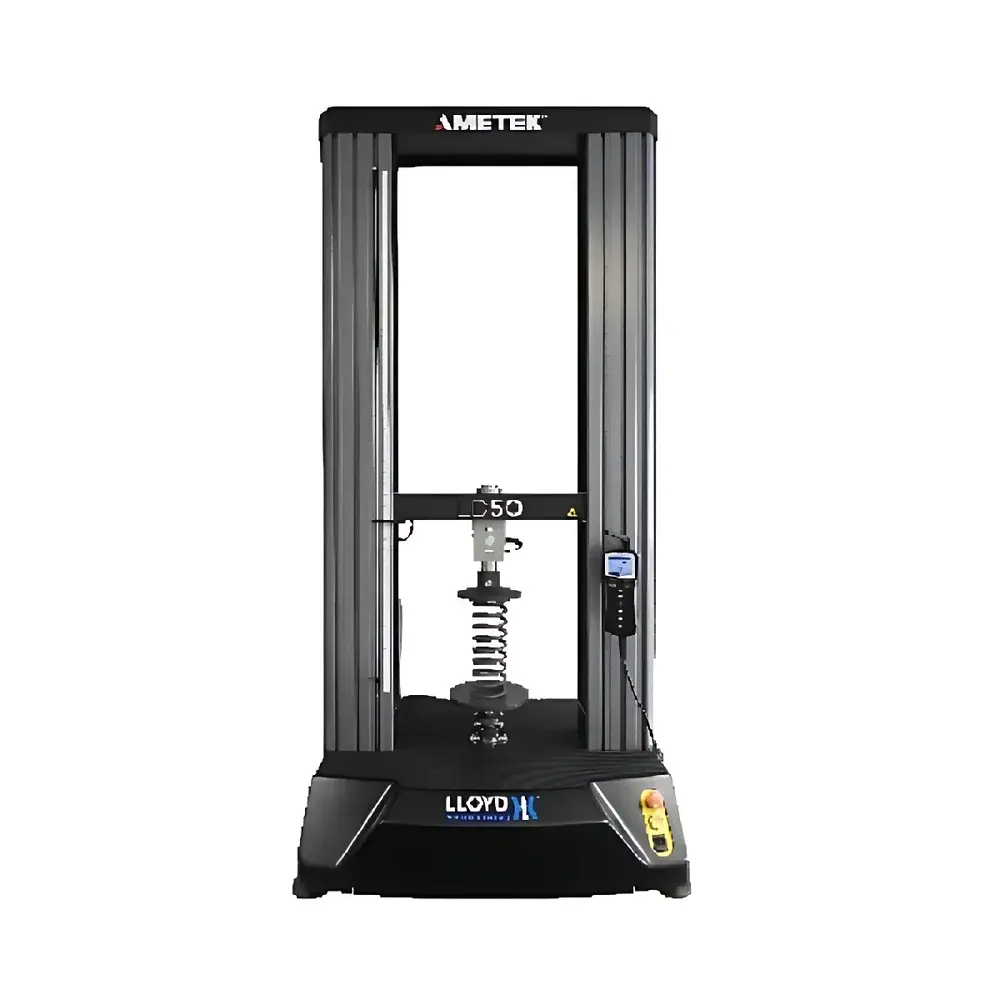
Lloyd Instruments LD100 Dual-Column Universal Testing Machine
| Brand | Lloyd Instruments |
|---|---|
| Origin | USA |
| Model | LD100 |
| Maximum Load Capacity | 100 kN (22,480 lbf) |
| Column Spacing | 452 mm (17.8 in) |
| Crosshead Travel (Standard) | 1070 mm (42 in) |
| Crosshead Travel (Extended) | 1669 mm (65.7 in) |
| Drive System | AC Servo Motor with Preloaded Ball Screw |
| Load Cell Type | Interchangeable Spoke-Type Load Cells |
| Compliance | CE Marked |
| Software | NEXYGENPlus with Built-in Standards Library |
| Frame Stiffness | High-Rigidity Dual-Column Architecture |
| Control & Data Interface | USB/Ethernet |
| Safety Features | Dual-channel Emergency Stop, Overload Protection, Position Limit Switches |
Overview
The Lloyd Instruments LD100 Dual-Column Universal Testing Machine is an electromechanical static testing system engineered for high-precision tensile, compression, flexure, peel, shear, and cyclic mechanical characterization of materials and components. Based on a robust dual-column load frame architecture, it operates under closed-loop servo control using a high-resolution AC servo motor coupled to a preloaded recirculating ball screw transmission. This configuration ensures exceptional displacement linearity (< ±0.5% of full scale), minimal axial deflection under load, and long-term repeatability essential for ISO 17025-accredited laboratories and regulated manufacturing environments. Designed for structural integrity validation across aerospace composites, biomedical polymers, automotive elastomers, and metallic alloys, the LD100 delivers traceable force measurement up to 100 kN with calibrated spoke-type load cells—each independently verified per ISO 376 and ASTM E4 guidelines. Its modular mechanical design supports seamless integration with environmental chambers, video extensometry, and digital image correlation (DIC) systems for advanced strain mapping.
Key Features
- High-rigidity dual-column steel frame with 452 mm (17.8 in) column spacing—optimized for large-format specimens and multi-axis fixture configurations
- Standard crosshead travel of 1070 mm (42 in); extended version available at 1669 mm (65.7 in) for elongation-intensive tests (e.g., rubber, geotextiles)
- Preloaded ball screw drive system with integrated position feedback—enabling displacement resolution down to 0.1 µm and velocity control from 0.001 to 2000 mm/min
- Interchangeable spoke-type load cells with factory-calibrated ranges (e.g., 1 kN, 5 kN, 10 kN, 50 kN, 100 kN)—each certified to ISO 376 Class 0.5 accuracy
- CE-compliant safety architecture including dual-redundant emergency stop circuitry, hardware-enforced overload cutoff, and programmable position limit switches
- Front-accessible maintenance zones—no tools required for routine load cell swaps or grip alignment calibration
Sample Compatibility & Compliance
The LD100 accommodates specimens ranging from micro-scale polymer films (via pneumatic side-action grips) to full-section structural beams (using hydraulic wedge grips or custom fixtures). Its open-test-zone geometry permits direct mounting of extensometers—including clip-on, non-contact laser, and video-based systems—without interference from frame obstructions. The system conforms to key international test standards including ASTM D638 (tensile plastics), ASTM D790 (flexural properties), ISO 527, ISO 178, ISO 6892-1 (metal tensile), and EN 10002-1. All firmware and controller logic are validated per IEC 61508 SIL 2 requirements for functional safety. For regulated industries, optional audit-trail-enabled NEXYGENPlus software meets FDA 21 CFR Part 11 requirements when configured with electronic signatures and user-role access controls.
Software & Data Management
NEXYGENPlus is a Windows-based, modular test control and analysis platform that operates natively in English, German, French, Japanese, and Chinese. It includes over 120 preconfigured test methods aligned with ASTM, ISO, DIN, JIS, and GB standards—each parameterized with default tolerances, ramp rates, and pass/fail criteria. Real-time data acquisition supports sampling rates up to 10 kHz, with synchronized capture of force, displacement, extensometer strain, and auxiliary analog inputs (e.g., temperature, humidity). Export workflows integrate directly with Microsoft Excel and Word via COM automation—enabling dynamic report generation using enterprise-defined templates. Raw data is stored in vendor-neutral XML format with embedded metadata (operator ID, calibration certificate ID, environmental conditions), ensuring full traceability during GLP/GMP audits.
Applications
- Mechanical validation of thermoplastic and thermoset composites in aerospace primary structures
- Compression testing of orthopedic implant materials (e.g., UHMWPE, PEEK, Ti-6Al-4V) per ISO 5832-12 and ASTM F2129
- Cyclic fatigue evaluation of elastomeric seals and gaskets under variable amplitude loading
- Tensile property mapping of additive-manufactured metal parts across build orientations
- Peel adhesion quantification for medical device packaging per ASTM F904
- Creep and stress-relaxation profiling of viscoelastic hydrogels and soft tissue simulants
FAQ
What load cell options are compatible with the LD100?
The LD100 accepts Lloyd’s full range of spoke-type load cells—from 100 N to 100 kN—with automatic recognition via integrated ID chips and plug-and-play calibration file loading.
Can the LD100 be used in a temperature-controlled chamber?
Yes—the system supports integration with commercially available environmental chambers (−70 °C to +300 °C) via pass-through ports and external signal conditioning modules.
Is NEXYGENPlus compliant with FDA 21 CFR Part 11?
When deployed with enabled audit trail, electronic signature, and role-based access modules, NEXYGENPlus satisfies all technical and procedural requirements for electronic records and signatures in regulated life science applications.
What maintenance intervals are recommended?
Lloyd recommends biannual verification of force and displacement metrology against NIST-traceable reference standards; ball screw lubrication every 2,000 operating hours; and annual inspection of emergency stop circuit functionality.
Does the LD100 support third-party extensometers?
Yes—via analog voltage input (±10 V) and digital TTL synchronization signals, enabling compatibility with extensometers from MTS, Instron, and HBM without proprietary interface licensing.



