
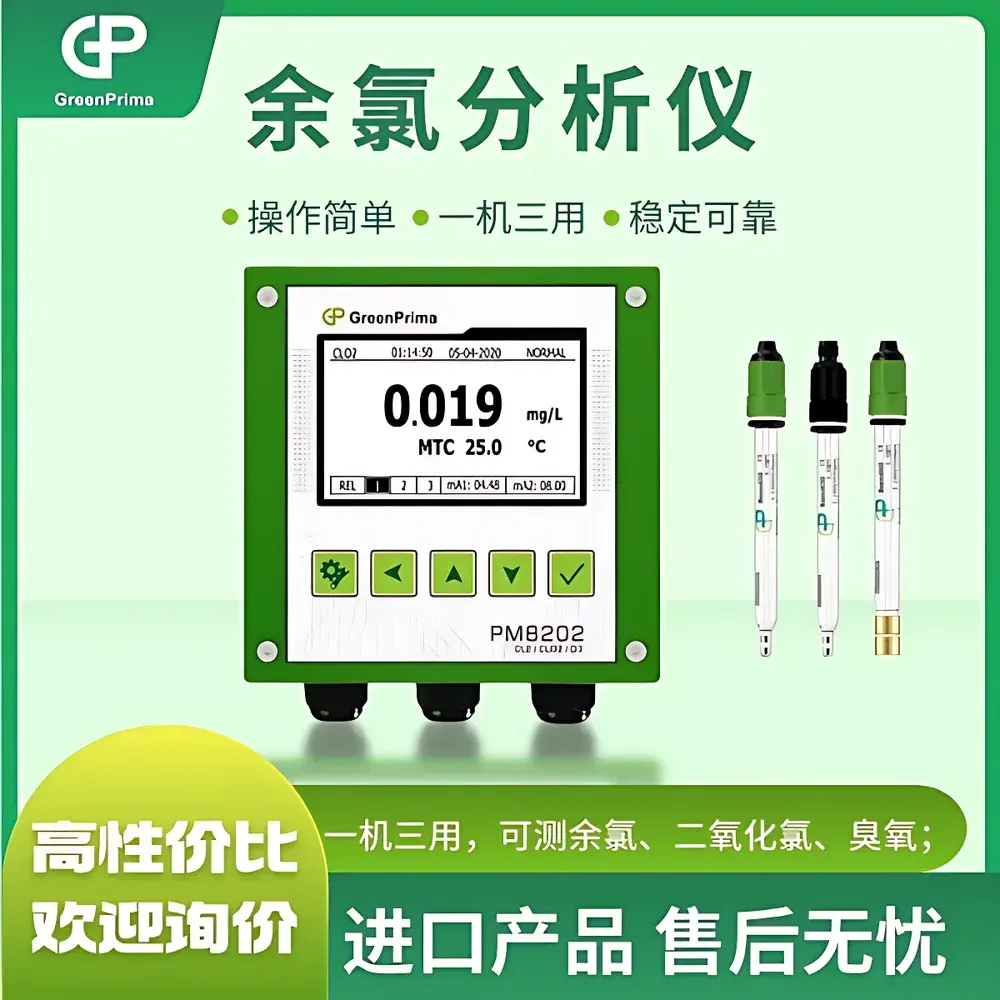
GreenPrima PM8202CL Residual Chlorine and Chlorine Dioxide Analyzer
| Brand | GreenPrima |
|---|---|
| Origin | United Kingdom |
| Manufacturer Type | Original Equipment Manufacturer (OEM) |
| Product Category | Imported Instrument |
| Model | PM8202CL |
| Instrument Type | Online Analyzer |
| Measurement Principle | Amperometric Constant-Voltage Detection |
| Measured Parameters | Free Chlorine, Total Chlorine, Chlorine Dioxide, Ozone |
| Range | 0.00–20.00 ppm / 0.00–200.00 ppb |
| Resolution | 0.001 ppm (low range), 0.01 ppm (high range) |
| Accuracy | ±2% of Full Scale |
| Temperature Compensation | -10 to 130 °C (NTC10K or PT1000 sensor input) |
| Operating Temperature | -10 to 70.0 °C |
| Storage Temperature | -20 to 70.0 °C |
| Display | Backlit Graphic LCD (Chinese/English switchable) |
| Data Storage | 600,000 records |
| Power Supply | 90–260 VAC, 50/60 Hz or optional 24 VDC |
| Output | Dual isolated 4–20 mA (≤500 Ω, 0.1% FS), RS485 Modbus RTU |
| Relay Outputs | Two programmable Hi/Lo alarms (5 A / 250 VAC / 30 VDC) |
| Cleaning Control | Adjustable interval (0.1–1000 h) and duration (1–1000 s) |
| Enclosure Rating | IP65 |
| Dimensions | 144 × 144 × 108 mm |
| Panel Cutout | 138 × 138 mm |
| Weight | 0.87 kg |
Overview
The GreenPrima PM8202CL is an online amperometric residual disinfectant analyzer engineered for continuous, reagent-free monitoring of free chlorine, total chlorine, chlorine dioxide, and ozone in aqueous systems. It operates on a constant-voltage amperometric principle—applying a fixed polarization potential across dual platinum (Bsens650) or gold (Bsens660) working electrodes to selectively oxidize target disinfectants at the electrode surface. The resulting current is linearly proportional to analyte concentration and is compensated in real time for temperature fluctuations using integrated NTC10K or PT1000 sensors. Unlike colorimetric or titrimetric methods, this electrochemical approach eliminates dependence on chemical reagents, membrane replacement, or sample pretreatment—enabling stable, low-maintenance operation in demanding water distribution and treatment environments.
Key Features
- True multi-analyte capability: Simultaneous or sequential measurement of free chlorine, total chlorine, chlorine dioxide, and ozone using interchangeable sensor modules (Bsens650/Bsens660) and dedicated BAF615 flow cell
- Reagent-free, membrane-free operation: No consumables required—reducing lifecycle cost and eliminating calibration drift associated with membrane aging or electrolyte depletion
- Robust electrochemical architecture: Dual-platinum electrode configuration provides high selectivity and resistance to common interferences including nitrite, bromide, and organic oxidants
- Stabilized hydrodynamic environment: Integrated BAF615 constant-flow cell maintains laminar, repeatable sample throughput—critical for signal stability and long-term reproducibility
- Flexible deployment: Supports wall-mount, panel-mount, and inline pipe-mount configurations with IP65-rated enclosure suitable for indoor and sheltered outdoor installations
- Comprehensive digital interface: Backlit graphic LCD with bilingual (English/Chinese) menu navigation, password-protected configuration access, and full audit trail support for operational integrity
- Dual analog outputs and Modbus RTU: Two isolated 4–20 mA channels (configurable for concentration and temperature) plus RS485 Modbus RTU for SCADA integration and centralized data logging
Sample Compatibility & Compliance
The PM8202CL is validated for use in potable water, hospital wastewater effluent, secondary distribution networks, cooling tower make-up, and industrial process water streams with pH 4.0–9.0 and turbidity < 5 NTU. Its amperometric detection meets the functional equivalency requirements of ASTM D1253 (Standard Test Method for Determining Residual Chlorine in Water) and ISO 7393-2 (Water quality — Determination of free chlorine and total chlorine — Part 2: Colorimetric method using N,N-diethyl-p-phenylenediamine (DPD)), though it does not rely on DPD chemistry. The instrument supports GLP/GMP-aligned data management through timestamped internal storage (600,000 records), configurable alarm hysteresis, and relay-triggered event logging—facilitating compliance with regulatory frameworks such as US EPA Safe Drinking Water Act (SDWA) monitoring protocols and EU Directive 98/83/EC.
Software & Data Management
Data acquisition and system configuration are managed locally via the front-panel interface or remotely via Modbus RTU commands. All measurements—including raw current values, temperature-corrected concentration, sensor status flags, and cleaning cycle logs—are timestamped and stored in non-volatile memory. The 4–20 mA outputs can be independently scaled to represent either primary analyte concentration or auxiliary parameters (e.g., temperature or sensor health index). Optional PC-based configuration software (available under NDA) enables firmware updates, calibration coefficient adjustment, and export of CSV-formatted datasets compatible with LIMS and enterprise analytics platforms. Audit trails include operator ID (if enabled), parameter changes, alarm activations, and cleaning events—supporting 21 CFR Part 11 readiness when deployed in regulated pharmaceutical or biotech water systems.
Applications
- Drinking water treatment plants: Real-time verification of chlorine residual at entry points, clearwells, and distribution system endpoints
- Hospital central sterile supply departments (CSSD): Monitoring of chlorine dioxide sterilant concentration in automated washer-disinfectors
- Pharmaceutical purified water (PW) and water-for-injection (WFI) loops: Continuous ozone residual tracking during periodic sanitization cycles
- Food and beverage processing: Verification of sanitizer concentration in CIP rinse stages and post-process line sanitation
- Municipal secondary water systems: Detection of chlorine decay and breakpoint chlorination shifts across extended管网
- Industrial cooling water management: Corrosion-inhibiting oxidant dosing control and microbiological risk mitigation
FAQ
Does the PM8202CL require daily maintenance or reagent replenishment?
No. The amperometric sensor design eliminates membranes, electrolytes, and colorimetric reagents—requiring only periodic verification of electrode cleanliness and flow cell integrity.
Can the same sensor measure both free chlorine and chlorine dioxide?
Yes—via software-selectable measurement modes and appropriate electrode configuration (Bsens650 for chlorine species; Bsens660 for ClO₂ and ozone). Sensor interchangeability is supported without hardware modification.
Is temperature compensation automatic and traceable?
Yes. The unit accepts NTC10K or PT1000 inputs with factory-traceable calibration coefficients; temperature compensation follows the Arrhenius-based kinetic model recommended in ISO 9963-1 for electrochemical chlorine sensors.
How is sensor fouling mitigated in high-solids or biofilm-prone applications?
The BAF615 flow cell includes programmable timed air/water purge cycles (adjustable from 1 second to 1000 seconds), triggered automatically or on demand via Modbus command.
What cybersecurity safeguards are implemented for Modbus communication?
Modbus RTU operates over isolated RS485 with no default network exposure; authentication and encryption are implemented at the supervisory SCADA layer—not within the analyzer firmware—as per IEC 62443-3-3 guidance for Level 1 devices.







