
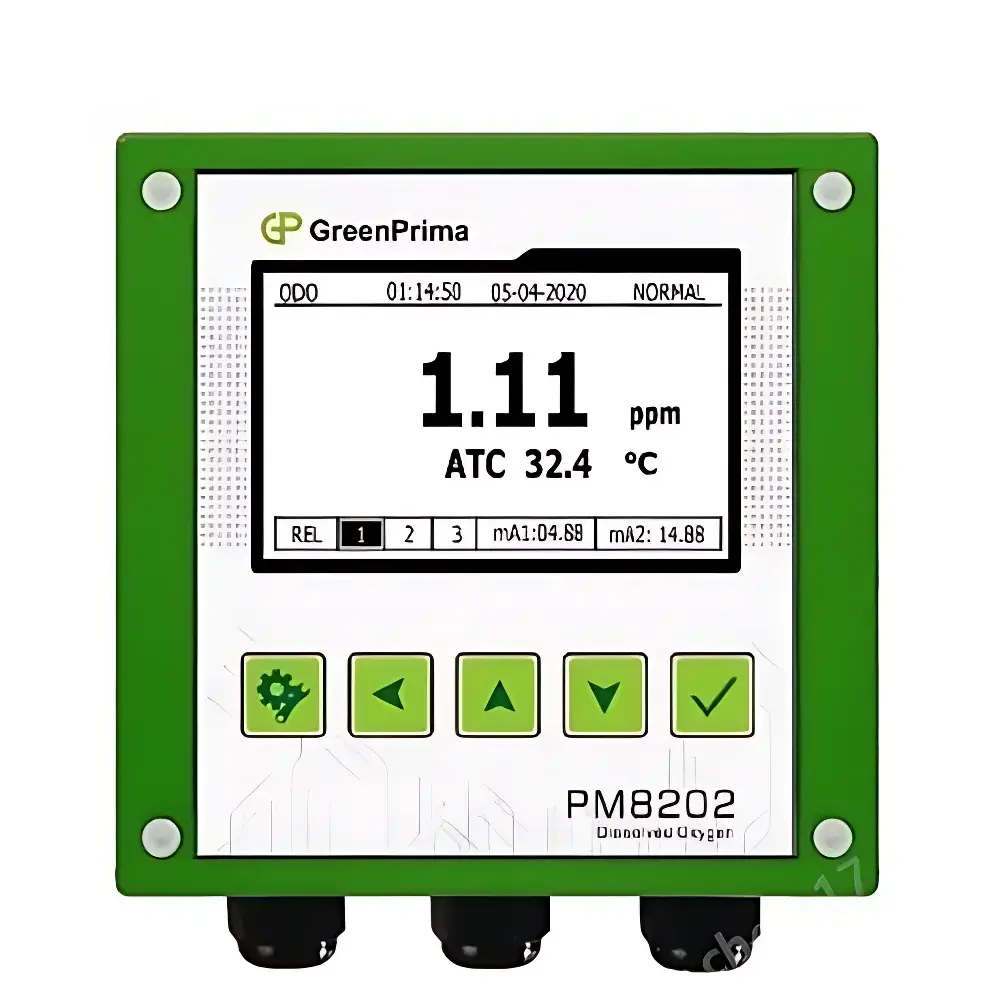
GreenPrima PM8202D Online Polarographic Dissolved Oxygen Analyzer
| Brand | GreenPrima |
|---|---|
| Origin | United Kingdom |
| Manufacturer Type | Original Equipment Manufacturer (OEM) |
| Product Category | Imported Instrument |
| Model | PM8202D |
| Instrument Type | Online |
| Measurement Principle | Electrochemical Polarographic Probe |
| Measurement Range | 0.00–20.00 ppm / 0.00–200.00 ppb |
| Accuracy | ±0.02 ppm / ±0.02 ppb |
| Resolution | 0.001 ppm / 0.01 ppb |
| Temperature Compensation | –10 to 130 °C (manual/automatic, NTC10K or PT1000 sensor compatible) |
| Operating Temperature | –10 to 70.0 °C |
| Storage Temperature | –20 to 70.0 °C |
| Display | Backlit large-dot-matrix LCD (bilingual: English/Chinese) |
| Data Storage | 600,000 records |
| Power Supply | 90–260 VAC, 50/60 Hz or optional 24 VDC |
| Analog Outputs | Two isolated 4–20 mA outputs (max. loop resistance 500 Ω, accuracy 0.1% FS, configurable for DO or temperature) |
| Communication | RS485 Modbus RTU |
| Cleaning Cycle Control | Adjustable interval (0.1–1000 h) and duration (1–1000 s) |
| Alarm Outputs | Two independent Hi/Lo relay outputs (5 A / 250 VAC / 30 VDC, hysteresis adjustable) |
| Enclosure Rating | IP65 |
| Mounting Options | Wall-mount, panel-mount, pipe-mount |
| Dimensions | 144 × 144 × 108 mm |
| Panel Cutout | 138 × 138 mm |
| Weight | 0.87 kg |
Overview
The GreenPrima PM8202D Online Polarographic Dissolved Oxygen Analyzer is an industrial-grade continuous monitoring system engineered for high-reliability dissolved oxygen (DO) measurement in aqueous process streams. It operates on the classical Clark-type polarographic principle: a noble metal cathode (typically gold or platinum) and a silver/silver chloride reference anode are immersed in an electrolyte-filled chamber, separated from the sample by a gas-permeable polytetrafluoroethylene (PTFE) membrane. Molecular oxygen diffuses through the membrane and is electrochemically reduced at the cathode surface, generating a current linearly proportional to the partial pressure of dissolved O₂. This analog signal is conditioned, temperature-compensated, and converted into a stable digital DO concentration reading in ppm or ppb. Designed for unattended operation in demanding environments—including wastewater treatment plants, municipal water distribution systems, aquaculture recirculation units, pharmaceutical bioreactors, and chemical process cooling loops—the PM8202D delivers long-term stability with minimal drift, supported by field-replaceable electrodes (e.g., Bsens420, Bsens430, Bsens440) and user-serviceable electrolyte refills.
Key Features
- IP65-rated fully sealed enclosure with corrosion-resistant housing—rated for outdoor and high-humidity installations
- Large backlit dot-matrix LCD display showing real-time DO concentration, temperature, system time, and relay status
- Polarographic sensor architecture with durable, fouling-resistant PTFE oxygen-permeable membranes
- Two isolated 4–20 mA analog outputs configurable for DO value, temperature, or diagnostic status
- RS485 interface compliant with Modbus RTU protocol for seamless integration into SCADA, DCS, or PLC-based control networks
- Configurable automatic cleaning cycle—interval (0.1–1000 h) and duration (1–1000 s) programmable via front panel or remote command
- Dual independent relay outputs with adjustable hysteresis for alarm, control, or actuation functions (5 A @ 250 VAC / 30 VDC)
- Multi-mode temperature compensation using either integrated NTC10K or external PT1000 sensors across –10 °C to 130 °C range
- Secure access control with password-protected configuration menu to prevent unauthorized parameter changes
- Flexible mechanical installation—supports wall-mount, panel-cutout (138 × 138 mm), and direct pipe-thread mounting
Sample Compatibility & Compliance
The PM8202D is validated for continuous use in low-to-moderate conductivity aqueous matrices including raw and treated wastewater, potable water, recirculating aquaculture systems (RAS), fermentation broths, boiler feedwater, and pharmaceutical process water (PW/WFI). Its polarographic probe design tolerates suspended solids and organic loading better than optical (luminescence-based) sensors, though periodic membrane cleaning and electrolyte replenishment remain essential maintenance requirements per ISO 5814:2012 and ASTM D888–22 guidelines. The instrument complies with electromagnetic compatibility standards EN 61326-1 (industrial environment) and safety standard EN 61010-1. While not intrinsically safe, its 24 VDC option enables deployment in non-hazardous classified zones. Data integrity features—including timestamped logging of 600,000 records—support GLP-aligned operational traceability; however, full 21 CFR Part 11 compliance requires external audit-trail software integration.
Software & Data Management
All configuration, calibration, and diagnostic operations are performed locally via the intuitive bilingual (English/Chinese) menu-driven interface. No proprietary PC software is required for basic commissioning. However, the Modbus RTU protocol enables bidirectional communication with third-party supervisory systems for centralized data aggregation, trend analysis, and automated reporting. Logged data includes DO value, temperature, timestamp, and event flags (e.g., cleaning activation, alarm trigger, sensor fault). Internal memory retains records during power loss, and data export is achievable via Modbus polling or manual USB transfer (if equipped with optional interface module). Firmware updates are delivered via secure binary file upload through the RS485 port under authenticated session control.
Applications
- Real-time DO monitoring in activated sludge basins and anaerobic digesters for optimized aeration control and energy savings
- Continuous verification of dissolved oxygen saturation in municipal drinking water storage tanks and distribution networks
- Process-critical DO control in aerobic bioreactors used for monoclonal antibody production or vaccine fermentation
- Early detection of hypoxia events in intensive fish farming and shrimp hatchery recirculation systems
- Monitoring oxygen ingress in high-purity steam condensate return lines within power generation facilities
- Quality assurance of purified water (PW) and water for injection (WFI) in regulated pharmaceutical manufacturing suites
FAQ
What electrode models are compatible with the PM8202D controller?
The PM8202D supports GreenPrima’s Bsens420, Bsens430, and Bsens440 polarographic DO probes—differing in membrane thickness, cathode geometry, and pressure rating for varied flow and fouling conditions.
Is temperature compensation automatic or manual?
Both modes are supported: automatic compensation using integrated NTC10K or externally connected PT1000 sensors, or manual offset entry for fixed-temperature applications.
How often must the electrolyte be replaced?
Typical replacement intervals range from 3 to 6 months under continuous operation; frequency increases with elevated temperature, high salinity, or particulate load—verified via zero-point stability checks.
Can the 4–20 mA outputs be assigned to different parameters?
Yes—each output is independently configurable for DO concentration, temperature, or system status (e.g., cleaning active, sensor fault).
Does the unit support HART communication?
No—the PM8202D uses RS485 Modbus RTU exclusively; HART capability is not implemented in this model series.
Related Products







