
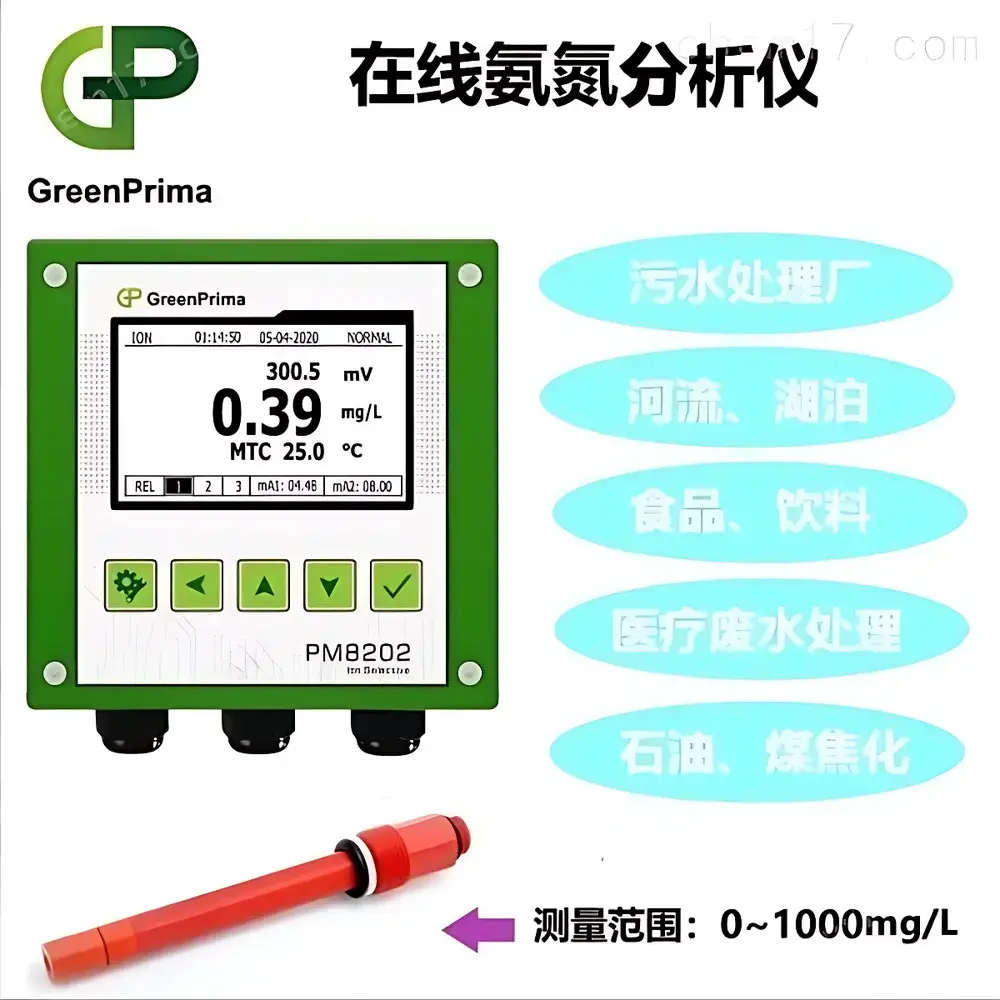
GreenPrima PM8202I Online Ammonia Nitrogen Analyzer
| Brand | GreenPrima |
|---|---|
| Origin | United Kingdom |
| Manufacturer Type | Manufacturer |
| Origin Category | Imported |
| Model | PM8202I |
| Instrument Type | Online |
| Measurement Principle | Ion-Selective Electrode (ISE) Method |
| Measurement Range | 0.00–20,000 ppm |
| Accuracy | ±0.01 ppm / ±0.1 ppm / ±1 ppm (depending on range) |
| Resolution | 0.01 / 0.1 / 1 ppm |
| Temperature Compensation | –10 to +130 °C (manual/automatic |
| Operating Temperature | –10 to +70.0 °C |
| Storage Temperature | –20 to +70.0 °C |
| Display | Backlit large-dot-matrix LCD |
| Language | English & Chinese |
| Data Storage | 600,000 records |
| Power Supply | 90–260 VAC, 50/60 Hz or optional 24 VDC |
| Output | Two isolated 4–20 mA outputs (max. loop resistance 500 Ω, accuracy 0.1% FS), configurable for measurement value or temperature |
| Communication | RS485 Modbus RTU |
| Cleaning Control | Adjustable cleaning interval (0.1–1000 h) and duration (1–1000 s) |
| Alarm Outputs | Two independent Hi/Lo relay alarms (5 A / 250 VAC / 30 VDC), with hysteresis setting |
| Enclosure Rating | IP65 |
| Mounting Options | Wall-mounted, pipe-mounted, panel-mounted |
| Dimensions (W×H×D) | 144 × 144 × 108 mm |
| Cut-out Size | 138 × 138 mm |
| Weight | 0.87 kg |
Overview
The GreenPrima PM8202I Online Ammonia Nitrogen Analyzer is an industrial-grade, continuous monitoring system engineered for real-time quantification of ammonia nitrogen (NH₃–N) in aqueous matrices using the ion-selective electrode (ISE) principle. Unlike colorimetric or photometric methods, the ISE-based approach provides direct electrochemical detection of ammonium ions (NH₄⁺) in solution, enabling rapid response (< 60 seconds typical T₉₀), minimal reagent consumption, and stable long-term operation in unattended environments. The analyzer integrates a dedicated Bsens730 ammonia-selective electrode with a robust, microprocessor-controlled transmitter unit—designed for deployment in municipal water supply networks, wastewater treatment plants, industrial process streams, and recirculating aquaculture systems where regulatory compliance and operational continuity are critical.
Key Features
- IP65-rated sealed enclosure with corrosion-resistant housing, suitable for indoor and outdoor installation in humid or chemically aggressive environments;
- Intuitive dual-language (English/Chinese) user interface with backlit dot-matrix LCD display showing real-time NH₃–N concentration, temperature, timestamp, relay status, and diagnostic indicators;
- High-resolution measurement capability across three selectable ranges (0.00–10 ppm, 0.0–200 ppm, 0–20,000 ppm), with corresponding resolution and accuracy optimized per range;
- Automatic or manual temperature compensation using either NTC30K or PT1000 sensors, ensuring measurement stability across wide thermal gradients (–10 to +130 °C);
- Two fully isolated 4–20 mA analog outputs configurable for primary measurement, temperature, or alarm status—with 0.1% full-scale accuracy and 500 Ω maximum loop resistance;
- RS485 Modbus RTU communication protocol for seamless integration into SCADA, DCS, or PLC-based control architectures;
- Programmable cleaning cycle (interval: 0.1–1000 hours; duration: 1–1000 seconds) to maintain electrode surface integrity in fouling-prone applications;
- Dual independent relay outputs with adjustable high/low setpoints and user-defined hysteresis, rated for 5 A at 250 VAC or 30 VDC;
- Built-in data logger storing up to 600,000 timestamped records (concentration, temperature, calibration events, alarms);
- Password-protected configuration mode prevents unauthorized parameter modification, supporting audit-ready operational discipline.
Sample Compatibility & Compliance
The PM8202I is validated for use in potable water, secondary and tertiary effluent, cooling tower water, boiler feedwater, and low-salinity industrial process streams. It operates effectively within pH 4–9 and conductivity < 20 mS/cm. While not requiring hazardous reagents, optimal performance necessitates periodic calibration (typically daily or per ISO 5667-3 recommendations) using certified NH₄⁺ standard solutions traceable to NIST. The instrument complies with electromagnetic compatibility (EMC) requirements per EN 61326-1 and safety standards per EN 61010-1. Its architecture supports implementation under GLP and GMP frameworks, with configurable audit trails for calibration history, alarm logs, and configuration changes—facilitating alignment with EPA Method 350.1, ISO 14911, and EU Drinking Water Directive (2020/2184) monitoring protocols.
Software & Data Management
Data retrieval is supported via local USB export or remote interrogation through Modbus RTU. Logged entries include date/time stamps, measured NH₃–N value, temperature, electrode millivolt reading, calibration status, and relay activation flags. All stored records are time-synchronized and non-volatile. Configuration parameters—including range selection, alarm thresholds, cleaning schedules, and communication settings—are retained during power loss. Firmware updates are performed via secure USB interface, with version rollback capability. No cloud dependency or proprietary software is required; integration with third-party historian platforms (e.g., Ignition, Siemens Desigo, Honeywell Experion) is achieved natively through standard Modbus register mapping.
Applications
- Continuous monitoring of ammonia breakthrough in granular activated carbon (GAC) or ion exchange units;
- Effluent compliance verification at wastewater treatment plant discharge points per national NPDES or equivalent permits;
- Early detection of nitrification failure in biological nutrient removal (BNR) processes;
- Feedwater quality assurance in steam generation systems to prevent copper and steel corrosion;
- Real-time control of chloramination dosing in drinking water distribution networks;
- Process optimization in semiconductor rinse water recycling loops and pharmaceutical clean-in-place (CIP) validation.
FAQ
What calibration standards are recommended for the Bsens730 ammonia electrode?
Certified ammonium chloride (NH₄Cl) solutions traceable to NIST or equivalent national metrology institutes, prepared in matrix-matched background electrolyte (e.g., 0.1 M KCl) to minimize liquid junction potential errors.
Can the PM8202I operate in seawater or high-salinity brines?
No—electrode selectivity degrades significantly above ~10,000 µS/cm conductivity; alternative optical or gas-diffusion amperometric analyzers are advised for marine or desalination applications.
Is FDA 21 CFR Part 11 compliance supported?
The device itself does not implement electronic signatures or audit trail encryption; however, its Modbus data output and logging structure enable compliant data capture when integrated with validated third-party LIMS or MES systems meeting Part 11 requirements.
How often should the Bsens730 electrode be replaced?
Typical service life is 12–18 months under continuous operation with regular cleaning and calibration; replacement intervals depend on sample fouling potential and storage conditions.
Does the analyzer support automatic zero and span calibration?
No—calibration requires manual introduction of standard solutions; automated calibration is not implemented due to ISE drift characteristics and the absence of internal reagent delivery mechanisms.
Related Products







