
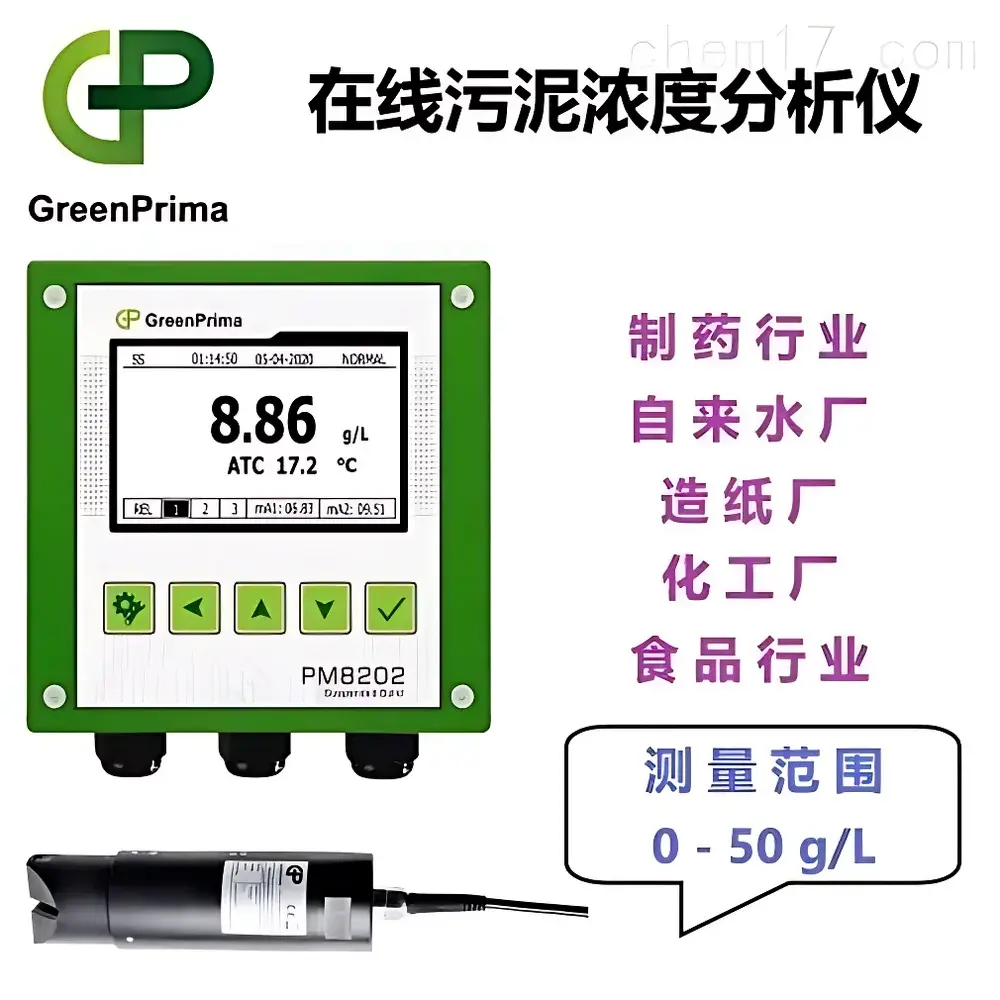
GreenPrima PM8202S Sludge Concentration Analyzer
| Brand | GreenPrima |
|---|---|
| Origin | United Kingdom |
| Manufacturer Type | Original Equipment Manufacturer (OEM) |
| Product Category | Imported Instrument |
| Model | PM8202S |
| Price | Upon Request |
Overview
The GreenPrima PM8202S Sludge Concentration Analyzer is a robust, industrial-grade online monitoring instrument engineered for continuous measurement of suspended solids concentration—commonly referred to as mixed liquor suspended solids (MLSS) or sludge concentration—in municipal and industrial wastewater treatment processes. It operates on the principle of fluorescence-based optical detection, where an excitation light source (typically in the UV–visible range) induces fluorescence emission from organic particulates in the slurry. The intensity of the emitted signal correlates linearly with particle concentration under calibrated conditions, enabling stable, color-independent quantification up to 50 g/L. Unlike turbidimetric or absorption-based methods, fluorescence technology minimizes interference from water color, dye contaminants, or dissolved chromophores—critical for reliable operation in chemically complex effluents and digester streams. The system comprises a wall-mountable or panel-mountable controller unit and the submersible Bsens550 sludge concentration sensor, designed for direct insertion into aeration tanks, clarifiers, return sludge lines, or thickening basins.
Key Features
- IP65-rated fully sealed housing with corrosion-resistant enclosure, suitable for humid, chemically aggressive plant environments;
- Backlit high-contrast dot-matrix LCD display showing real-time sludge concentration (g/L), temperature (°C), relay status, and system diagnostics;
- Bilingual (English/Chinese) intuitive menu navigation with password-protected configuration access and one-touch factory reset;
- Dual isolated 4–20 mA analog outputs (0.1% FS accuracy, max. loop resistance 500 Ω), configurable for concentration and/or temperature signals;
- RS485 interface supporting Modbus RTU protocol for integration into SCADA, DCS, or PLC-based process control systems;
- Programmable automatic cleaning output: cleaning interval adjustable from 0.1 to 1000 hours; cleaning duration from 1 to 1000 seconds;
- Two independent high/low alarm relays (5 A / 250 VAC / 30 VDC), each with user-defined setpoints and hysteresis adjustment;
- Integrated temperature compensation using NTC30K or PT1000 sensors (manual or auto mode), covering full operational range from –10 °C to +130 °C;
- Onboard data logging capacity of up to 600,000 records with timestamp, supporting trend analysis and compliance reporting.
Sample Compatibility & Compliance
The PM8202S is validated for use in activated sludge, membrane bioreactor (MBR), sequencing batch reactor (SBR), and anaerobic digestion applications. Its optical design accommodates heterogeneous suspensions containing biological flocs, inert solids, and filamentous organisms without requiring sample dilution or filtration. The sensor head is compatible with standard 1½” NPT or DIN 11851 sanitary fittings and supports both immersion and flow-through installation configurations. The analyzer meets IEC 61000-6-2 (immunity) and IEC 61000-6-4 (emissions) standards. Its firmware architecture supports audit-trail-enabled configuration changes, aligning with GLP and GMP documentation requirements for wastewater utilities operating under regulatory oversight (e.g., EPA NPDES permit holders or EU Urban Wastewater Treatment Directive compliance frameworks).
Software & Data Management
Data export is supported via USB flash drive (FAT32 formatted) or RS485 serial dump, generating CSV-formatted files compatible with Excel, MATLAB, or LIMS platforms. Optional GreenPrima Insight™ PC software enables remote calibration validation, historical curve overlay, alarm event filtering, and report generation (PDF/Excel). All configuration changes—including sensor calibration coefficients, alarm thresholds, and communication parameters—are logged with user ID, timestamp, and pre-/post-change values—satisfying traceability needs under ISO/IEC 17025 and FDA 21 CFR Part 11 (when used in regulated pharmaceutical wastewater streams).
Applications
- Real-time MLSS monitoring in aerobic and anoxic zones to optimize aeration energy consumption;
- Return activated sludge (RAS) concentration control for clarifier hydraulic loading management;
- Waste activated sludge (WAS) flow balancing based on solids inventory;
- Thickener feed consistency monitoring to prevent overloading and polymer dosing optimization;
- Biological nutrient removal (BNR) process feedback control in denitrification and phosphorus uptake zones;
- Performance verification during commissioning and routine maintenance of secondary treatment units.
FAQ
What measurement principle does the PM8202S employ, and why is it preferred over turbidity-based methods?
It uses fluorescence intensity detection, which is insensitive to background coloration and provides superior specificity for organic suspended solids compared to broad-spectrum light attenuation.
Can the sensor be installed directly in a pipe without bypass or flow cell?
Yes—the Bsens550 probe supports inline mounting with standard process connections and includes pressure-rated sealing for continuous operation at line pressures up to 6 bar.
Is temperature compensation mandatory, and how is it implemented?
Temperature compensation is enabled by default and supports both manual input and automatic sensing via integrated NTC30K or PT1000 elements across the full –10 °C to +130 °C range.
Does the device support digital calibration traceability per ISO 17025 requirements?
Yes—calibration history, including date, operator ID, standard reference values, and deviation logs, is stored internally and exportable for laboratory accreditation audits.
What power supply options are available for field deployment?
Dual-input capability: universal AC input (90–260 VAC, 50/60 Hz) or optional 24 VDC auxiliary supply for hazardous-area or UPS-backed installations.







