
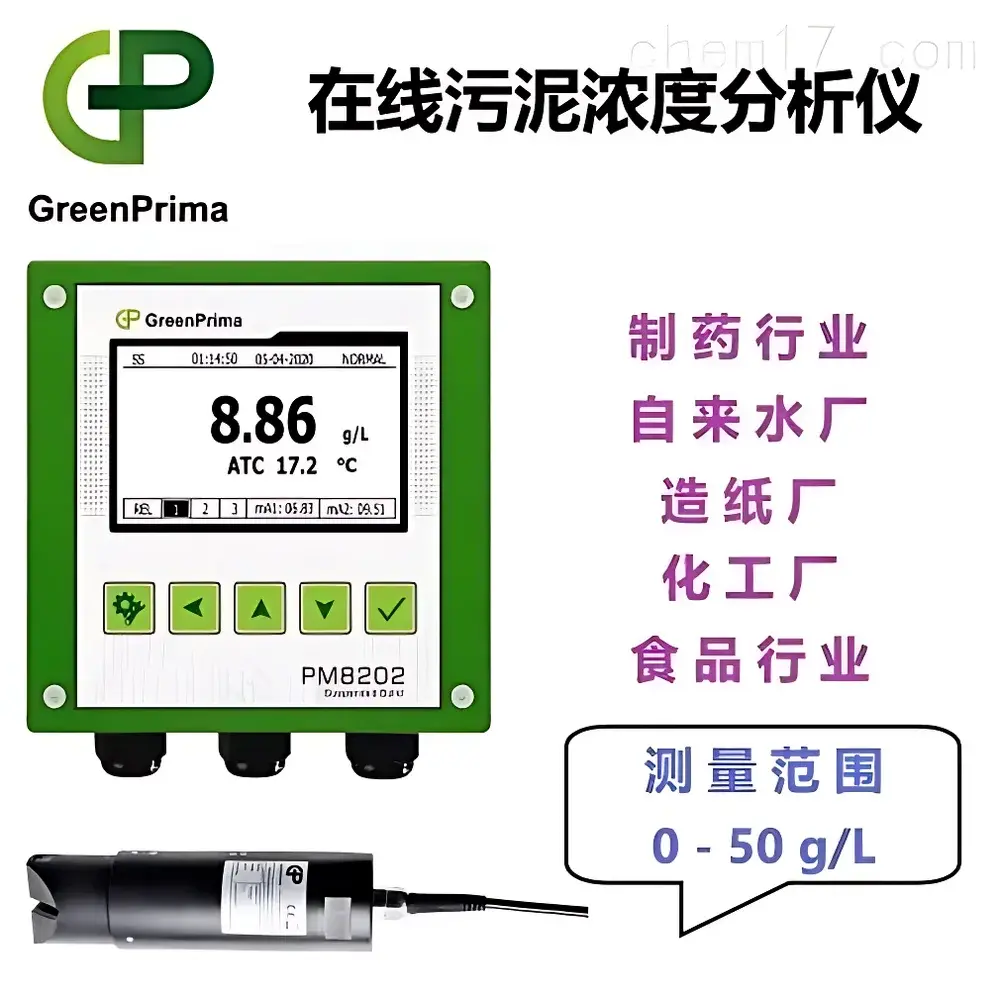
GreenPrima PM8202S Sludge Concentration Analyzer
| Brand | GreenPrima |
|---|---|
| Origin | United Kingdom |
| Manufacturer Type | Original Equipment Manufacturer (OEM) |
| Product Category | Imported Instrument |
| Model | PM8202S |
| Measurement Range | 0–50 g/L |
| Resolution | 0.01 g/L (sludge), 0.1 °C (temperature) |
| Temperature Compensation | -10 to 130 °C, manual/automatic (NTC30K or PT1000 sensor) |
| Operating Temperature | -10 to 70.0 °C |
| Storage Temperature | -20 to 70.0 °C |
| Display | Backlit large-dot-matrix LCD |
| Language Support | English & Chinese |
| Data Storage Capacity | 600,000 records |
| Power Supply | 90–260 VAC, 50/60 Hz or optional 24 VDC |
| Output Signals | Two isolated 4–20 mA outputs (max. loop resistance 500 Ω, accuracy ±0.1% FS), configurable for sludge concentration and temperature |
| Communication | RS485 Modbus RTU |
| Cleaning Control Output | Adjustable cleaning interval (0.1–1000 h), adjustable duration (1–1000 s) |
| Alarm Outputs | Two independent Hi/Lo relay alarms (5 A / 250 VAC / 30 VDC), with hysteresis setting |
| Enclosure Rating | IP65 |
| Mounting Options | Wall-mount, pipe-mount, panel-mount |
| Dimensions (W×H×D) | 144 × 144 × 108 mm |
| Panel Cutout | 138 × 138 mm |
| Weight | 0.87 kg |
Overview
The GreenPrima PM8202S Sludge Concentration Analyzer is an industrial-grade online turbidity-based analyzer engineered for continuous, real-time monitoring of suspended solids concentration in activated sludge, return activated sludge (RAS), and waste activated sludge (WAS) streams within municipal and industrial wastewater treatment plants. It operates on the principle of fluorescence quenching—where a pulsed blue LED excites a proprietary fluorophore embedded in the BSENS550 sludge sensing electrode; emitted fluorescence intensity correlates inversely with particle density in the medium. This optical method eliminates interference from water color, dye leaching, or background absorbance—critical advantages over traditional white-light turbidimetry in chemically complex effluents. The system comprises a rugged controller unit and a submersible, flow-through optical probe calibrated for stable performance across a wide dynamic range (0–50 g/L total suspended solids, TSS). Designed for long-term deployment in aggressive wet environments, it supports fully automatic temperature compensation (–10 to 130 °C) via integrated NTC30K or PT1000 thermistors, ensuring measurement integrity under varying thermal conditions typical of bioreactors and clarifiers.
Key Features
- IP65-rated sealed enclosure with corrosion-resistant housing, suitable for indoor control rooms and semi-outdoor process areas
- Backlit high-contrast dot-matrix LCD display showing real-time sludge concentration (g/L), process temperature (°C), relay status, and system diagnostics
- Dual isolated 4–20 mA analog outputs—configurable independently for primary sludge signal and compensated temperature output—with full-scale accuracy of ±0.1% FS
- RS485 Modbus RTU interface for seamless integration into SCADA, DCS, or PLC-based plant automation systems (slave address and baud rate user-configurable)
- Programmable relay-driven cleaning cycle: cleaning interval adjustable from 0.1 to 1000 hours; cleaning duration from 1 to 1000 seconds—enabling adaptive fouling mitigation without manual intervention
- Two independent alarm relays with programmable high/low thresholds and user-defined hysteresis—compliant with IEC 61508 functional safety prerequisites for basic process alerts
- Secure operational access via multi-level password protection; one-button factory reset ensures rapid recovery after configuration errors
- Onboard non-volatile memory stores up to 600,000 timestamped data points (concentration + temperature), supporting trend analysis and regulatory audit trails
Sample Compatibility & Compliance
The PM8202S is validated for use in mixed liquor suspended solids (MLSS), return activated sludge (RAS), and digester feed streams containing organic particulates, bioflocs, and inorganic precipitates typical of biological nutrient removal (BNR) and membrane bioreactor (MBR) processes. It meets EN 61326-1 (EMC for industrial environments) and EN 61000-6-2/-4 compliance requirements. While not certified to ISO 5667-2 or ASTM D3977 for laboratory-grade TSS quantification, its field calibration protocol aligns with EPA Method 160.1 principles for continuous sludge monitoring. The instrument supports GLP-aligned data logging—including operator ID tagging (via optional external keypad), time/date stamping, and change history—facilitating traceability in regulated wastewater facilities operating under EU Urban Wastewater Treatment Directive (91/271/EEC) or U.S. Clean Water Act enforcement frameworks.
Software & Data Management
Data acquisition and configuration are managed locally via the front-panel interface; no proprietary PC software is required for routine operation. All logged measurements include UTC timestamps and are stored in a circular buffer with overwrite protection for critical events. Export is supported via Modbus register polling—enabling direct ingestion into historian platforms such as Siemens Desigo CC, Honeywell Experion PKS, or open-source tools like Grafana + InfluxDB. Configuration parameters—including calibration offsets, alarm setpoints, cleaning schedules, and language selection—are retained in EEPROM and survive power loss. Audit logs record all parameter modifications, including timestamp, user level, and changed value—meeting baseline expectations for FDA 21 CFR Part 11 Annex 11 electronic record integrity where local validation protocols are implemented.
Applications
- Real-time optimization of dissolved oxygen (DO) control in aerobic zones by correlating MLSS trends with respiration rates
- Automated sludge wasting control in secondary clarifiers using RAS concentration feedback loops
- Early detection of bulking events or filamentous overgrowth through abnormal sludge density drift
- Performance verification of membrane filtration units in MBR systems via permeate turbidity correlation
- Commissioning support and long-term performance benchmarking during plant upgrades or capacity expansions
- Regulatory reporting compliance for sludge blanket depth and solids inventory management per ISO 22966 and EN 14855
FAQ
What optical principle does the PM8202S use to measure sludge concentration?
It employs fluorescence quenching technology—not absorption or scattering—making it insensitive to colored dissolved organic matter (CDOM) and ideal for dyed or tannin-rich industrial effluents.
Can the BSENS550 electrode be installed in pressurized pipelines?
Yes—the probe is rated for continuous submersion at static pressures up to 6 bar and features a threaded NPT 3/4″ connection compatible with ANSI Class 150 flanged or sanitary tri-clamp adapters.
Is third-party calibration certification available?
GreenPrima provides NIST-traceable factory calibration certificates upon request; field recalibration is performed using standardized kaolin or polystyrene latex suspensions per ISO 7027 guidelines.
Does the system support HART communication?
No—the PM8202S uses RS485 Modbus RTU exclusively; HART is not implemented to maintain signal integrity in electrically noisy plant environments.
How often does the optical window require manual cleaning?
With enabled auto-cleaning, intervals typically extend to 3–6 months depending on sludge rheology; visual inspection is recommended quarterly per ISO 17025 preventive maintenance schedules.
Related Products







