
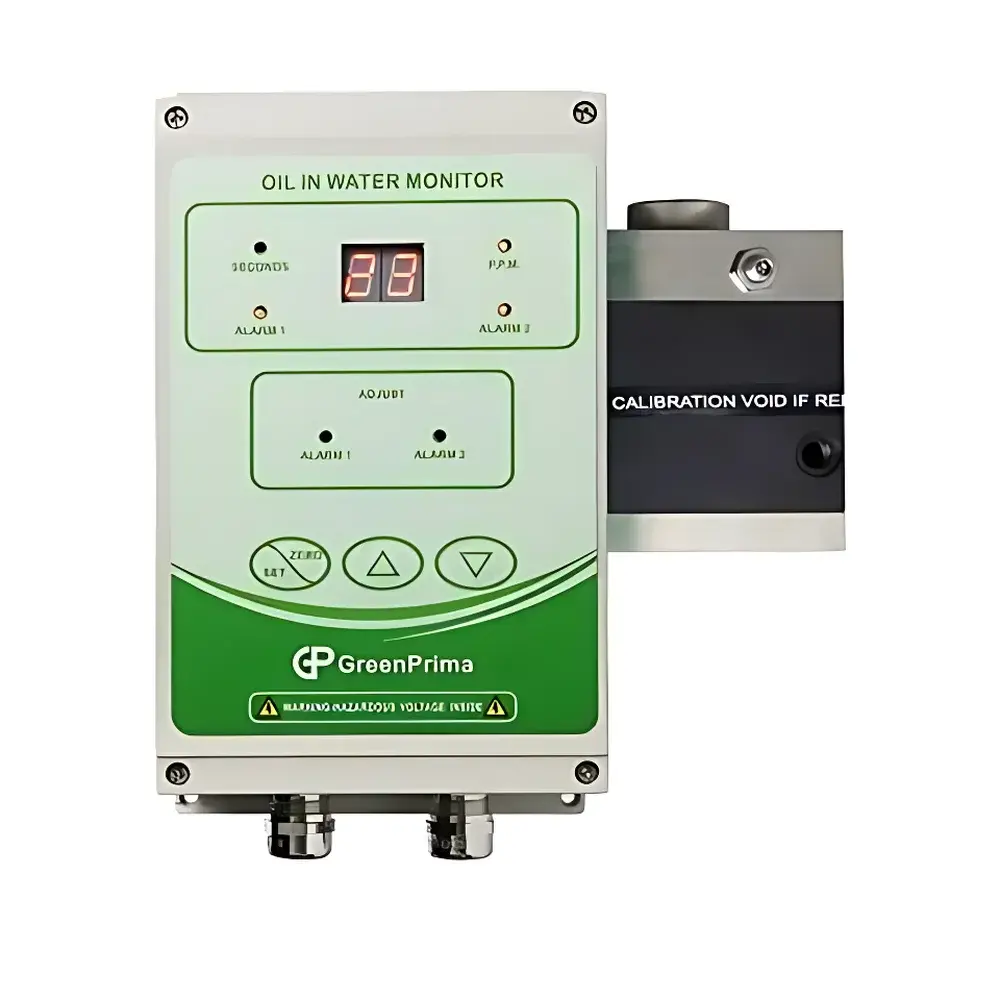
GreenPrima PRO CON7000 Online Oil-in-Water Analyzer
| Brand | GreenPrima |
|---|---|
| Origin | UK |
| Manufacturer Type | Manufacturer |
| Origin Category | Imported |
| Model | PRO CON7000 |
| Instrument Type | Online |
| Measurement Principle | Fluorescence-based Optical Detection (Non-extractive, In-situ) |
| Measurement Range | 0–99 ppm |
| Accuracy | ±2 ppm |
| Alarm Setpoint Range | 1–98 ppm (adjustable) |
| Alarm 1 Delay | 0–60 s (adjustable) |
| Alarm 2 Delay | 10–240 s (adjustable) |
| Display | 240×128 pixel touchscreen |
| Analog Outputs | 0/4–20 mA (min. load 820 Ω), 0–5 V / 1–5 V DC (min. load 50 kΩ) |
| Sample Temp. | 1–40 °C |
| Sample Flow Rate | 0.1–2 L/min |
| Sample Pressure | 0.1–10 bar |
| Ambient Temp. | 1–60 °C |
| Humidity | ≤90% RH at 55 °C |
| Enclosure Rating | IP55 |
| Electrical Safety | EN 61010-1 / IEC 61010-1, Overvoltage Category II |
| Weight | 2.25 kg |
| Dimensions (H×W×D) | 215 × 242 × 73 mm |
| Power Supply | 230 V / 115 V AC or 24 V AC |
| Max. Power Consumption | 10 VA |
Overview
The GreenPrima PRO CON7000 Online Oil-in-Water Analyzer is an industrial-grade, fluorescence-based optical instrument engineered for continuous, real-time monitoring of hydrocarbon contamination in aqueous streams. It operates on the principle of selective ultraviolet (UV) excitation and native fluorescence detection—exploiting the intrinsic fluorescent properties of aromatic hydrocarbons (e.g., mineral oils, diesel, lubricants) without requiring reagents, extraction solvents, or sample pre-concentration. This non-invasive, in-situ measurement approach ensures high specificity for free and dispersed oil phases while minimizing interference from turbidity, suspended solids (<50 ppm), or common water treatment chemicals. Designed for rugged deployment in cooling water circuits, condensate return lines, and effluent discharge points, the PRO CON7000 delivers stable baseline performance across temperature fluctuations (1–40 °C sample range) and variable flow conditions (0.1–2 L/min), making it suitable for integration into existing plant DCS/SCADA architectures via standardized analog and relay interfaces.
Key Features
- Automatic self-calibration and drift compensation—eliminates routine manual recalibration and reduces long-term maintenance overhead.
- Configurable measurement intervals (1–3600 seconds) to match process dynamics and data logging requirements.
- Intuitive 240×128-pixel resistive touchscreen interface with multilingual menu navigation (English, German, French, Spanish).
- Dual independently programmable alarm outputs with adjustable time delays (Alarm 1: 0–60 s; Alarm 2: 10–240 s) for staged response protocols (e.g., alert → isolation → shutdown).
- Isolated 0/4–20 mA analog output (820 Ω min. load) and dual DC voltage outputs (0–5 V and 1–5 V, 50 kΩ min. load) compliant with ISA-50.00.01 signal standards.
- IP55-rated enclosure with external M12/IP65-rated terminal block for relay connections (8 A @ 240 V AC), enabling direct interfacing with PLCs, solenoid valves, or audible/visual alarm panels.
- External start/stop trigger capability via dry-contact input—supports synchronization with pump cycles or scheduled maintenance windows.
- USB port (optional) for local firmware updates and offline data export (CSV format) compatible with Excel, LabVIEW, and PI System import workflows.
Sample Compatibility & Compliance
The PRO CON7000 is validated for use with freshwater, boiler condensate, engine cooling water, and low-salinity industrial wastewater (TDS < 5,000 ppm). It maintains measurement integrity in the presence of iron oxide particulates, calcium carbonate scaling precursors, and typical biocide residuals (e.g., glutaraldehyde, THPS), provided sample turbidity remains below 100 NTU and suspended solids do not exceed 50 ppm. The analyzer complies with EN 61010-1:2010 for electrical safety and conforms to IEC 61000-6-2 (immunity) and IEC 61000-6-4 (emissions) for industrial electromagnetic environments. While not certified to ISO 8573-2 or ASTM D7622 for laboratory-grade quantification, its ±2 ppm accuracy and repeatability (RSD < 3.5% over 72 h) meet operational thresholds defined in CEN/TS 15739 and EPA Method 1664B for screening-level oil-in-water compliance monitoring in non-regulated discharge applications.
Software & Data Management
No proprietary software installation is required for basic operation; all configuration, calibration history, and alarm logs are stored locally in non-volatile memory and accessible via the front-panel interface. Optional GreenPrima DataLink™ software (Windows-based) enables remote configuration, trend visualization (hourly/daily/weekly averages), and audit-trail generation—including timestamped operator actions, alarm acknowledgments, and sensor diagnostic events. Data export supports CSV and XML formats, facilitating ingestion into LIMS platforms compliant with FDA 21 CFR Part 11 (when deployed with user authentication and electronic signature modules). All analog outputs retain full traceability through internal calibration certificates (NIST-traceable reference standards applied during factory verification).
Applications
- Real-time leak detection in lubricating oil coolers servicing gas turbines and steam generators.
- Condensate purity assurance in thermal power plants—monitoring for hydrocarbon ingress prior to boiler feedwater reintroduction.
- Pre-discharge screening of treated industrial wastewater from refineries, petrochemical units, and metalworking facilities.
- Groundwater remediation site monitoring—tracking plume migration of light non-aqueous phase liquids (LNAPLs) in extraction well effluents.
- Marine engine room bilge water monitoring per IMO MEPC.107(49) guidelines (as a pre-treatment screening tool).
FAQ
Does the PRO CON7000 require daily calibration or zero-point adjustment?
No. The instrument performs automatic zero tracking and gain stabilization during standby cycles. Factory calibration remains valid for ≥12 months under normal operating conditions; annual verification against certified mineral oil standards is recommended for audit readiness.
Can it measure emulsified oil or only free-phase hydrocarbons?
It detects fluorescent aromatic compounds present in both free and mechanically emulsified oil phases (e.g., diesel-in-water emulsions stabilized by surfactants), but does not quantify chemically emulsified or dissolved fractions (e.g., BTEX). For total petroleum hydrocarbons (TPH), pairing with GC-FID analysis is advised.
Is the analyzer suitable for seawater applications?
Not without modification. High chloride content (>10,000 ppm) accelerates quartz window fouling and quenches fluorescence signal intensity. A custom seawater-compatible flow cell with sapphire optics and enhanced cleaning protocol is available as a configured option (PRO CON7000-SW).
What maintenance intervals are recommended?
Quarterly visual inspection of the optical path window and flow cell; semi-annual verification of analog output linearity using a precision loop calibrator; annual replacement of the UV LED source (rated lifetime: 25,000 hours).
How is sensor fouling mitigated in high-solids environments?
The flow cell incorporates a self-cleaning geometry and supports optional pulsed air or low-pressure water backflush (0.5–2 bar) triggered automatically upon differential pressure threshold exceedance—integrated via auxiliary digital input.







