
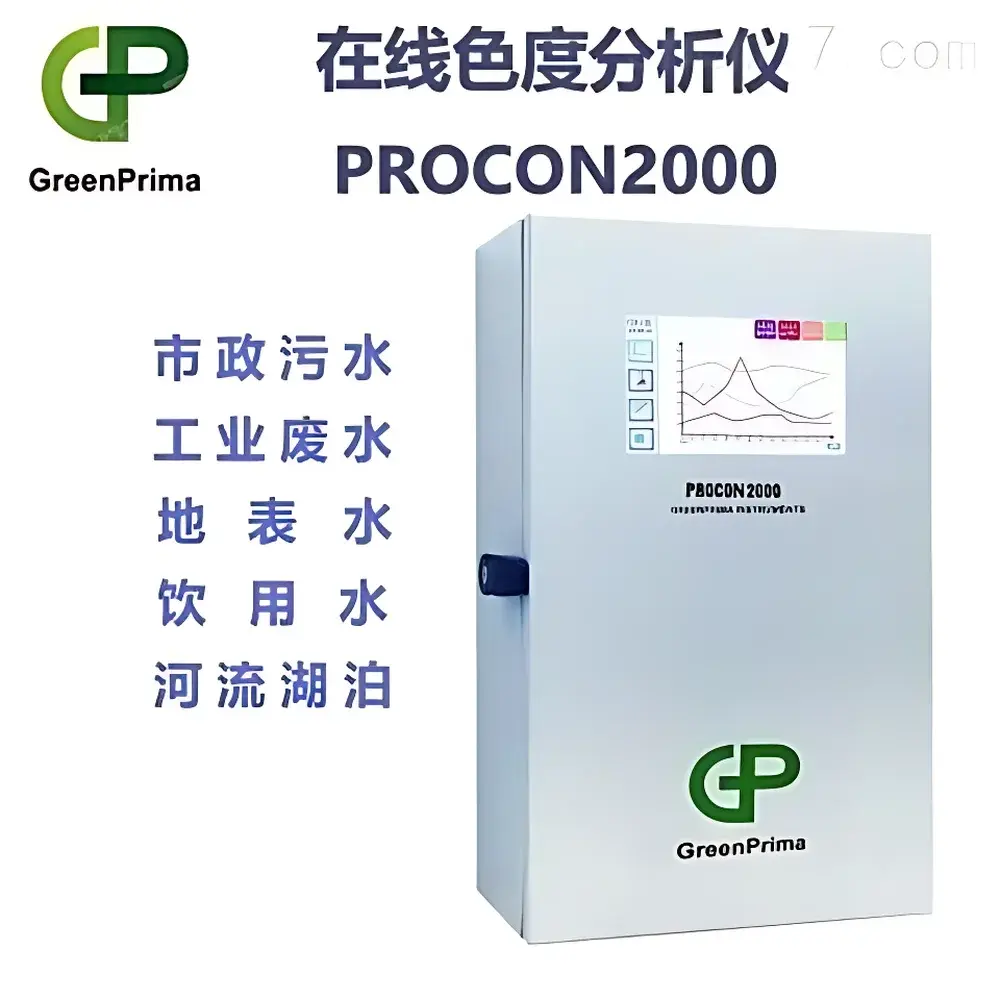
GreenPrima PRO CO N2000 Online Colorimeter for Pulp & Paper Mills
| Brand | GreenPrima |
|---|---|
| Origin | UK |
| Manufacturer Type | Original Equipment Manufacturer (OEM) |
| Import Status | Imported |
| Model | PRO CO N2000 |
| Pricing | Upon Request |
Overview
The GreenPrima PRO CO N2000 is a high-precision, fully automated online colorimeter engineered specifically for continuous color monitoring in pulp and paper manufacturing environments. It operates on the principle of UV-VIS absorption spectroscopy—measuring absorbance across the visible and near-ultraviolet spectrum (typically 350–750 nm)—to quantify color intensity in aqueous process streams according to standardized Pt-Co (Platinum-Cobalt) units. Unlike subjective visual assessment or offline lab-based spectrophotometry, the PRO CO N2000 delivers real-time, traceable, and metrologically robust color data directly within production lines, effluent channels, or whitewater recirculation systems. Its design addresses the unique challenges of paper mill applications: high turbidity variability, suspended fiber interference, and stringent hygiene requirements. The instrument complies with ISO 7887:2011 (Water quality — Examination of colour), ASTM D1209 (Standard Test Method for Color of Clear Liquids), and supports regulatory alignment with EU Water Framework Directive (WFD) reporting criteria and US EPA Method 8026 for color-related wastewater compliance.
Key Features
- True zero-reagent operation: No chemical reagents, no consumables, and zero secondary waste generation—fully aligned with ISO 14001 environmental management systems.
- Multi-mode measurement flexibility: Supports manual spot-checking, programmable time-based sampling (e.g., every 15 min), and event-triggered acquisition (e.g., post-bleach stage).
- Optical path integrity: Quartz flow cell with integrated self-cleaning mechanism; optical surfaces resist fouling from lignin residues, fillers, or coating pigments.
- Long-term stability: LED light source rated for >10 years (L70 lifetime); factory-calibrated photodetector array ensures drift-free performance under continuous operation.
- Intelligent diagnostics: Embedded self-validation routines include automatic zero-point correction using deionized water reference, air-gap blank compensation, and spectral baseline normalization.
- Rugged industrial housing: IP65-rated stainless steel (1.4435 / SS316L) enclosure with ATEX Zone 1/2 optional certification for installation in hazardous areas adjacent to pulping or chemical dosing zones.
Sample Compatibility & Compliance
The PRO CO N2000 accommodates a broad range of process-relevant matrices without sample dilution or filtration: raw pulp stock suspensions (up to 1.5% consistency), bleach plant filtrates, whitewater, alkaline cleaners, and final effluent streams. Its flow-through quartz cell (wetted materials: fused silica, PP, FPM fluoroelastomer, 316L SS, borosilicate glass) ensures chemical resistance to chlorine dioxide, hydrogen peroxide, sodium hydroxide (up to 5 mol/L), and sulfuric acid (up to 1 mol/L). All measurements conform to GLP-compliant data integrity standards: full audit trail logging (timestamped calibration events, cleaning cycles, alarm triggers), electronic signatures, and 21 CFR Part 11-ready firmware architecture. Calibration traceability is maintained to NIST-traceable Pt-Co standard solutions (certified reference materials SRM 2135a/b).
Software & Data Management
The embedded controller features an 8.5″ TFT capacitive touchscreen (800 × 480 resolution) with intuitive HMI navigation optimized for glove-compatible operation in industrial control rooms. Local data storage (8 GB SD card) retains ≥12 months of second-resolution color trends, diagnostic logs, and maintenance history. Data export is supported via USB mass storage or Modbus RTU over RS485 (slave mode default; master mode configurable). Analog 4–20 mA output provides seamless integration into DCS/SCADA platforms (e.g., Siemens Desigo, Honeywell Experion, ABB 800xA) with ≤0.5% FS linearity error. Optional cloud connectivity enables remote firmware updates, predictive maintenance alerts (based on lamp intensity decay rate), and centralized fleet monitoring across multi-site mill operations.
Applications
- Real-time optimization of bleaching sequences (EOP, D0, P stages) by correlating color shift with kappa number trends.
- Monitoring color carryover in closed-loop whitewater systems to prevent brightness loss in sheet formation.
- Regulatory compliance tracking for discharge permits (e.g., EPA NPDES, UK EA General Binding Rules) requiring Pt-Co limits ≤500 units.
- Quality assurance during coating pigment dispersion—detecting premature flocculation via subtle hue deviation.
- Validation of activated carbon or ozone treatment efficiency in tertiary effluent polishing.
FAQ
Does the PRO CO N2000 require periodic recalibration with certified standards?
Yes—annual traceable recalibration using NIST-certified Pt-Co reference solutions is recommended for ISO/IEC 17025 accredited labs; field verification with factory-supplied check standards is performed quarterly.
Can it measure samples with high turbidity or fiber content?
Yes—the optical design incorporates dual-beam referencing and spectral deconvolution algorithms to distinguish true chromophore absorbance from Mie scattering effects up to 200 NTU.
Is the flow cell compatible with CIP/SIP protocols?
Yes—rated for 2 bar max pressure and 50°C continuous operation; validated for caustic soda (2% w/w, 80°C, 30 min) and nitric acid (1% v/v) cleaning cycles.
How is sensor drift compensated during extended unattended operation?
Through synchronized air-blank and water-blank measurements prior to each sample cycle, plus real-time LED intensity monitoring with automatic gain adjustment.
What cybersecurity provisions are included for network-connected units?
Modbus communication uses configurable slave ID and CRC-16 checksum; no open TCP/IP stack—remote access requires authenticated VPN tunneling per IEC 62443-3-3 Level 1 guidelines.





