
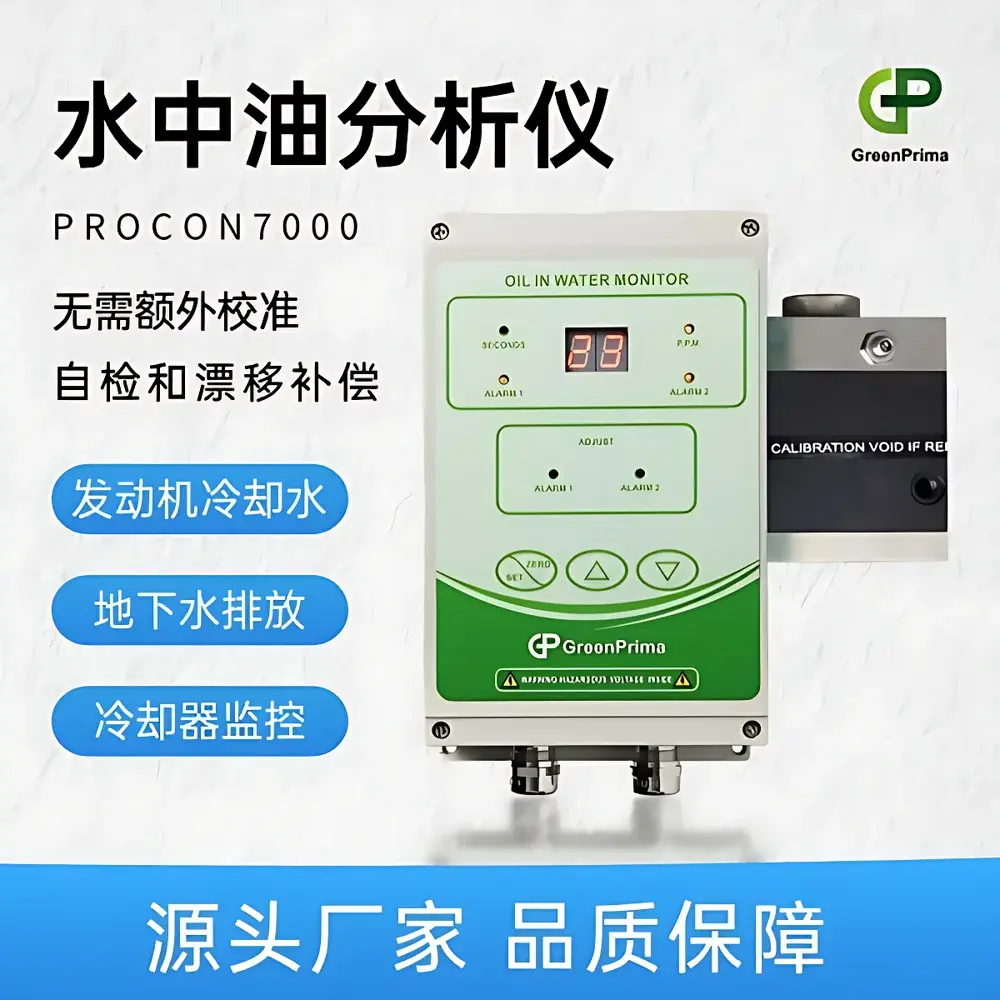
GreenPrima PROCO N70 00 Online Oil-in-Water Analyzer
| Brand | GreenPrima |
|---|---|
| Origin | United Kingdom |
| Manufacturer Type | Manufacturer |
| Origin Category | Imported |
| Model | PROCO N70 00 |
| Instrument Type | Online |
| Measurement Principle | Fluorescence-based optical detection (non-extractive, in-situ) |
| Measurement Range | 0–99 ppm |
| Accuracy | ±2 ppm |
| Alarm Setpoint Range | 1–98 ppm (adjustable) |
| Alarm Delay 1 | 0–60 s (adjustable) |
| Alarm Delay 2 | 10–240 s (adjustable) |
| Display | 240 × 128 pixel resistive touchscreen |
| Analog Outputs | 0/4–20 mA (min. load 820 Ω), 0–5 V / 1–5 V DC (min. load 50 kΩ) |
| Sample Flow Rate | 0.1–2 L/min |
| Sample Temperature | 1–40 °C |
| Sample Pressure | 0.1–10 bar |
| Ambient Operating Temperature | 1–60 °C |
| Relative Humidity | ≤90% RH at 55 °C |
| Enclosure Rating | IP55 |
| Electrical Safety | EN 61010-1, IEC 664 Category II |
| Power Supply | 230 V / 115 V AC or 24 V AC |
| Max. Power Consumption | 10 VA |
| Weight | 2.25 kg |
| Dimensions (H×W×D) | 215 × 242 × 73 mm |
Overview
The GreenPrima PROCO N70 00 Online Oil-in-Water Analyzer is an industrial-grade, fluorescence-based optical instrument engineered for continuous, real-time monitoring of hydrocarbon contamination in aqueous streams. Designed specifically for regulatory compliance and process integrity assurance, it employs a non-invasive, extractive-free measurement principle—exciting hydrocarbon molecules with UV light and quantifying emitted fluorescence intensity in the visible spectrum. This method delivers high selectivity for mineral oils, diesel, lubricants, and other aromatic hydrocarbons while minimizing interference from turbidity, suspended solids (<50 ppm), or dissolved organic matter. The analyzer is deployed directly in-line or via sidestream sampling loops, making it suitable for unattended operation in demanding environments such as groundwater discharge points, power plant condensate systems, refinery cooling circuits, and municipal wastewater outfalls.
Key Features
- Automatic self-calibration and drift compensation—eliminates routine manual calibration and ensures long-term measurement stability.
- Configurable dual-stage alarm system with independently adjustable setpoints (1–98 ppm), delay timers (0–60 s for Alarm 1; 10–240 s for Alarm 2), and relay outputs rated at 8 A @ 240 V AC.
- Intuitive 240 × 128 pixel resistive touchscreen interface supporting multilingual menu navigation and real-time parameter adjustment.
- Flexible analog output configuration: isolated 0/4–20 mA (min. 820 Ω load) and voltage outputs (0–5 V / 1–5 V DC, min. 50 kΩ load) compatible with PLCs, DCS, and SCADA systems.
- Programmable analysis interval (1–3600 seconds) and external start/stop control via dry-contact inputs—enabling synchronization with pump cycles or sampling events.
- IP55-rated enclosure with industrial-grade electrical protection (EN 61010-1, IEC 664 Category II) for reliable operation in humid, dusty, or temperature-variable field installations.
- USB data logging port (optional accessory) supports CSV export of time-stamped concentration values, alarm status, and diagnostic logs for audit-ready recordkeeping.
Sample Compatibility & Compliance
The PROCO N70 00 is validated for use with low-turbidity water matrices including boiler condensate, freshwater cooling circuits, treated groundwater effluent, and pre-treated industrial wastewater. It tolerates particulate loads up to 50 ppm without filter clogging when operated within specified flow (0.1–2 L/min) and pressure (0.1–10 bar) windows. While not intended for raw sewage or highly emulsified oil-water mixtures, its robust optical path design maintains signal fidelity across varying sample temperatures (1–40 °C). The analyzer meets functional requirements aligned with ISO 9377-2 (water quality — determination of hydrocarbon oil — part 2: fluorescence method) and supports environmental reporting under EU Water Framework Directive (2000/60/EC) and U.S. EPA Method 1664B (where fluorescence screening precedes confirmatory gravimetric analysis). Its analog outputs and timestamped digital logs are structured to support GLP-compliant data integrity frameworks.
Software & Data Management
No embedded operating system or proprietary software runtime is required—the device operates autonomously via firmware-controlled logic. All configuration, calibration history, alarm logs, and real-time readings are accessible locally via the front-panel touchscreen. For integration into centralized monitoring infrastructures, the 4–20 mA output provides linear proportional response to oil concentration (0–99 ppm), traceable to factory-set reference standards. Optional USB data capture enables periodic retrieval of chronological datasets—including measurement timestamps, alarm triggers, relay state changes, and internal sensor diagnostics—for import into LIMS or environmental compliance databases. Audit trails comply with basic ALCOA+ principles (Attributable, Legible, Contemporaneous, Original, Accurate), though full 21 CFR Part 11 compliance requires external validation of the host data acquisition system.
Applications
- Groundwater discharge monitoring at remediation sites and landfill leachate collection points.
- Continuous surveillance of lubricating oil leakage in steam turbine and diesel engine cooling circuits.
- Early-warning detection of heat exchanger tube failure in power generation and petrochemical facilities.
- Compliance verification for NPDES permits and local wastewater discharge consent limits.
- Process optimization in closed-loop freshwater systems where oil ingress compromises corrosion inhibition or heat transfer efficiency.
FAQ
Does the PROCO N70 00 require reagent addition or consumable sensors?
No—it uses solid-state UV-LED excitation and photodiode detection with no reagents, membranes, or replaceable optical cells.
Can it distinguish between diesel, lubricating oil, and crude oil fractions?
It provides total hydrocarbon equivalent (THE) response calibrated against mineral oil standards; speciation requires GC-MS or FTIR confirmation.
Is temperature compensation applied automatically?
Yes—integrated PT100 sensor feeds real-time correction coefficients to the fluorescence algorithm across the 1–40 °C operational range.
What maintenance intervals are recommended?
Optical window cleaning every 3–6 months depending on fouling potential; no scheduled component replacement is specified within the 5-year design life.
How is calibration verified in the field?
Using certified mineral oil standard solutions (e.g., ISO 8769 traceable) introduced via the sample inlet—no hardware adjustment is needed beyond software verification.







