
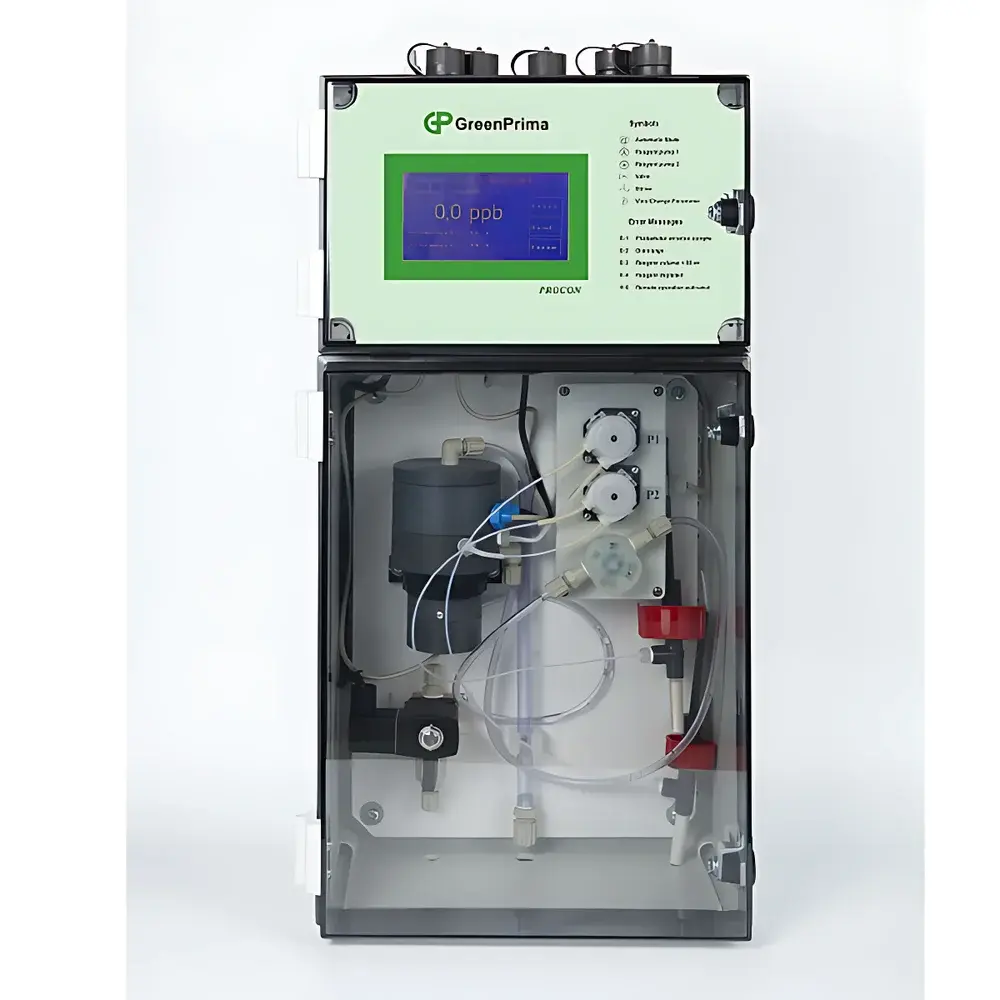
GreenPrima PROCON 6000 Online Silica Analyzer
| Brand | GreenPrima |
|---|---|
| Origin | UK |
| Manufacturer Type | Manufacturer |
| Origin Category | Imported |
| Model | PROCON 6000 |
| Instrument Type | Online Analyzer |
| Measurement Method | Photometric (reduction of molybdate to form β-molybdo-silicic acid complex) |
| SiO₂ Range Options | 1–100 ppb |
| Resolution | 0.1 ppb |
| Accuracy | ±2% of full scale |
| Repeatability | 0.5 ppb |
| Zero Stability | Auto-adjusting |
| Analysis Cycle | 13 min (including rinse) |
| Dimensions (H×W×D) | 640 × 315 × 190 mm |
| Display | 240 × 128 pixel monochrome touchscreen |
| Analog Output | 0/4–20 mA, max. load 500 Ω |
| Relay Outputs | 3 × SPDT, dry contact, 230 V AC / 3 A (alarm, limit, analysis) + 1 × remote start/stop (18 V DC, ~4 mA) |
| Environmental Operating Temp. | 5–45 °C |
| Power Supply | 110–230 V AC, 50/60 Hz |
| Enclosure Rating | IP65 |
| Power Consumption | ~16 VA |
Overview
The GreenPrima PROCON 6000 Online Silica Analyzer is a dedicated photometric instrument engineered for continuous, real-time quantification of dissolved silica (SiO₂) in ultra-pure water streams. It operates on the principle of molybdate-based colorimetry: soluble silicate ions react with ammonium molybdate under acidic conditions to form heteropoly acids, which are subsequently reduced to yield a stable blue-colored β-molybdo-silicic acid complex. The intensity of this chromophore—measured at 815 nm via a precision photodiode system—is directly proportional to the silica concentration. Designed for mission-critical applications where trace-level silica contamination compromises thermal efficiency or material integrity, the PROCON 6000 delivers high reproducibility and minimal operator intervention across demanding industrial environments.
Key Features
- Fully automated measurement cycle—including sample aspiration, line flushing, reagent dosing (molybdate + reducing agent), reaction timing, optical detection, and waste discharge—controlled by an embedded microprocessor.
- Three selectable measurement ranges (1–100 ppb, 4–999 ppb, 0.02–3 ppm SiO₂) optimized for distinct process stages: boiler feedwater, condensate return, and steam purity verification.
- Integrated 240 × 128 pixel monochrome touchscreen interface enabling intuitive navigation, parameter configuration, real-time trend visualization, and event log review without external PC dependency.
- Auto-zero compensation and drift correction algorithms eliminate routine manual calibration; baseline stability is maintained through periodic blank referencing using deionized water.
- Configurable analog output (0/4–20 mA) with user-defined scaling, supporting integration into DCS, PLC, or SCADA systems for centralized process monitoring and control.
- IP65-rated enclosure ensures reliable operation in humid, chemically exposed utility corridors and turbine halls; all wetted parts (PFA tubing, ceramic valves, quartz flow cell) resist corrosion and minimize adsorption artifacts.
- Flexible analysis scheduling: fixed interval (13–99 minutes), external trigger via dry-contact input, or on-demand initiation—enabling synchronization with blowdown cycles or maintenance windows.
Sample Compatibility & Compliance
The PROCON 6000 is validated for use with low-conductivity (< 1 µS/cm), particle-free water samples typical of power plant demineralized water, nuclear primary coolant loops, pharmaceutical WFI (Water for Injection), and semiconductor UPW (Ultra-Pure Water) distribution systems. Its measurement methodology aligns with ASTM D859 (Standard Test Method for Silica in Water) and ISO 10523 (Water quality — Determination of pH), while its operational architecture supports compliance with FDA 21 CFR Part 11 requirements when paired with audit-trail-enabled data logging software. The analyzer meets IEC 61000-6-2 (EMC immunity) and IEC 61000-6-4 (EMC emissions) standards, and its relay outputs conform to EN 61810-1 for safety-rated control functions.
Software & Data Management
Data acquisition and system diagnostics are managed via the onboard firmware, which stores up to 30 days of compressed historical data (timestamped SiO₂ values, alarm states, maintenance events) in non-volatile memory. Optional USB data export (via standard USB-A port) enables offline analysis in CSV format compatible with Excel, MATLAB, or LIMS platforms. Remote diagnostics and firmware updates can be performed over Modbus RTU (RS-485) or optional Ethernet module (PROCON-ETH6000 add-on). Audit trails record all parameter changes, calibration resets, and user logins—essential for GLP/GMP-regulated environments requiring full traceability.
Applications
- Thermal power generation: Continuous monitoring of silica breakthrough in ion exchange resin beds, condensate polishing units, and drum boiler feedwater to prevent silica deposition on turbine blades and heat exchanger surfaces.
- Nuclear facilities: Detection of leached silica from concrete containment structures or steam generator tube degradation in PWR/BWR secondary circuits.
- Pharmaceutical manufacturing: Verification of silica levels in purified water (PW) and water-for-injection (WFI) systems per USP and EU Annex 1 requirements.
- Microelectronics fabrication: Control of silica ingress in UPW loops supplying wafer cleaning tools—where sub-ppb excursions risk gate oxide defects and yield loss.
- Chemical and petrochemical plants: Monitoring silica carryover in high-pressure steam networks used for catalyst regeneration and process heating.
FAQ
What is the minimum detectable silica concentration?
The lowest measurable range is 1–100 ppb SiO₂, with a resolution of 0.1 ppb and repeatability of ±0.5 ppb under controlled laboratory conditions.
Does the analyzer require daily maintenance or reagent replenishment?
Reagents (ammonium molybdate and reducing agent) are supplied in sealed, pre-calibrated cartridges with shelf life indicators; typical replacement interval is 3–6 months depending on analysis frequency and ambient temperature.
Can the PROCON 6000 interface with existing plant DCS systems?
Yes—via isolated 4–20 mA analog output (HART-compatible upon request) or Modbus RTU over RS-485; engineering support includes loop diagram validation and signal mapping documentation.
Is the optical measurement cell susceptible to fouling in high-silica feedwater?
No—the flow cell employs laminar flow design and automatic high-pressure rinse cycles between analyses; quartz optical path length is optimized to reduce particulate interference and maintain signal linearity.
How is zero-point drift addressed during extended unattended operation?
The system performs automatic zero-reference checks every 24 hours using certified deionized water, adjusting baseline offset in real time without interrupting scheduled measurements.
Related Products







