
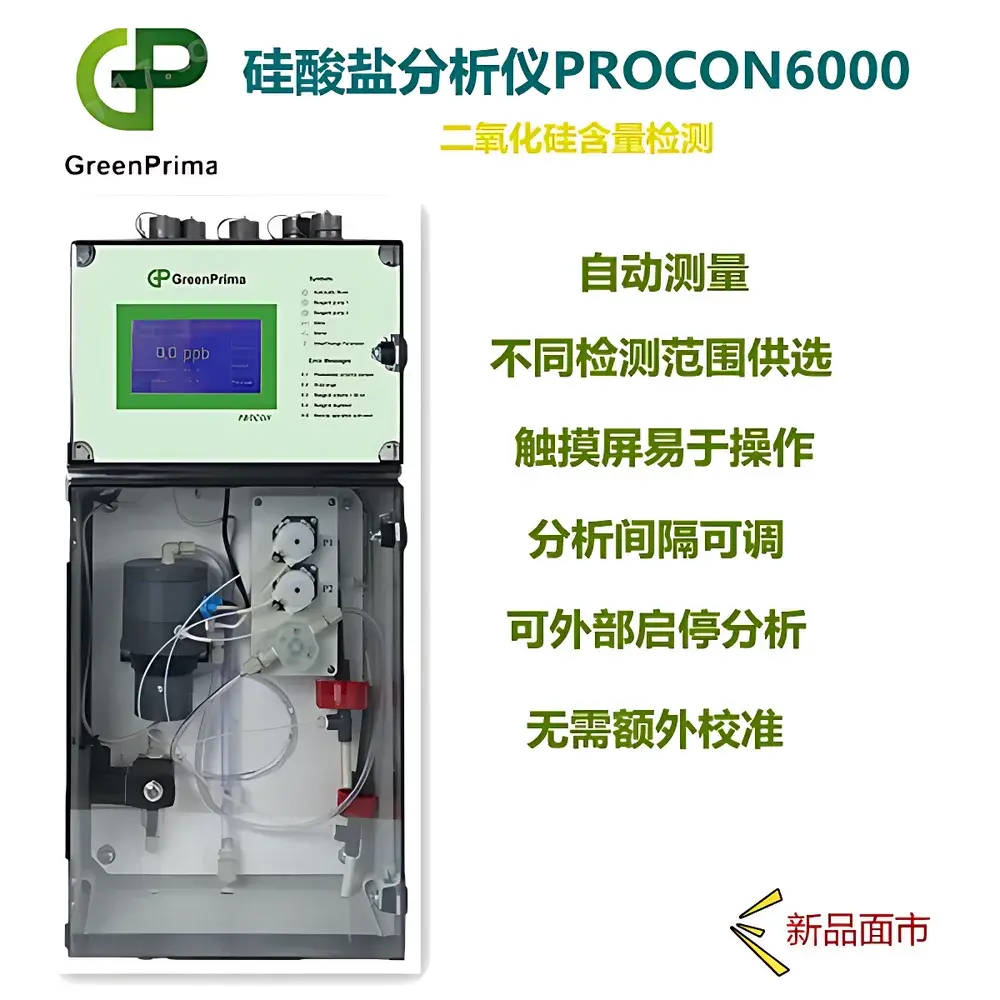
GreenPrima PROCON 6000 Online Silicate Analyzer for Semiconductor Industry
| Brand | GreenPrima |
|---|---|
| Origin | United Kingdom |
| Manufacturer Type | Original Equipment Manufacturer (OEM) |
| Product Category | Imported Instrument |
| Model | PROCON 6000 |
| Instrument Type | Online Analyzer |
| Measurement Principle | Photometric Analysis of Reduced β-Molybdo-Silicic Acid Complex |
| Measuring Range | 1–100 ppb / 4–999 ppb / 0.02–3 ppm SiO₂ |
| Resolution | 0.1 ppb / 1 ppb / 0.01 ppm |
| Accuracy | ±2% of full scale |
| Repeatability | ±0.5 ppb / ±4 ppb / ±0.02 ppm |
| Zero Stability | Auto-zero compensation |
| Cycle Time | 13 min (standard), adjustable 1–99 min or externally triggered |
| Display | 240×128 pixel touchscreen LCD |
| Output | 0/4–20 mA (max. 500 Ω load), USB data logging (optional) |
| Environmental Operating Temperature | 5–45 °C |
| Power Supply | 110–230 V AC, 50/60 Hz |
| Enclosure Rating | IP65 |
| Power Consumption | ~16 VA |
| Dimensions (H×W×D) | 640×315×190 mm |
| Relay Outputs | 3× zero-potential contacts (230 V AC, 3 A), 1× remote control input (18 V DC, ~4 mA) |
Overview
The GreenPrima PROCON 6000 Online Silicate Analyzer is a dedicated photometric instrumentation system engineered for continuous, real-time quantification of dissolved silica (SiO₂) in ultrapure water streams critical to semiconductor manufacturing and high-integrity thermal power generation. It operates on the established molybdate-reactive silica method: soluble silicate ions react with ammonium molybdate under acidic conditions to form heteropoly acids, which are subsequently reduced—typically using ascorbic acid—to yield a stable, intensely colored β-molybdo-silicic acid complex. The absorbance of this complex at 815 nm is linearly proportional to silica concentration within defined dynamic ranges. Unlike offline lab-based ICP-MS or colorimetric benchtop analyzers, the PROCON 6000 integrates sample conditioning, reagent metering, reaction timing, optical detection, and data processing into a single self-contained platform—enabling unattended operation with minimal operator intervention and eliminating manual sampling errors. Its design prioritizes metrological integrity in sub-ppb regimes where even trace silica can nucleate deposits on turbine blades or compromise gate oxide integrity in wafer fabrication.
Key Features
- Automated photometric measurement cycle including integrated self-diagnostic routines, automatic zero-point drift compensation, and scheduled internal flushing to prevent carryover and biofilm formation
- Three selectable measurement ranges (1–100 ppb, 4–999 ppb, 0.02–3 ppm SiO₂) optimized for distinct process points—from boiler feedwater to steam condensate and UPW polishing loops
- Industrial-grade 240×128 pixel resistive touchscreen interface with intuitive menu navigation, multilingual support, and embedded event log
- Configurable alarm thresholds and limit setpoints with visual and relay-based notification (3 independent zero-potential relays rated 230 V AC / 3 A)
- Programmable 0/4–20 mA analog output with galvanic isolation and configurable scaling, compliant with standard DCS/SCADA signal acquisition protocols
- Optional USB data export capability for raw absorbance values, calibration history, maintenance logs, and diagnostic timestamps—facilitating audit-ready record retention
- Adjustable analysis interval (13 min nominal; user-defined from 1 to 99 minutes) and external start/stop triggering via dry-contact input (18 V DC, ~4 mA)
- No routine manual recalibration required due to built-in reference channel monitoring and temperature-compensated LED light source stability
- IP65-rated enclosure with rear-mounted ring-terminal connections for power, analog outputs, relay contacts, and remote control—suitable for installation in utility corridors or cleanroom support areas
Sample Compatibility & Compliance
The PROCON 6000 is validated for use with low-conductivity (<0.1 µS/cm), particle-free water samples typical of semiconductor ultrapure water (UPW) distribution systems, nuclear/thermal power plant demineralized water circuits, and pharmaceutical purified water (PW) loops. It complies with ASTM D859 (Standard Test Method for Silica in Water) and ISO 10523 (Water quality — Determination of pH), and its operational methodology aligns with USP and EP 2.2.38 guidelines for conductivity and impurity monitoring in pharmaceutical water systems. All wetted components—including peristaltic pump tubing, reaction chamber, and flow cells—are constructed from PFA, PTFE, and quartz to ensure chemical inertness and eliminate leachable silica contamination. The analyzer supports GLP/GMP-aligned data integrity through time-stamped event logging and non-volatile memory retention—even during power interruption.
Software & Data Management
Embedded firmware provides closed-loop control of fluidic sequencing, photometric gain adjustment, temperature normalization (via NTC sensor in optical path), and adaptive baseline correction. Data output includes real-time SiO₂ concentration, absorbance at 815 nm, temperature, system status flags (e.g., “low reagent”, “clog warning”, “lamp aging”), and cycle completion timestamp. The optional USB interface exports CSV-formatted records compatible with LIMS integration and statistical process control (SPC) platforms such as Minitab or JMP. Audit trail functionality meets FDA 21 CFR Part 11 requirements when paired with secure user authentication (admin/operator roles) and electronic signature-capable external software—though native electronic signatures are not implemented onboard. Firmware updates are performed via USB without requiring factory service.
Applications
- Real-time monitoring of silica breakthrough in mixed-bed ion exchange polishers feeding semiconductor fab UPW skids
- Steam purity assurance in combined-cycle and nuclear power plants—detecting silica carryover from drum boilers or once-through steam generators
- Validation of reverse osmosis and electrodeionization performance in pharmaceutical water-for-injection (WFI) production systems
- Leak detection in heat recovery steam generators (HRSGs) via silica spike analysis in condensate return lines
- Process qualification and routine surveillance in specialty chemical synthesis where silica catalysis or fouling must be excluded
FAQ
What is the minimum detectable silica concentration?
The lower detection limit is 1 ppb SiO₂ in the low-range configuration, with resolution of 0.1 ppb.
Does the analyzer require daily maintenance?
No daily maintenance is required; routine tasks include quarterly reagent replacement and semi-annual inspection of peristaltic pump tubing and optical windows.
Can it operate in a Class 100 cleanroom environment?
Yes—the IP65 enclosure and absence of internal fans or volatile organic components permit wall-mount installation in cleanroom utility zones, provided ambient temperature remains within 5–45 °C.
Is the measurement affected by phosphate or other interfering anions?
Phosphate interference is minimized through optimized acidification pH control and selective reduction kinetics; cross-sensitivity is <±0.5 ppb SiO₂ equivalent per 100 ppb PO₄³⁻ under typical UPW matrices.
How is calibration verified in situ?
Calibration integrity is confirmed using factory-prepared traceable standard solutions (NIST-traceable SiO₂ in dilute HCl matrix); verification frequency follows site-specific PQ protocols—typically quarterly or after major component replacement.







