
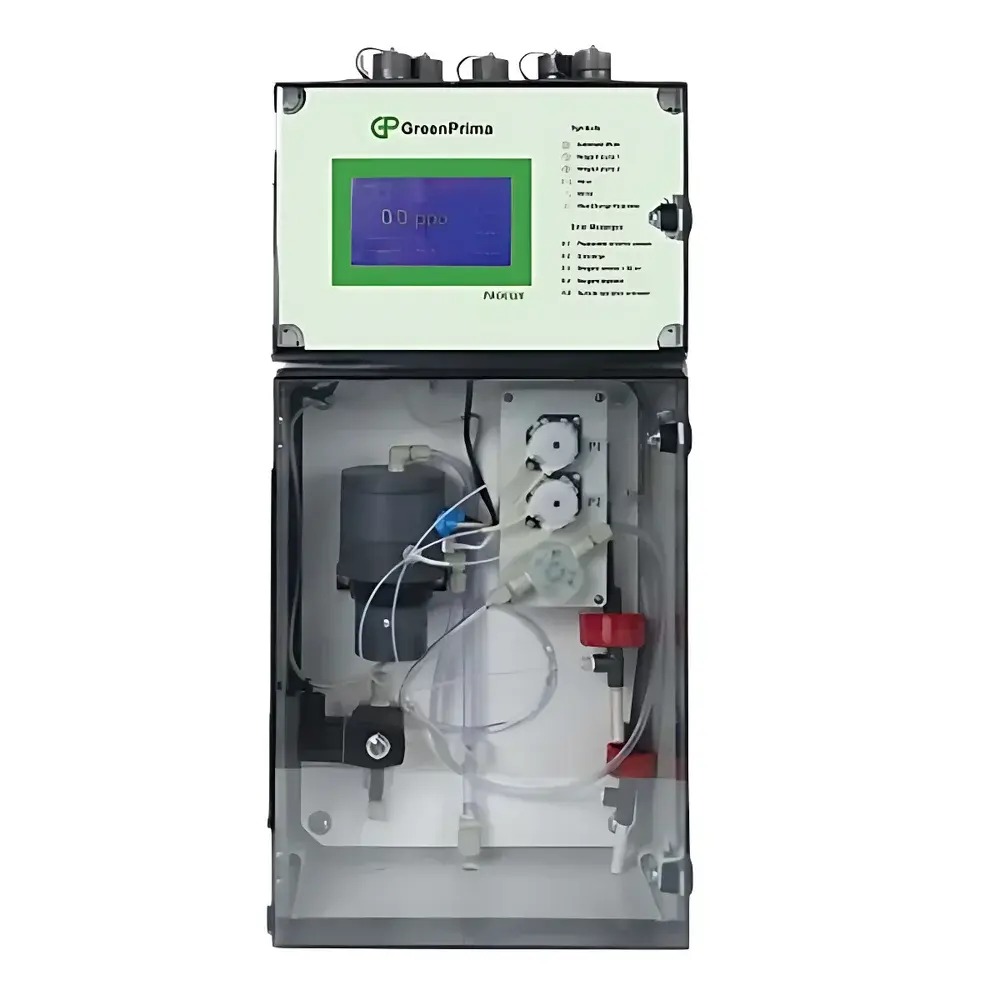
GreenPrima PROCON N6000 Photometric Silicate Analyzer
| Brand | GreenPrima |
|---|---|
| Origin | UK |
| Manufacturer Type | Manufacturer |
| Origin Category | Imported |
| Model | PROCON N6000 |
| Instrument Type | Online Analyzer |
| Measurement Method | Photometric (β-Molybdenum Blue Reduction) |
| Silicate Range Options | 1–100 ppb, 4–999 ppb, 0.02–3 ppm SiO₂ |
| Resolution | 0.1 ppb / 1 ppb / 0.01 ppm |
| Accuracy | ±2% of full scale |
| Repeatability | 0.5 ppb / 4 ppb / 0.02 ppm |
| Zero Stability | Automatic drift compensation |
| Cycle Time | 13 min (standard), adjustable 1–99 min or external trigger |
| Display | 240×128 pixel touchscreen |
| Output | 0/4–20 mA (max. 500 Ω load) |
| Relay Outputs | 3 × SPDT, zero-potential, 230 V AC / 3 A (alarm, limit, analysis) |
| Environmental Operating Temp. | 5–45 °C |
| Enclosure Rating | IP65 |
| Power Supply | 110–230 V AC, 50/60 Hz |
| Power Consumption | ~16 VA |
| Dimensions (H×W×D) | 640×315×190 mm |
| Connectivity | USB (optional data logging) |
Overview
The GreenPrima PROCON N6000 Photometric Silicate Analyzer is a fully automated, online analytical instrument engineered for continuous, high-precision quantification of dissolved reactive silica (SiO₂) in ultra-pure water streams. It operates on the validated photometric β-molybdenum blue reduction principle: soluble silicate reacts with molybdate under acidic conditions to form heteropoly acids, which are subsequently reduced to an intensely colored blue complex. The absorbance of this complex—measured at a defined wavelength using a stable LED light source and precision photodiode detector—is directly proportional to the silicate concentration. Designed specifically for critical steam-water cycles in thermal power generation and high-purity process water systems, the analyzer delivers trace-level detection down to 0.1 ppb with robust interference rejection against common anions (e.g., phosphate, sulfate) and organic contaminants.
Key Features
- Fully autonomous operation: integrated microprocessor controls sampling, reagent dosing (acid, ammonium molybdate, reducing agent), reaction timing, optical measurement, and system flushing—no manual intervention required.
- Three selectable measurement ranges (1–100 ppb, 4–999 ppb, 0.02–3 ppm SiO₂) enable optimal signal-to-noise ratio across diverse applications—from boiler feedwater to semiconductor rinse water.
- Self-calibrating architecture with automatic zero-point adjustment and real-time drift compensation ensures long-term stability without scheduled recalibration.
- Intuitive 240×128 pixel resistive touchscreen interface supports multilingual menus, configurable alarm thresholds, user-defined analysis intervals (1–99 minutes), and external start/stop triggering via dry-contact input.
- Industrial-grade I/O: three isolated zero-potential relays (alarm, limit, analysis status), programmable 4–20 mA analog output (HART-compatible wiring), and optional USB-based data export compliant with CSV format for LIMS integration.
- IP65-rated enclosure with reinforced polymer housing and sealed electrical connectors (ring-terminal termination) ensures reliable deployment in humid, chemically aggressive environments including turbine halls and utility corridors.
Sample Compatibility & Compliance
The PROCON N6000 is optimized for low-conductivity (<5 µS/cm), particle-free aqueous samples typical of demineralized, condensate, and boiler water circuits. Sample inlet pressure must be maintained between 0.1–0.6 bar; particulate filtration (≤5 µm) is recommended upstream. The analyzer complies with key industry requirements for critical water monitoring: it supports audit-ready operation per ASTM D859 (Standard Test Method for Silica in Water) and aligns with ISO 17025 documentation practices for method validation. Its relay logic and analog output architecture meet IEC 61511 functional safety guidelines for SIL 1-capable auxiliary instrumentation. While not FDA 21 CFR Part 11-certified out-of-the-box, its timestamped event log (including calibration events, reagent depletion alerts, and measurement anomalies) provides foundational traceability for GLP/GMP-aligned pharmaceutical and biotech facilities.
Software & Data Management
Embedded firmware enables local configuration and diagnostics via the front-panel touchscreen. All operational parameters—including measurement range, cycle time, alarm setpoints, and relay behavior—are stored in non-volatile memory with battery-backed real-time clock. Optional USB data logging captures time-stamped concentration values, system status flags (e.g., “reagent low”, “flow fault”), and diagnostic codes at user-defined intervals. Exported files adhere to plain-text CSV structure for seamless ingestion into SCADA historians (e.g., Siemens Desigo, Honeywell Experion) or Excel-based trend analysis. No proprietary software installation is required; data integrity is preserved through cyclic redundancy check (CRC) verification during write operations.
Applications
- Power generation: Continuous monitoring of silica in condensate return, boiler feedwater, and saturated/ superheated steam to prevent silica deposition on turbine blades and heat exchanger surfaces.
- Pharmaceutical manufacturing: Verification of silica compliance in purified water (PW) and water for injection (WFI) distribution loops per USP and EP 2.2.42.
- Semiconductor fabrication: Detection of sub-ppb silica breakthrough in ultrapure water (UPW) polishing stages to avoid wafer surface defects during etching and cleaning.
- Chemical and petrochemical plants: Control of silica ingress in ion exchange regeneration effluents and closed-loop cooling water systems.
- Research laboratories: Reference-grade validation of silica removal efficiency in novel membrane or adsorption media testing protocols.
FAQ
What reagents are required, and what is their typical shelf life?
Three reagents are used: sulfuric acid (0.5 M), ammonium molybdate solution (10 g/L), and ascorbic acid (reducing agent, 10 g/L). When stored sealed at 15–25 °C, all remain stable for ≥6 months. Reagent consumption is ≤2 mL per analysis cycle.
Can the analyzer operate unattended for extended periods?
Yes. With standard reagent reservoirs (500 mL each), uninterrupted operation exceeds 30 days at 13-minute cycle intervals. Integrated low-reagent alarms and flow-fault detection prevent invalid measurements.
Is sample pre-filtration mandatory?
While not strictly required for particle-free condensate, a 5 µm inline filter is strongly recommended to protect the peristaltic pump tubing and measurement cell from abrasion or clogging—especially when deployed on raw demineralizer outlet streams.
How is temperature variation compensated during measurement?
The optical path and reaction chamber are housed within a thermally stabilized zone. Internal temperature sensors feed real-time corrections to the photometric algorithm, minimizing thermal drift across the 5–45 °C operating envelope.
Does the unit support MODBUS RTU or other industrial communication protocols?
Standard configuration includes only 4–20 mA and dry-contact I/O. MODBUS RTU (RS-485) is available as a factory-installed option upon request, enabling direct integration with PLC-based control systems.
Related Products







