
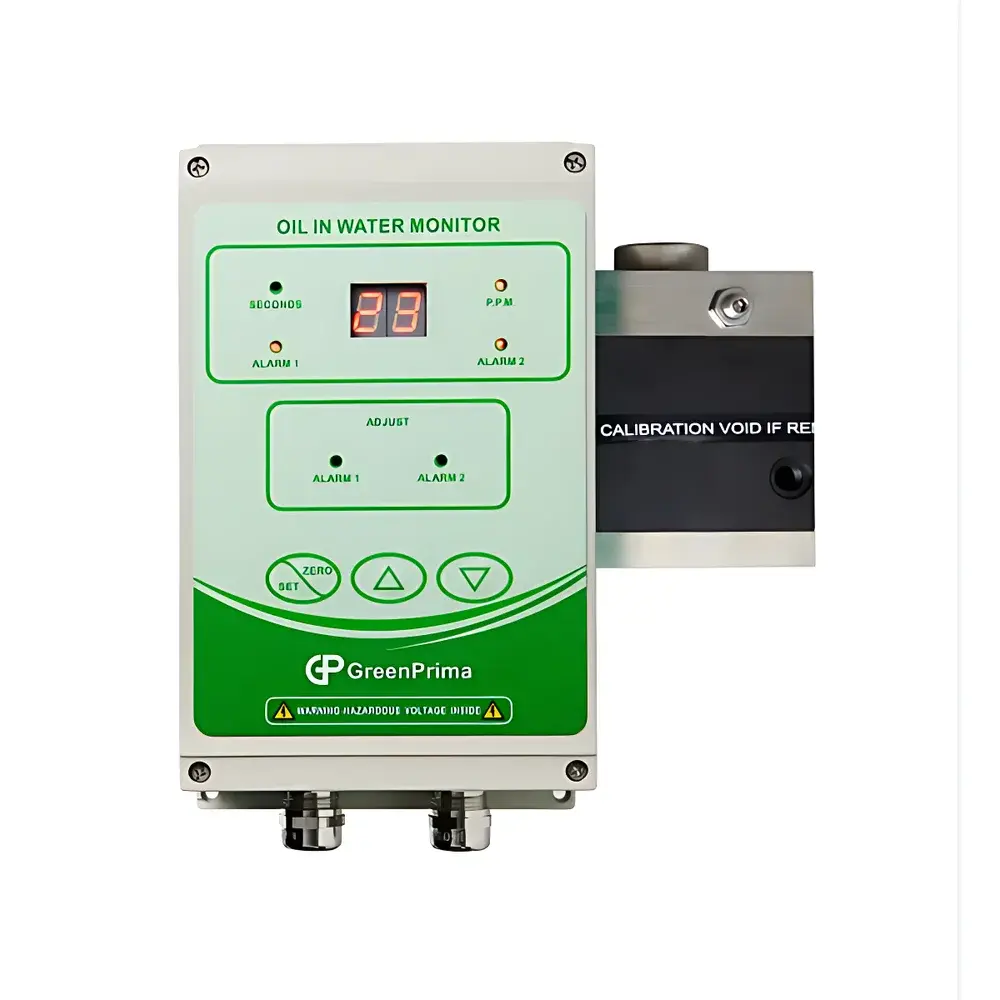
GreenPrima PROCON7000 Online Oil-in-Water Analyzer
| Brand | GreenPrima |
|---|---|
| Origin | United Kingdom |
| Manufacturer Type | Original Equipment Manufacturer (OEM) |
| Product Origin | Imported |
| Model | PROCON7000 |
| Instrument Type | Online Analyzer |
| Measurement Principle | Infrared Spectrophotometry (IR) |
| Measurement Range | 1–99 ppm |
| Detection Limit | 1 ppm |
| Accuracy | ±2 ppm |
| Resolution | 1 ppm |
| Measurement Frequency | Real-time |
| Display | 240 × 128 pixel touchscreen |
| Output Signals | 0–20 mA, 4–20 mA (min. load 820 Ω), 0–5 V DC, 1–5 V DC (min. load 50 kΩ) |
| Ambient Temperature Range | 1–60 °C |
| Relative Humidity | ≤90 % RH at 55 °C |
| Sample Temperature Range | 1–40 °C |
| Sample Flow Rate | 0.1–2 L/min |
| Sample Pressure Range | 0.1–10 bar |
| Weight | 2.25 kg |
| Dimensions (W × H × D) | 215 × 242 × 73 mm |
| Power Supply | 230 V / 115 V AC or 24 V AC |
| Max. Power Consumption | 10 VA |
| Enclosure Rating | IP55 |
| Electrical Safety Compliance | EN 61010-1 / IEC 61000-4 (Overvoltage Category II) |
Overview
The GreenPrima PROCON7000 Online Oil-in-Water Analyzer is an industrial-grade, real-time monitoring instrument engineered for continuous measurement of hydrocarbon oil concentration in aqueous streams using mid-infrared (MIR) absorption spectroscopy. Based on the fundamental principle that aliphatic and aromatic C–H bonds exhibit characteristic absorbance bands near 2940 cm⁻¹ and 2960 cm⁻¹, the PROCON7000 employs a dual-wavelength IR photometric method to quantify total petroleum hydrocarbons (TPH) with high selectivity and minimal interference from common water matrix constituents. Designed for unattended operation in demanding process environments, it delivers stable, drift-compensated readings across dynamic flow and temperature conditions — critical for regulatory compliance and early leak detection in closed-loop cooling systems and effluent discharge points.
Key Features
- Real-time, continuous measurement with configurable update intervals down to 1 second
- Dual-channel IR optical path with temperature-stabilized detector and reference compensation for long-term baseline stability
- Integrated sample conditioning module supporting flow rates from 0.1 to 2 L/min and pressures up to 10 bar
- Robust IP55-rated enclosure suitable for indoor and semi-outdoor industrial installations
- Touchscreen interface (240 × 128 pixels) with intuitive menu navigation and local data logging (up to 30 days of 1-min averaged values)
- Dual independent alarm outputs with fully programmable thresholds (1–98 ppm), delay timers (0–60 s for Alarm 1; 10–240 s for Alarm 2), and relay contact ratings of 8 A @ 240 V AC
- Comprehensive analog output suite: isolated 4–20 mA (min. load 820 Ω), 0–20 mA, 0–5 V DC, and 1–5 V DC (min. load 50 kΩ) for integration into DCS, PLC, or SCADA systems
Sample Compatibility & Compliance
The PROCON7000 is validated for use with clarified, low-turbidity aqueous samples containing mineral oils, synthetic lubricants, diesel-range hydrocarbons, and light fuel oils. It is not intended for emulsified or highly suspended matrices without upstream filtration (e.g., 5 µm nominal pore size). The analyzer meets EN 61010-1 for electrical safety and conforms to IEC 61000-4 electromagnetic compatibility standards. Its design supports operational alignment with ISO 9377-2 (water quality — determination of hydrocarbons — part 2: infrared spectrometric method) and EPA Method 1664A (for screening-level verification). While not certified for direct regulatory reporting under US EPA or EU WFD requirements, its performance characteristics satisfy internal QA/QC benchmarks for continuous emission monitoring (CEM) and preventive maintenance programs governed by ISO 55001 asset management frameworks.
Software & Data Management
Data acquisition and configuration are managed locally via the embedded touchscreen HMI. No external PC or proprietary software is required for routine operation. Logged data (timestamped concentration values, alarm events, system diagnostics) can be exported via USB flash drive in CSV format. Optional Modbus RTU (RS-485) or Modbus TCP (Ethernet) communication modules enable bidirectional integration with supervisory control systems. Audit trails — including parameter changes, calibration logs, and alarm acknowledgments — are retained onboard with time-stamped entries compliant with GLP-aligned record-keeping practices. Firmware updates are performed via secure USB-based deployment with SHA-256 signature verification.
Applications
- Monitoring oil carryover in lubricating oil cooler circuits of gas turbines and large compressors
- Continuous surveillance of engine jacket cooling water for early detection of cylinder liner or head gasket failure
- Effluent compliance tracking at industrial wastewater treatment plant outfalls (e.g., metalworking, power generation, marine facilities)
- Groundwater remediation site monitoring where hydrocarbon plume migration must be quantified in near real time
- Pre-treatment verification prior to membrane filtration or activated carbon polishing stages
FAQ
What types of oil does the PROCON7000 detect?
It responds to aliphatic and aromatic hydrocarbons with C–H bond structures, including mineral oils, white oils, diesel fuel, and synthetic ester-based lubricants. Performance varies with molecular weight distribution and oxidation state.
Is calibration required, and how often?
Factory calibration is traceable to NIST-certified mineral oil standards. Field verification using certified reference materials is recommended quarterly; full recalibration is advised annually or after sensor replacement.
Can the PROCON7000 operate in pressurized sample lines?
Yes — it accommodates inlet pressures from 0.1 to 10 bar absolute. An integrated pressure relief valve and flow restrictor ensure safe, laminar flow through the measurement cell.
Does it support hazardous area installation?
The standard unit is rated for non-hazardous locations (IP55). For Zone 2/Class I Div 2 environments, consult GreenPrima’s ATEX/IECEx-certified variant (PROCON7000-EX), available upon request.
How is zero drift managed during extended operation?
The optical system incorporates an internal reference channel and periodic auto-zero cycles triggered by user-defined idle periods or flow cessation, minimizing baseline drift to <0.5 ppm/month under stable thermal conditions.







