
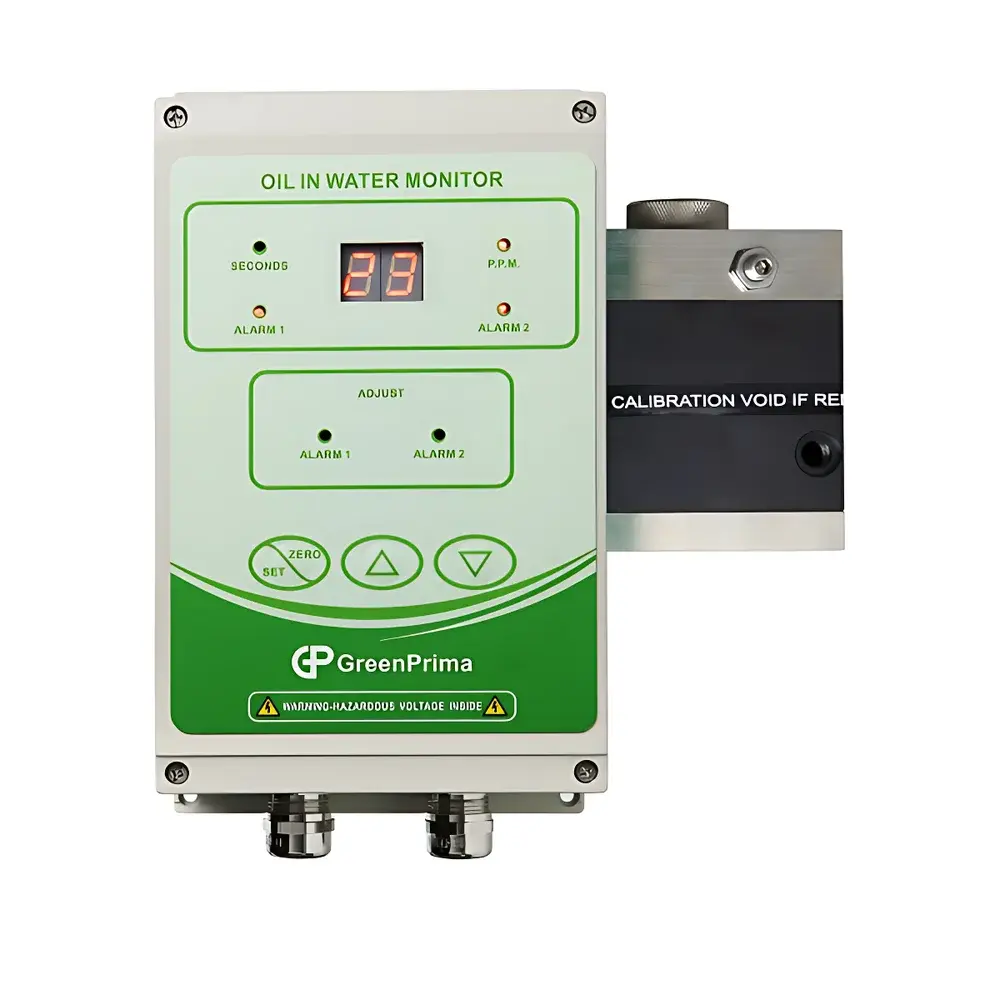
GreenPrima PROCON7000 Online Oil-in-Water Analyzer
| Brand | GreenPrima |
|---|---|
| Origin | United Kingdom |
| Manufacturer Type | Manufacturer |
| Origin Category | Imported |
| Model | PROCON7000 |
| Instrument Type | Online |
| Measurement Principle | Fluorescence-based optical detection (non-extractive, in-situ) |
| Measurement Range | 0–99 ppm |
| Accuracy | ±2 ppm |
| Alarm Setpoint Range | 1–98 ppm (adjustable) |
| Alarm 1 Delay | 0–60 s (adjustable) |
| Alarm 2 Delay | 10–240 s (adjustable) |
| Display | 240 × 128 pixel touchscreen |
| Analog Outputs | 0/4–20 mA (min. load 820 Ω), 0–5 V / 1–5 V DC (min. load 50 kΩ) |
| Sample Temp. | 1–40 °C |
| Sample Flow Rate | 0.1–2 L/min |
| Sample Pressure | 0.1–10 bar |
| Ambient Temp. | 1–60 °C |
| Humidity | ≤90% RH at 55 °C |
| Enclosure Rating | IP55 |
| Electrical Safety | EN 61010-1 / IEC 61000-4 (Overvoltage Category II) |
| Weight | 2.25 kg |
| Dimensions (H×W×D) | 215 × 242 × 73 mm |
| Power Supply | 230 V / 115 V AC or 24 V AC |
| Max. Power Consumption | 10 VA |
Overview
The GreenPrima PROCON7000 Online Oil-in-Water Analyzer is an industrial-grade, fluorescence-based optical sensor engineered for continuous, real-time monitoring of hydrocarbon contamination in aqueous process streams. Unlike extractive or gravimetric methods, the PROCON7000 employs a non-contact, in-situ optical measurement principle—exciting native aromatic compounds in mineral oils, synthetic lubricants, and diesel-range hydrocarbons with UV light and quantifying emitted fluorescence intensity. This approach eliminates solvent use, sample preparation, and membrane fouling risks, delivering stable baseline performance across fluctuating flow and temperature conditions typical in cooling water circuits, condensate return lines, and wastewater effluent channels. Designed specifically for high-reliability operation in demanding utility and refining environments, the analyzer meets the functional requirements of ISO 9377-2 (water quality — determination of hydrocarbon oil — part 2: fluorescence method) and supports compliance with local discharge limits under EU Industrial Emissions Directive (IED) and US EPA Effluent Guidelines (40 CFR Part 420).
Key Features
- Automatic self-diagnostic routine and real-time drift compensation ensure long-term measurement stability without manual recalibration.
- Adjustable measurement intervals (1–60 min) and external trigger capability enable synchronization with process control logic or PLC-initiated sampling events.
- Intuitive 240 × 128-pixel resistive touchscreen interface supports multilingual menu navigation (English, German, Spanish, French) and on-device configuration of alarm thresholds, output scaling, and system logging parameters.
- Dual independent alarm outputs (Alarm 1 & Alarm 2) with programmable delay timers (0–60 s and 10–240 s respectively) allow staged response protocols—for example, initiating pump shutdown after sustained exceedance or triggering secondary filtration activation.
- Configurable analog outputs (0/4–20 mA and 0–5 V / 1–5 V DC) provide direct integration into DCS, SCADA, or BMS platforms with galvanic isolation and load-matching specifications compliant with IEC 61000-6-2 EMC immunity standards.
- IP55-rated enclosure and IP65-rated external terminal block housing ensure operational integrity in humid, dusty, or splash-prone areas such as turbine halls, boiler houses, and wastewater lift stations.
- No consumables or reagents required; maintenance limited to periodic optical window inspection and optional ultrasonic cleaning of the flow cell (recommended every 6–12 months depending on suspended solids concentration).
Sample Compatibility & Compliance
The PROCON7000 is validated for use with freshwater, treated condensate, closed-loop cooling water, and pre-treated industrial wastewater containing mineral oils, hydraulic fluids, turbine oils, and diesel-range hydrocarbons (C10–C25). It exhibits minimal cross-sensitivity to humic substances, chlorophyll-a, or common biocides when operated within its specified temperature (1–40 °C) and turbidity (<100 NTU) limits. The analyzer conforms to EN 61010-1 for electrical safety in measurement and control equipment, and its analog output circuitry satisfies IEC 61326-1 for electromagnetic compatibility in industrial environments. While not certified for hazardous area installation (e.g., ATEX or IECEx), its design supports safe deployment in Zone 2/Class I Division 2 locations when installed downstream of explosion-proof barriers per IEC 60079-14 guidelines.
Software & Data Management
Data logging is supported via optional USB flash drive (FAT32 formatted, up to 32 GB), recording timestamped oil concentration values, alarm status flags, diagnostic codes, and ambient/sensor temperature readings at user-defined intervals. Logged files export in CSV format for post-processing in Excel, MATLAB, or LIMS platforms. Firmware updates are performed offline via USB—no network connectivity or cloud dependency required—ensuring full data sovereignty and alignment with ITAR-free and GDPR-compliant operational policies. Audit trail functionality (enabled via configuration flag) records all parameter changes with timestamps and operator IDs when integrated with external authentication systems via Modbus TCP handshake.
Applications
- Monitoring lube oil leakage across shell-and-tube heat exchangers in power plant cooling circuits.
- Early detection of fuel oil ingress in steam turbine condensate return lines to prevent boiler tube deposition and corrosion.
- Compliance verification of final effluent from metalworking, petrochemical, and food processing facilities prior to municipal sewer discharge.
- Groundwater remediation site monitoring where hydrocarbon plume migration must be tracked against regulatory action levels (e.g., EPA Region 10 Tier 1 screening values).
- Pre-treatment verification upstream of dissolved air flotation (DAF) or activated carbon units in refinery wastewater treatment trains.
FAQ
Does the PROCON7000 require periodic calibration with standard oil solutions?
No. The instrument performs automatic zero tracking using a reference photodiode channel and compensates for optical path degradation through internal gain normalization. Field verification may be conducted annually using a certified mineral oil standard (e.g., ISO 8767) if required by internal QA protocols or third-party audits.
Can it measure emulsified oil effectively?
Yes—within its dynamic range. The fluorescence method responds to dissolved and finely dispersed aromatic hydrocarbons regardless of physical state, making it suitable for detecting stable microemulsions formed by surfactants in cutting fluid wastewater.
Is the flow cell compatible with abrasive or high-solids wastewater?
The standard quartz flow cell is rated for suspended solids up to 50 mg/L. For applications exceeding this—such as primary clarifier effluent—a stainless-steel bypass manifold with inline 50-µm filtration is recommended to protect optical surfaces.
What communication protocols are supported beyond analog outputs?
Modbus RTU (RS-485) is available as a factory-configurable option. Ethernet/IP and PROFIBUS DP-V1 are not supported natively but can be interfaced via third-party protocol gateways compliant with IEC 61784-3.







