
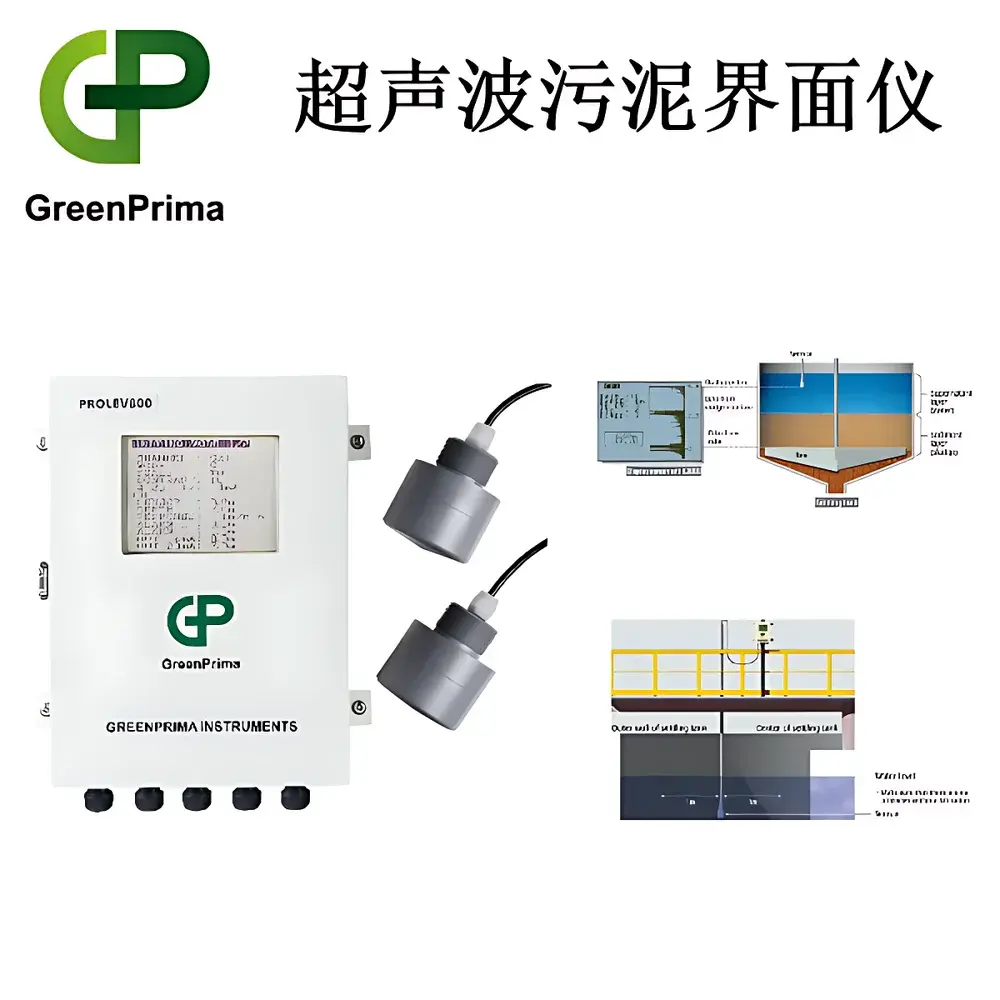
GreenPrima PROLEV 800 Sludge Interface Level Meter
| Brand | GreenPrima |
|---|---|
| Origin | Japan |
| Manufacturer Type | Manufacturer |
| Origin Category | Imported |
| Model | PROLEV 800 |
| Measurement Range | 0.4–10 m |
| Sensor Capacity | Up to 2 independent ultrasonic transducers |
| Accuracy | ±1 cm |
| Response Time | 1 s |
| Operating Temperature | −20 to +60 °C |
| Display | Large-backlit LCD with graphical interface (level profile, echo waveform, trend plot) |
| Protection Rating | IP68 |
| Weight | 3.6 kg (transmitter), 3.0 kg (per probe) |
| Output | 4–20 mA analog output |
| Alarms | Dual programmable high/low level relay outputs |
| Communication | RS-232C (cable length ≤10 m) |
| Power Supply | 85–264 VAC, 10 VA |
| Cable Length | 20 m |
Overview
The GreenPrima PROLEV 800 Sludge Interface Level Meter is an industrial-grade ultrasonic interface detection system engineered for continuous, non-invasive monitoring of sludge blanket depth and settling dynamics in water and wastewater treatment processes. Based on time-of-flight ultrasonic pulse-echo principle, the instrument emits low-frequency acoustic waves through the liquid phase and precisely detects the acoustic impedance discontinuity at the suspended solids–clear liquid interface. Unlike optical or conductivity-based methods, ultrasonic sensing remains unaffected by turbidity, color, chemical composition, or surface foam—making it especially suitable for heterogeneous, high-solids environments such as primary clarifiers, secondary sedimentation tanks, gravity thickeners, and coal washery tailings basins. The PROLEV 800 delivers real-time vertical profiling of the sludge–supernatant boundary, enabling operators to quantify both interface elevation and sludge blanket thickness with ±1 cm repeatability under field conditions.
Key Features
- Integrated dual-transducer support: A single transmitter unit accommodates two independent ultrasonic probes—enabling simultaneous measurement of top interface and bottom sludge bed (e.g., in thickener cones) or redundant monitoring across parallel basins.
- Graphical LCD interface: High-contrast backlit display renders real-time sludge profile cross-sections, raw echo amplitude waveforms, and time-series trends (5 m to 48 h span) without external software.
- Embedded microprocessor architecture: Performs adaptive signal averaging, noise filtering, and dynamic thresholding to maintain stable interface tracking during variable flow, scum layer formation, or hydraulic surges.
- Mechanically robust design: No moving parts; stainless steel (SUS316L) wetted components and IP68-rated housing ensure long-term reliability in humid, chemically aggressive, or submersible installations.
- Configurable analog and digital I/O: Standard 4–20 mA output scalable to user-defined range (e.g., 0–10 m = 4–20 mA); two independent relay outputs for high/low alarm thresholds; RS-232 serial port for configuration backup and diagnostic logging.
Sample Compatibility & Compliance
The PROLEV 800 is validated for use in municipal and industrial wastewater streams containing suspended solids concentrations up to 15% w/w, including activated sludge, primary settleable solids, anaerobic digester supernatant, fly ash slurries, and coal preparation plant effluents. It complies with IEC 61326-1 (EMC for industrial environments) and meets functional safety requirements aligned with IEC 61508 SIL 2 for critical level control applications. While not certified for explosive atmospheres, its design conforms to ISO 9001 manufacturing quality standards. For regulatory reporting contexts—including EPA NPDES permit compliance or EU Urban Wastewater Treatment Directive (91/271/EEC)—the device supports audit-ready data logging when integrated with SCADA systems via Modbus RTU (via optional RS-232-to-Modbus converter).
Software & Data Management
Configuration and calibration are performed locally via intuitive menu navigation on the front-panel LCD—no PC required. All settings (e.g., damping factor, echo gain, alarm hysteresis, measurement interval) are stored in non-volatile memory. Raw echo data and timestamped level values can be exported via RS-232 to third-party historian platforms (e.g., Ignition, Siemens Desigo, or custom Python-based data ingestion pipelines). The built-in trend buffer retains 72 hours of 1-minute interval measurements, allowing rapid diagnosis of abnormal settling behavior—such as rising sludge blankets preceding denitrification events or sudden interface collapse due to septic conditions. When deployed in GLP/GMP-regulated facilities, the system supports traceable calibration records and operator action logs when interfaced with validated electronic lab notebook (ELN) or LIMS solutions.
Applications
- Optimization of return activated sludge (RAS) and waste activated sludge (WAS) flow rates based on real-time interface position.
- Early detection of sludge bulking or filamentous overgrowth via progressive interface elevation trends.
- Control logic input for automatic scraper bridge speed modulation in circular thickeners.
- Performance verification of lamella settlers and tube settlers in potable water treatment plants.
- Monitoring of ash slurry concentration stability in coal-fired power station dewatering lagoons.
FAQ
Can the PROLEV 800 distinguish between multiple layers (e.g., scum, sludge, and clear water)?
It reliably identifies the dominant acoustic interface—the highest-density discontinuity within the measurement path—but does not resolve multi-layer stratification without auxiliary sensors (e.g., conductivity or density probes).
Is calibration required after installation?
A one-time zero-point calibration (using known still-water level) is recommended; no periodic recalibration is needed due to temperature-compensated transducer design and factory-trimmed time-base accuracy.
What is the maximum allowable suspended solids concentration for accurate interface detection?
The system maintains consistent performance up to ~120,000 mg/L TSS; beyond that, attenuation may reduce effective range—field validation is advised for >15% w/w slurries.
Does the device support Modbus TCP/IP or Profibus communication?
Native protocol support is RS-232 only; however, industrial protocol gateways (e.g., Moxa EDS-G205) enable seamless integration into Ethernet-based DCS/PLC networks.
How is sensor fouling mitigated in high-fouling applications?
The transducers feature self-cleaning ultrasonic pulsing mode (optional firmware upgrade) and smooth-polished ceramic faces resistant to biofilm adhesion; mechanical wipers are not required under normal operation.







