
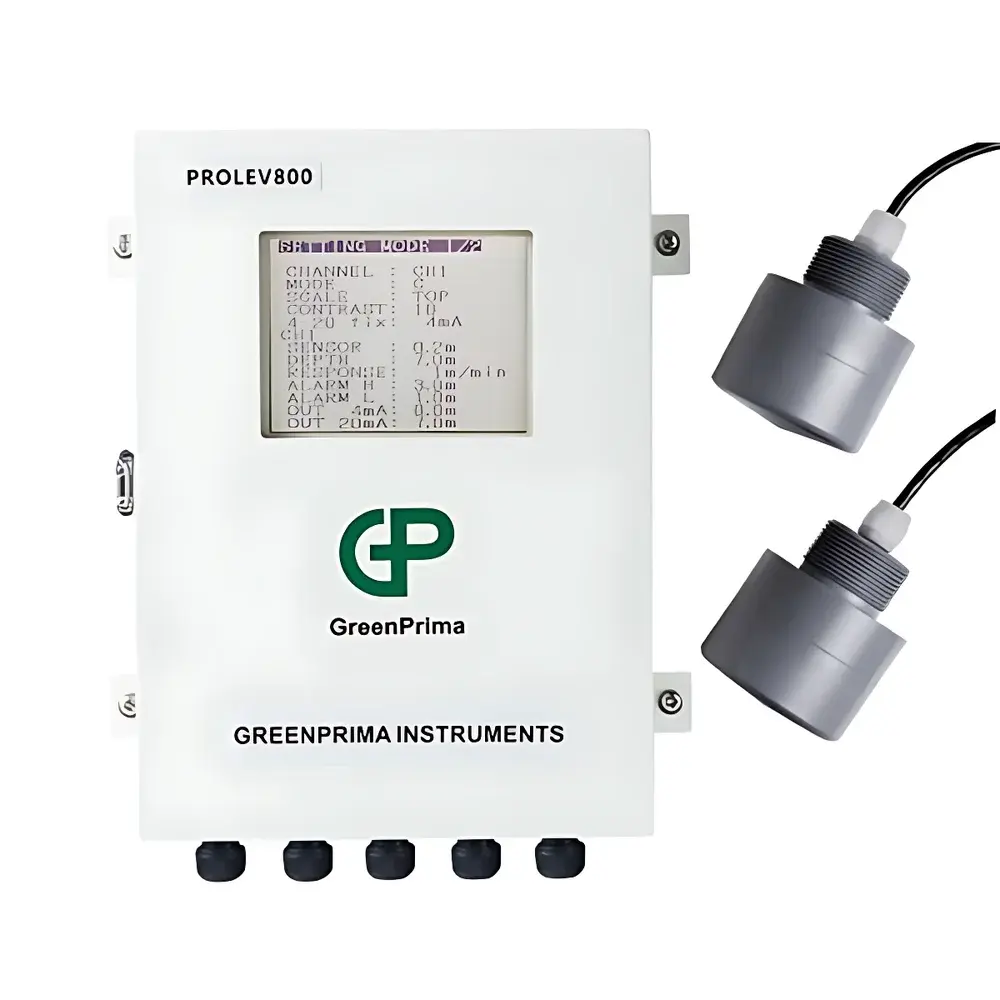
GreenPrima PROLEV 800 Ultrasonic Sludge Interface Level Gauge
| Brand | GreenPrima |
|---|---|
| Origin | United Kingdom |
| Manufacturer Type | Original Equipment Manufacturer (OEM) |
| Product Origin | Imported |
| Model | PROLEV 800 |
| Pricing | Available Upon Request |
Overview
The GreenPrima PROLEV 800 is an industrial-grade ultrasonic sludge interface level gauge engineered for continuous, non-invasive monitoring of suspended solids concentration gradients in wastewater and slurry treatment processes. It operates on the principle of time-of-flight ultrasonic pulse echo analysis, transmitting high-frequency acoustic waves (typically 1–5 MHz) through the liquid phase and detecting reflected signals from density discontinuities—primarily the interface between clarified supernatant and the suspended sludge blanket. Unlike optical or conductivity-based methods, ultrasonic sensing remains unaffected by turbidity, color, chemical composition, or surface foam, ensuring stable performance across variable influent conditions typical in municipal and industrial wastewater treatment plants. The device delivers real-time quantification of both sludge blanket height (from tank bottom or reference datum) and effective sludge layer thickness, enabling precise control of return activated sludge (RAS) and waste activated sludge (WAS) flows—critical for maintaining optimal mixed liquor suspended solids (MLSS) concentrations and preventing under- or over-aeration.
Key Features
- Large-format backlit LCD display supporting simultaneous numeric readout, graphical trend plots (5 minutes to 48 hours), and real-time ultrasonic echo waveform visualization for diagnostic validation
- Embedded microprocessor with adaptive signal averaging and noise rejection algorithms, ensuring stable interface tracking even during transient hydraulic surges or scum layer interference
- No moving parts or submerged electronics—ultrasonic transducers are potted stainless steel housings rated IP68, eliminating mechanical wear and minimizing maintenance intervals
- Dual-sensor capability: a single transmitter unit supports two independent ultrasonic probes, enabling cross-verification or multi-zone profiling (e.g., primary vs. secondary clarifier zones)
- Adjustable display brightness and configurable alarm thresholds (two independent 4–20 mA analog outputs with programmable high/low setpoints)
- RS-232C serial interface (up to 10 m cable length) for integration with SCADA systems, PLCs, or data loggers; supports Modbus RTU protocol upon firmware configuration
- Robust power design: wide-input AC supply (85–264 VAC, 50/60 Hz, 10 VA), suitable for direct connection to plant distribution panels without external transformers
Sample Compatibility & Compliance
The PROLEV 800 is validated for use in heterogeneous aqueous suspensions containing organic particulates (e.g., activated sludge flocs), inorganic precipitates (e.g., metal hydroxides), coal fines, fly ash slurries, and lime softening residuals. It complies with IEC 61326-1 (EMC for industrial environments) and IEC 60529 (IP68 ingress protection). While not certified to SIL standards, its architecture supports integration into safety-related control loops per IEC 61511 when deployed with appropriate system-level redundancy and verification. The instrument meets general requirements for GLP-compliant data acquisition when paired with audit-trail-enabled logging software, and its analog outputs conform to NAMUR NE43 signaling conventions for fault detection.
Software & Data Management
Local data visualization is performed via the integrated LCD interface, which stores up to 48 hours of time-stamped interface height data at 1-second resolution. For extended archival and remote access, the RS-232C port enables connection to third-party supervisory software (e.g., Ignition SCADA, Siemens Desigo CC, or custom Python-based dashboards). Raw echo profiles and processed interface positions can be exported as CSV files. Firmware updates are performed via serial terminal emulation; no cloud connectivity or proprietary vendor software is required. All configuration parameters—including damping filters, echo gain, and alarm hysteresis—are stored in non-volatile memory with battery-backed retention.
Applications
- Primary and secondary clarifiers in municipal wastewater treatment plants, where real-time sludge blanket depth informs RAS pump scheduling and prevents sludge washout
- Gravity thickeners and dissolved air flotation (DAF) units requiring optimization of underflow concentration and overflow clarity
- Coal preparation plant sedimentation basins and ash handling systems in thermal power stations
- Industrial pretreatment facilities managing metal hydroxide precipitates or food processing effluents with high BOD/COD load fluctuations
- Research-scale bioreactors and pilot plants studying settling velocity, compression characteristics, and zone settling behavior per ASTM D4053 and ISO 11571
FAQ
What measurement principle does the PROLEV 800 employ?
It uses pulsed ultrasonic time-of-flight measurement to detect acoustic impedance changes at the supernatant–sludge interface.
Can it distinguish multiple layers (e.g., scum, sludge, grit)?
No—it identifies the dominant density transition closest to the sensor; layered analysis requires complementary techniques such as multi-frequency sonar or gamma densitometry.
Is calibration required after installation?
Field calibration is not needed; however, a one-time zero-point setup (reference distance to tank bottom or stilling well base) must be entered during commissioning.
How does temperature variation affect accuracy?
The built-in temperature sensor compensates for sound speed changes in water across –20 °C to +60 °C; accuracy degrades only outside this range or in highly viscous (>100 mPa·s) or aerated media.
What is the minimum detectable sludge concentration?
Reliable interface detection begins at approximately 1,000 mg/L TSS under laminar flow conditions; performance may vary with floc size distribution and particle density.
Related Products







