
GreenPrima PROLEV800 Sludge Interface Level Meter
| Brand | GreenPrima |
|---|---|
| Origin | Japan |
| Manufacturer Type | Manufacturer |
| Origin Category | Imported |
| Model | PROLEV800 |
| Price Range | USD 2,700 – 6,800 |
| Measurement Range | 0.4–10 m |
| Sensor Capacity | Up to 2 independent ultrasonic transducers |
| Accuracy | ±1 cm |
| Response Time | 1 s |
| Operating Temperature | −20 to +60 °C |
| Display | Large backlit LCD with graphical interface (digital level, trend plot, echo waveform) |
| Protection Rating | IP68 |
| Weight | 3.6 kg (transmitter), 3 kg per probe |
| Output | 4–20 mA analog, dual high/low alarm relay outputs |
| Communication | RS-232C (≤10 m cable length) |
| Power Supply | 85–264 VAC, 10 VA |
| Cable Length | 20 m |
| Trend Logging | 5 min to 48 h on-screen display |
Overview
The GreenPrima PROLEV800 Sludge Interface Level Meter is an ultrasonic-based continuous monitoring instrument engineered for precise, non-contact detection of the sludge-water interface in clarifiers, thickeners, and sedimentation basins. It operates on the principle of time-of-flight ultrasonic pulse reflection: a high-frequency transducer emits short-duration acoustic pulses downward into the liquid column; the elapsed time between emission and reception of echoes from both the liquid surface and the dense sludge layer is measured with microsecond resolution. By analyzing the amplitude and temporal separation of these dual echoes—particularly the sharp attenuation shift at the sludge interface—the system calculates real-time sludge blanket height and thickness with ±1 cm repeatability. Designed for robust operation in harsh wastewater environments, the PROLEV800 delivers stable performance under variable suspended solids concentrations, temperature gradients, and surface turbulence—without mechanical moving parts or immersion of electronics in process media.
Key Features
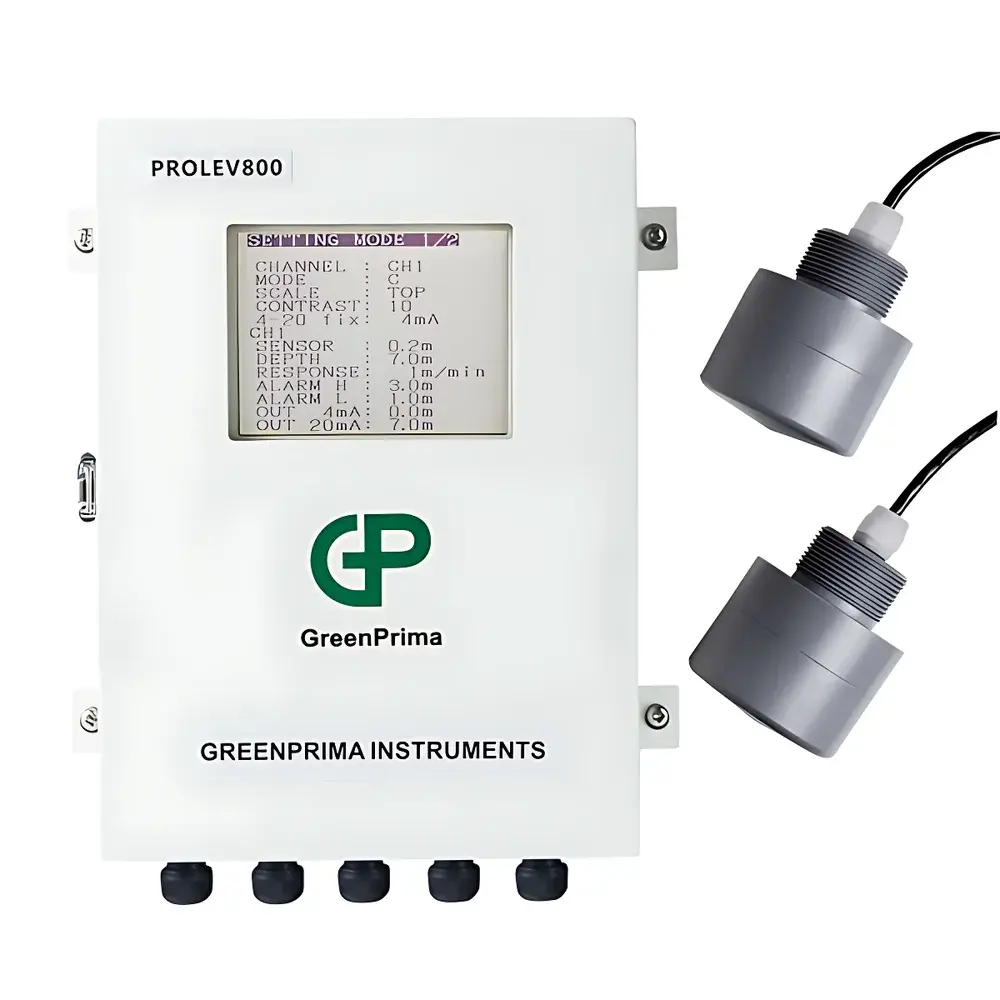
- Large-format backlit LCD display supporting simultaneous numeric level readout, real-time ultrasonic echo waveform visualization, and dynamic trend plotting (selectable time windows from 5 minutes to 48 hours)
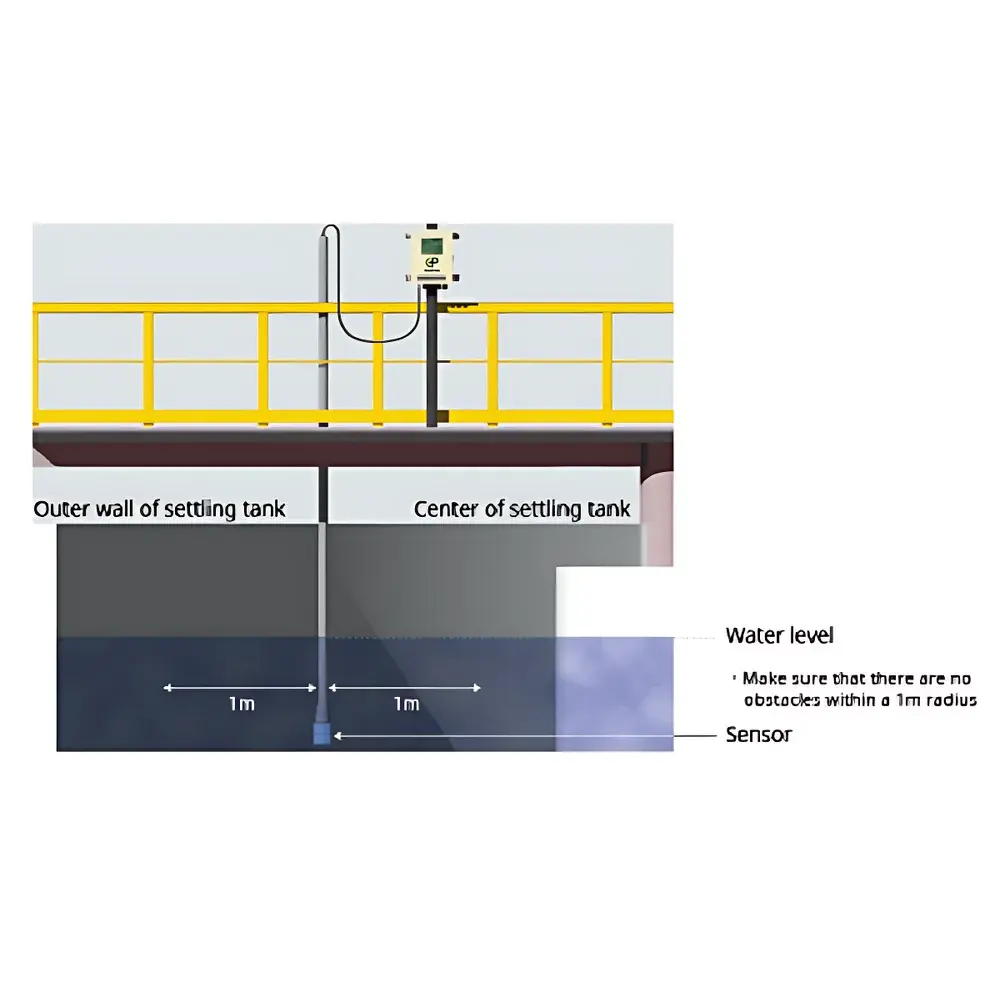
- Dual-sensor capability: single transmitter unit supports two independently mounted ultrasonic probes—enabling differential measurement across tank width or redundancy configuration
- Embedded microprocessor with adaptive signal filtering algorithms to suppress false echoes from floating scum, foam, or tank structure reflections
- No moving parts or submerged electronics: transducer housing rated IP68, transmitter enclosure rated IP65; maintenance-free operation with field-replaceable probe modules
- Adjustable LCD brightness control optimized for varying ambient lighting conditions in pump rooms and outdoor enclosures
- Configurable 4–20 mA analog output (HART-compatible wiring optional) with programmable scaling and linearization over full 0.4–10 m range
- Two independent relay outputs for high/low sludge level alarms, configurable with adjustable hysteresis to prevent chatter during transient settling events
Sample Compatibility & Compliance
The PROLEV800 is validated for use in municipal and industrial wastewater streams containing suspended solids up to 50,000 mg/L, including activated sludge, primary sludge, anaerobic digester supernatant, and coal-washing effluent. Its ultrasonic frequency (typically 20–50 kHz) ensures reliable penetration through moderate surface foam layers while maintaining sensitivity to density transitions characteristic of compacted sludge blankets. The instrument complies with IEC 61000-6-2 (immunity) and IEC 61000-6-4 (emissions) for industrial electromagnetic environments. Enclosure materials meet UL 94 V-0 flammability requirements. While not intrinsically safe, it is suitable for Zone 2/Class I Div 2 hazardous locations when installed with appropriate conduit sealing and grounding per NEC Article 501. Documentation supports audit readiness for ISO 14001 environmental management systems and EPA NPDES compliance reporting workflows.
Software & Data Management
Data acquisition and configuration are managed via local front-panel navigation or remote serial interface (RS-232C, ≤10 m). The built-in trend buffer stores timestamped level values at user-defined intervals (1–300 seconds), enabling immediate visual assessment of settling dynamics without external SCADA integration. For long-term data archival, ASCII-formatted logs can be exported via terminal emulation software for import into LIMS or asset management platforms. The firmware supports firmware update via serial port and includes password-protected parameter locking to prevent unauthorized configuration changes—a functional prerequisite for GLP-aligned operational procedures. Audit trail functionality (e.g., change log with timestamp and operator ID) is available when integrated with third-party historian systems compliant with FDA 21 CFR Part 11 requirements.
Applications
- Real-time optimization of return activated sludge (RAS) flow rates in secondary clarifiers based on measured sludge blanket depth
- Monitoring pre-thickener feed consistency and detecting early-stage sludge compaction in gravity thickeners
- Automated control of scraper torque and drive speed in circular clarifiers using interface position feedback
- Early warning of sludge bulking or filamentous overgrowth through abnormal interface rise rate analysis
- Performance verification of dissolved air flotation (DAF) units by tracking float layer thickness and stability
- Process validation during commissioning and routine QA/QC audits in water reclamation facilities certified to ISO 24510 and EN 12255 standards
FAQ
What ultrasonic frequency does the PROLEV800 operate at?
The transducer operates in the 20–50 kHz range, optimized for propagation through aqueous suspensions with minimal attenuation in typical wastewater matrices.
Can the PROLEV800 distinguish between scum and sludge layers?
It detects the dominant acoustic impedance discontinuity—primarily the sludge-water interface. Scum layers may produce secondary echoes but are not quantified separately without supplemental optical or conductivity sensors.
Is calibration required after installation?
Factory calibration is traceable to NIST standards; field zero/span verification using known reference depths is recommended at commissioning and semiannually thereafter.
How is the 4–20 mA output scaled for custom tank geometry?
Scaling parameters (e.g., 4 mA = 0.4 m, 20 mA = 10.0 m) are configured via menu-driven setup; linear or segmented (multi-point) scaling is supported.
Does the unit support Modbus RTU or other industrial protocols?
Native protocol is ASCII over RS-232C; Modbus RTU conversion requires an external protocol gateway—no onboard Modbus stack is implemented.
Related Products







