
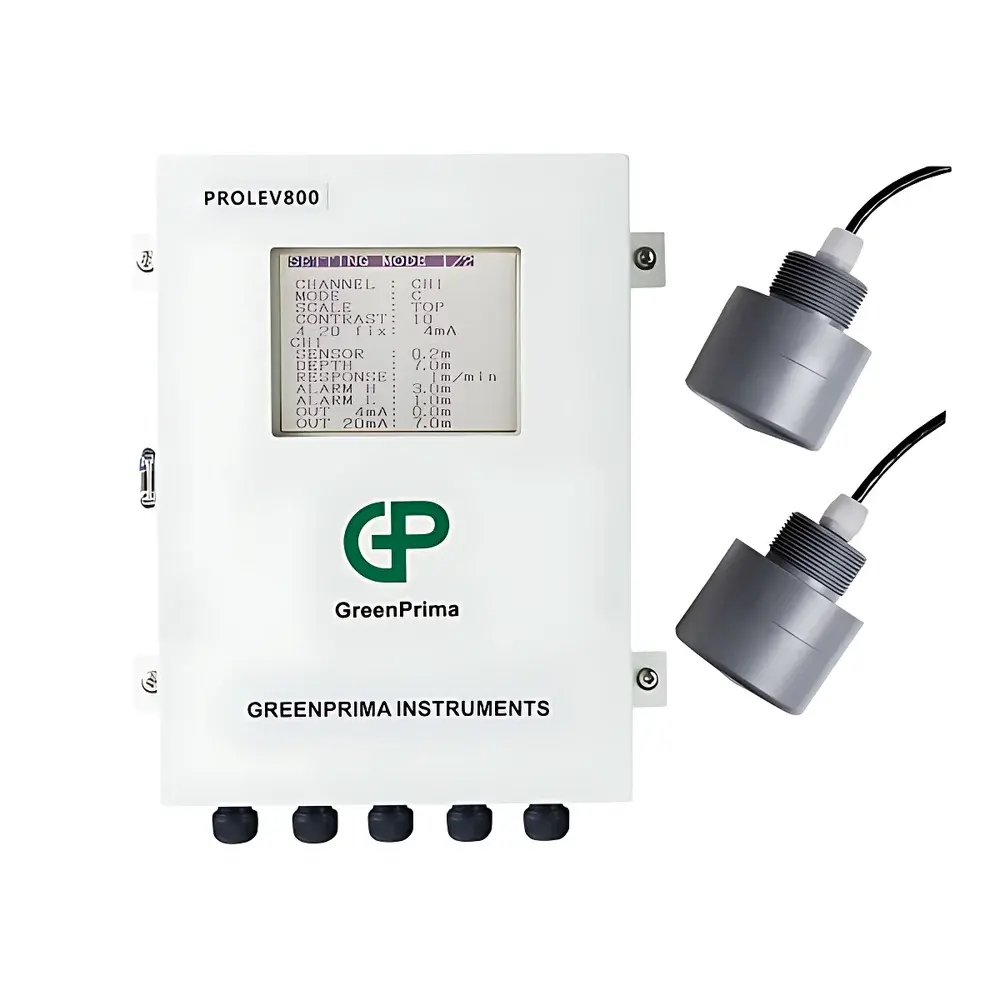
GreenPrima Prolev800 Sludge Interface Monitor
| Brand | GreenPrima |
|---|---|
| Origin | United Kingdom |
| Manufacturer Type | Original Equipment Manufacturer (OEM) |
| Product Category | Imported Instrument |
| Model | Prolev800 |
| Measurement Range | 0.4–10 m |
| Sensor Capacity | Up to 2 independent ultrasonic probes |
| Accuracy | ±1 cm |
| Response Time | 1 s |
| Operating Temperature | −20 to +60 °C |
| Display | Large-backlit LCD with graphical interface (numeric readout, trend plot, real-time echo waveform) |
| Output | 4–20 mA analog signal |
| Alarms | Dual programmable Hi/Lo relay outputs |
| Communication | RS232C (cable length ≤10 m) |
| Power Supply | 85–264 VAC, 10 VA |
| Ingress Protection | IP68 |
| Cable Length | 20 m |
| Weight | 3.6 kg (transmitter), 3.0 kg (per probe) |
Overview
The GreenPrima Prolev800 Sludge Interface Monitor is an industrial-grade ultrasonic interface detection system engineered for continuous, non-invasive measurement of sludge blanket depth and thickness in wastewater treatment sedimentation basins. It operates on the principle of time-of-flight ultrasonic pulse-echo technology: a high-frequency transducer emits acoustic pulses into the liquid column; the instrument precisely calculates the distance to the sludge–liquid interface by measuring the elapsed time between pulse transmission and echo return from the density discontinuity at the suspended solids boundary. This method provides stable, drift-free measurements unaffected by turbidity, conductivity, or chemical composition—critical for reliable operation in variable-strength municipal and industrial effluents. Designed specifically for primary clarifiers, secondary settling tanks, thickeners, and pre-concentration basins, the Prolev800 delivers real-time quantification of interface elevation, enabling dynamic control of sludge withdrawal rates and minimizing underflow solids loss or surface scum carryover.
Key Features
- Large backlit LCD display supporting simultaneous numeric height readout, time-series trend graphs (configurable from 5 minutes to 48 hours), and real-time ultrasonic echo waveform visualization for diagnostic validation.
- Dual-probe capability: A single transmitter unit interfaces with up to two independently mounted ultrasonic sensors—reducing hardware footprint, installation labor, and total cost of ownership.
- Embedded microprocessor architecture ensures robust signal processing, automatic gain control, and adaptive noise filtering—enabling stable performance even during transient hydraulic surges or foam layer formation.
- No moving parts or immersed electronics: The sensor head is fully sealed and rated IP68, eliminating mechanical wear and simplifying long-term maintenance.
- User-configurable parameters including measurement interval, alarm thresholds, display brightness, and data logging intervals—all accessible via intuitive on-device menu navigation.
- Integrated analog output (4–20 mA) with galvanically isolated relays for Hi/Lo interface level alarms, compatible with PLCs, SCADA systems, and DCS architectures.
Sample Compatibility & Compliance
The Prolev800 is validated for use across diverse aqueous suspension environments, including activated sludge, primary settleable solids, anaerobic digester feed streams, coal washery tailings, and fly ash slurries. Its ultrasonic transduction methodology remains insensitive to changes in pH (2–12), conductivity (<100 mS/cm), and suspended solids concentration (up to 50 g/L). The instrument conforms to IEC 61326-1 (EMC for industrial environments) and IEC 60529 (IP68 ingress protection). While not intrinsically safe, it is suitable for Zone 2/Class I Div 2 areas when installed per local electrical codes. Data integrity aligns with GLP-compliant operational practices; though not FDA 21 CFR Part 11 certified out-of-the-box, audit-trail-ready configurations are achievable via optional external data loggers meeting ISO/IEC 17025 traceability requirements.
Software & Data Management
Local configuration and diagnostics are performed directly on the device using its tactile keypad and graphical interface—no PC required for routine operation. RS232C serial communication supports firmware updates, raw echo data export, and remote parameter adjustment within 10 meters. For centralized monitoring, the 4–20 mA output integrates seamlessly with industry-standard SCADA platforms (e.g., Ignition, Siemens Desigo, Honeywell Experion). Optional Modbus RTU firmware (available upon request) enables multi-drop network integration. All trend data displayed on-screen is internally timestamped and retains last-known values during brief comms outages—ensuring continuity of operational awareness without dependency on external infrastructure.
Applications
- Optimization of return activated sludge (RAS) and waste activated sludge (WAS) pumping schedules based on real-time interface position.
- Early detection of sludge bulking or deflocculation events through abnormal interface rise rate analysis.
- Control logic input for automated scraper bridge speed modulation in rectangular clarifiers.
- Performance verification of lamella or tube settlers by tracking interface stability under varying hydraulic loading.
- Monitoring of gravity thickeners in water reclamation facilities to prevent over-thickening and supernatant turbidity spikes.
- Supporting predictive maintenance programs by correlating interface behavior with pump runtime, valve actuation cycles, and historical rainfall data.
FAQ
Can the Prolev800 distinguish between multiple layers (e.g., scum, clarified water, and sludge)?
No—it is optimized to detect the dominant acoustic impedance discontinuity corresponding to the primary sludge–liquid interface. Multi-layer resolution requires advanced broadband or frequency-modulated sonar systems beyond this instrument’s design scope.
Is calibration required after initial installation?
Field calibration is not necessary; the instrument uses factory-trimmed time-of-flight algorithms referenced to sound velocity in water at 20 °C. Zero offset may be adjusted if mounting geometry deviates significantly from vertical alignment.
What is the maximum recommended distance between transmitter and sensor?
The standard 20 m cable is rated for full specification performance. Extension beyond this length risks signal attenuation and echo distortion; custom cabling requires impedance-matched shielding and is subject to site-specific validation.
Does the system support HART or Modbus communication protocols?
RS232C is standard; Modbus RTU is available as a firmware option. HART protocol is not supported due to hardware architecture constraints.
How does the instrument handle foam or floating scum layers?
Foam attenuates ultrasonic energy but rarely produces a coherent echo. The Prolev800’s adaptive thresholding prioritizes the strongest consistent return—typically from the underlying sludge interface—unless foam exceeds 30 cm in depth and exhibits high-density consistency.
Related Products







