
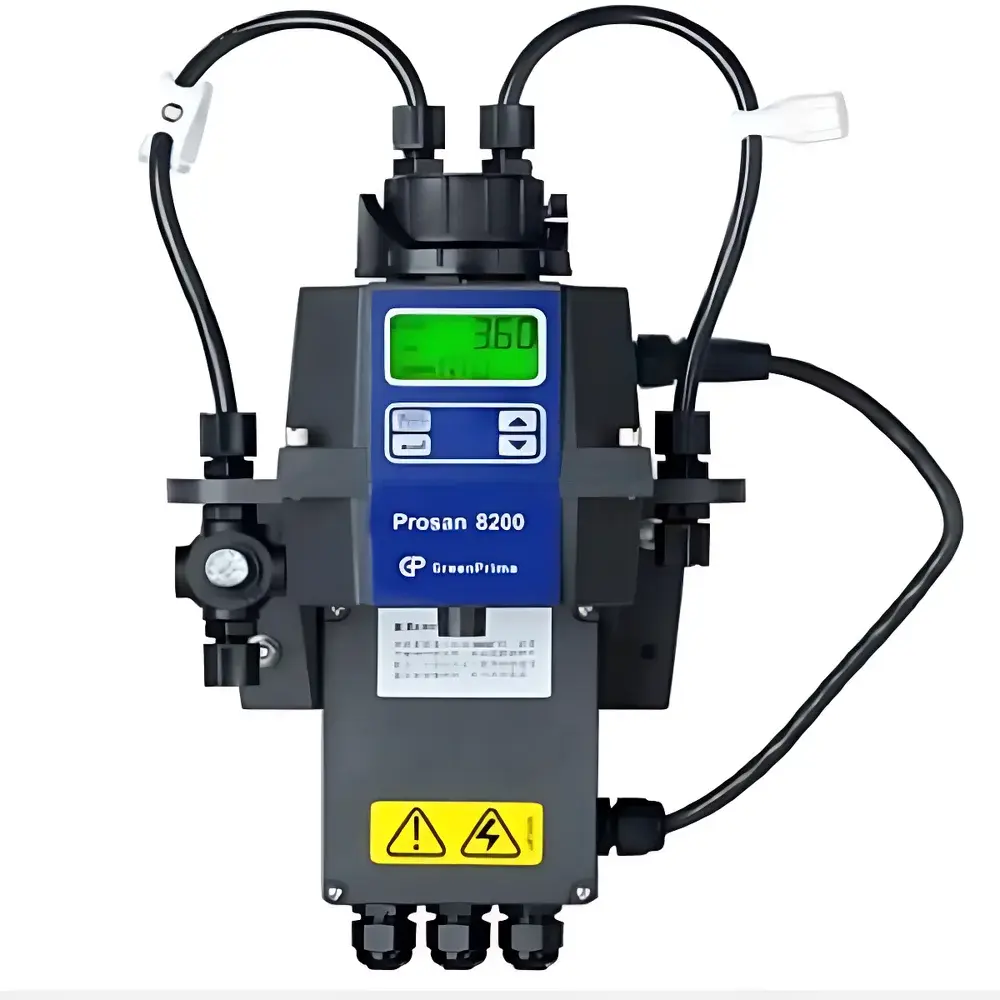
GreenPrima Prosan 8200 Online Turbidimeter
| Brand | GreenPrima |
|---|---|
| Origin | United Kingdom |
| Manufacturer Type | Original Equipment Manufacturer (OEM) |
| Product Category | Imported Instrument |
| Model | Prosan 8200 |
| Measurement Principle | 90° Nephelometric Scattering |
| Measurement Range | 0–1000 NTU |
| Resolution | 0.0001 NTU (adjustable) |
| Accuracy | ±2% of reading or ±0.02 NTU (≤40 NTU) |
| Response Time | 5–500 s (adjustable) |
| Light Source | 850 nm LED (7-year lifetime) |
| Sample Pressure Range | 1–200 psi (integrated pressure regulator, factory-set to 15 psi) |
| Operating Temperature | 1–50 °C |
| Display | Backlit multi-line LCD |
| Output Signals | Isolated 4–20 mA and/or RS-485 (MODBUS RTU protocol) |
| Alarm Outputs | Two independent Hi/Lo relay outputs (250 VAC) |
| Enclosure Rating | IP66 |
| Dimensions | 35 × 30 × 30 cm |
| Weight | 2.5 kg |
| Installation | Wall-mount |
Overview
The GreenPrima Prosan 8200 Online Turbidimeter is a high-performance, continuous-monitoring nephelometer engineered for precision turbidity measurement in demanding industrial and municipal water applications. It operates on the standardized 90° scattered light detection principle, compliant with both U.S. EPA Method 180.1 and ISO 7027:2016 for turbidity determination in drinking water and process streams. Unlike benchtop or portable units, the Prosan 8200 is designed as a permanently installed, process-integrated instrument—capable of real-time, unattended operation under variable hydraulic and environmental conditions. Its optical architecture employs a stable 850 nm infrared LED source, selected to minimize interference from color and natural organic matter while ensuring long-term photometric consistency over its rated 7-year service life. The sensor’s flow cell integrates an internal pressure regulation system, maintaining optimal sample flow at a fixed 15 psi regardless of upstream fluctuations—a critical feature for reproducible scattering geometry and signal stability.
Key Features
- True online capability with integrated pressure-regulated flow cell (1–200 psi input range, factory-set to 15 psi)
- High-resolution detection down to 0.0001 NTU, with user-selectable resolution scaling across the full 0–1000 NTU range
- Dual-mode accuracy specification: ±2% of reading or ±0.02 NTU at low concentrations (≤40 NTU); ±5% of reading at higher turbidities
- Active moisture management system featuring replaceable desiccant cartridges and internal cooling fan to prevent condensation-induced optical drift
- Automatic desiccant exhaustion alert via onboard diagnostics—reducing unscheduled maintenance and calibration uncertainty
- Modular optical and electronics architecture enabling field-replaceable components without full unit removal
- Configurable response time (5–500 seconds), allowing optimization for either rapid transient detection or noise-suppressed averaging in steady-state processes
- IP66-rated enclosure suitable for outdoor or wet-location installation without additional housing
Sample Compatibility & Compliance
The Prosan 8200 is validated for continuous monitoring of clarified and raw water streams, including filter influent and effluent, distribution system nodes, and recirculating loops in food & beverage, pharmaceutical, and power generation facilities. It meets the optical performance criteria defined in ISO 7027 for formazin-equivalent turbidity reporting and satisfies the instrumental requirements of U.S. EPA Method 180.1 for regulatory-grade compliance monitoring. When deployed in GMP or GLP environments, the device supports audit-ready operation through time-stamped calibration logs, configurable data retention, and MODBUS-enabled integration with SCADA or LIMS platforms. Its 4–20 mA output is intrinsically isolated to prevent ground-loop interference in electrically noisy plant settings, and relay alarm outputs are rated for direct connection to PLC safety circuits per IEC 61000-4 standards.
Software & Data Management
Local configuration and diagnostics are performed via the built-in backlit LCD interface with intuitive menu navigation. All operational parameters—including measurement range, response time, alarm thresholds, and calibration history—are stored in non-volatile memory with battery-backed timestamping. For centralized oversight, the RS-485 interface implements MODBUS RTU protocol (slave ID configurable), enabling seamless integration into existing industrial control networks. Data logging intervals, hold times, and alarm hysteresis can be remotely adjusted using standard MODBUS function codes (e.g., FC06, FC16). Optional firmware upgrades support enhanced traceability features, including electronic signature capture for calibration events—aligning with FDA 21 CFR Part 11 requirements where electronic records are subject to regulatory review.
Applications
- Real-time turbidity monitoring at key points in municipal water treatment: coagulation/flocculation basins, sedimentation effluent, dual-media filter influent/effluent, and finished water storage outlets
- Early-warning detection of filter breakthrough or membrane integrity loss in advanced treatment plants
- Process water quality assurance in pharmaceutical clean steam condensate loops and purified water (PW) distribution systems per USP
- Monitoring of cooling tower make-up and blowdown cycles to optimize biocide dosing and minimize fouling risk
- Quality control in beverage production lines—especially for bottled water, juice, and dairy-based beverages where suspended solids affect clarity and shelf-life
- Regulatory reporting compliance for utilities operating under national drinking water standards (e.g., EU Directive 98/83/EC, China GB 5749-2022)
FAQ
What turbidity standards are supported for calibration?
The Prosan 8200 is compatible with primary formazin standards (e.g., StablCal® or equivalent traceable to NIST SRM 2134), as well as secondary polymer-based standards meeting ISO 7027 metrological equivalence. Calibration kits include reusable cuvettes and documented lot-specific reference values.
Can the instrument operate under variable inlet pressure?
Yes—the integrated pressure regulator maintains a constant 15 psi across the measurement cell regardless of upstream pressure between 1 and 200 psi, ensuring consistent flow velocity and scattering geometry.
Is the 850 nm LED source replaceable in the field?
No—the LED is sealed within the optical module and rated for 7 years of continuous operation; replacement requires module-level service under warranty or extended service agreement.
How does the desiccant monitoring system work?
A humidity-sensitive indicator integrated into the desiccant cartridge triggers a visual and relay-based alert when saturation exceeds 80%, prompting scheduled replacement before optical window fogging occurs.
Does the device support digital communication for predictive maintenance?
Yes—MODBUS registers include diagnostic flags for desiccant status, LED intensity decay, temperature excursion history, and calibration interval expiration, enabling integration with CMMS platforms for condition-based servicing.



