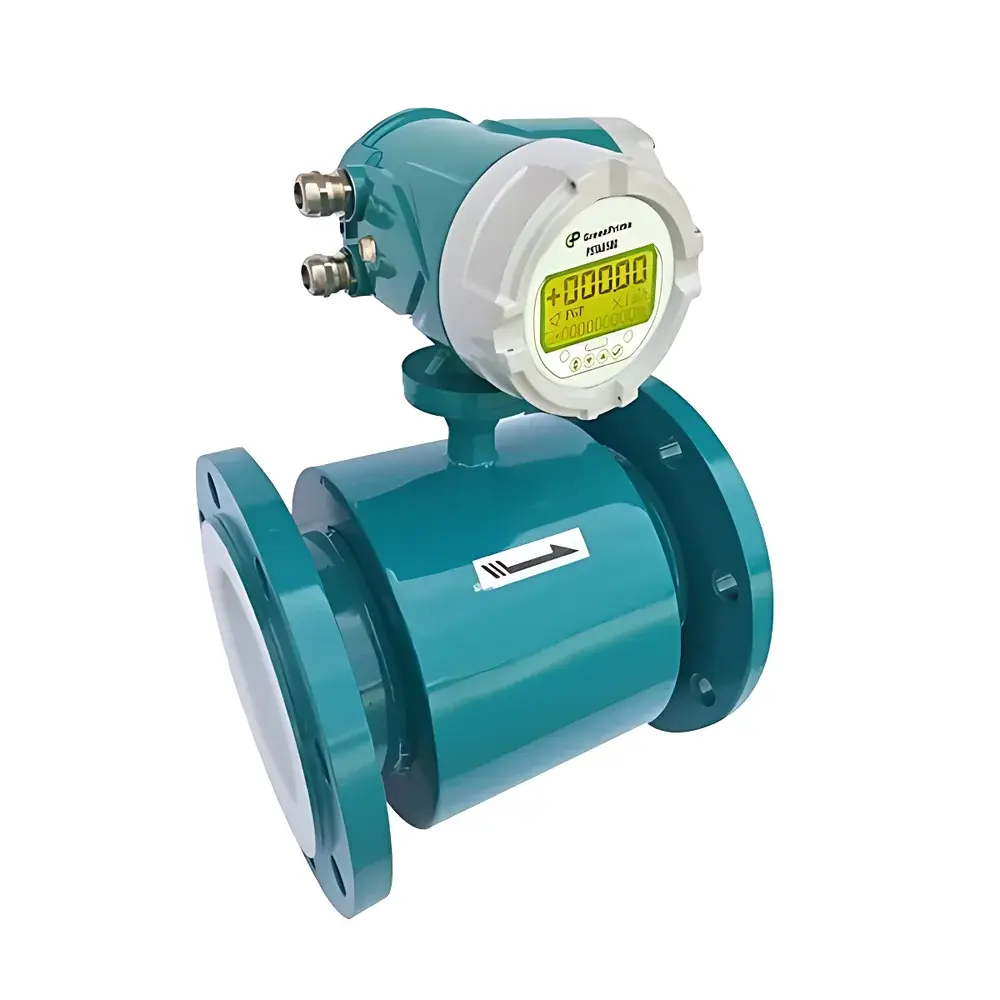
GreenPrima PSTA B500 Electromagnetic Flow Meter
| Brand | GreenPrima |
|---|---|
| Origin | United Kingdom |
| Manufacturer Type | Manufacturer |
| Origin Category | Imported |
| Model | PSTA B500 |
| Pricing | Upon Request |
Overview
The GreenPrima PSTA B500 Electromagnetic Flow Meter is a high-performance, industrial-grade online flow measurement instrument engineered for precision volumetric flow monitoring of conductive liquids in demanding process environments. Operating on Faraday’s Law of Electromagnetic Induction, the device measures flow velocity by detecting the voltage induced across a conductive fluid moving perpendicularly through a magnetic field. This principle ensures measurement independence from fluid density, viscosity, temperature, pressure, and moderate variations in conductivity—provided the liquid maintains a minimum conductivity of 5 µS/cm. Designed for continuous, non-intrusive installation in pipelines, the PSTA B500 features a zero-moving-parts measuring tube, eliminating pressure loss and minimizing maintenance requirements. Its robust electromagnetic architecture delivers stable, repeatable output under fluctuating process conditions, making it suitable for applications ranging from municipal water distribution to aggressive chemical dosing and pulp & paper stock handling.
Key Features
- Full-bore, obstruction-free flow tube with no internal moving parts—ensures negligible pressure drop and long-term metrological stability.
- Bi-directional flow measurement capability with real-time direction indication and integrated flow reversal compensation.
- Advanced self-diagnostic firmware supporting continuous sensor health monitoring, electrode contamination detection, and empty-pipe identification with automatic zero reset.
- Wide operating flow velocity range: 0.1–15 m/s, compatible with nominal pipe sizes from DN10 to DN2200 (0.4″ to 86″).
- High-accuracy performance: ≤ ±0.3% of reading (typical), with repeatability better than ±0.1% of reading under controlled calibration conditions.
- Configurable power options: 85–260 VAC or 11–40 VDC, supporting both hazardous and non-hazardous area installations.
- IP65/IP67/IP68 ingress protection ratings available—validated for outdoor, washdown, and submersible deployments.
- Backlit, high-contrast LCD display with intuitive multilingual menu navigation (English interface standard); supports local configuration without external software.
Sample Compatibility & Compliance
The PSTA B500 is validated for use with a broad spectrum of conductive process media, including potable water, wastewater, acids (e.g., HCl, H₂SO₄), alkalis (e.g., NaOH), saline solutions, slurries, mineral pulps, and paper stock suspensions. Electrode materials—including 316L stainless steel, Hastelloy B/C, titanium, tantalum, platinum-iridium, and niobium—are selected based on corrosion resistance requirements. Liner options (PTFE, F46, chloroprene rubber, polyurethane, ceramic, and alumina) accommodate thermal, abrasive, and chemical compatibility constraints. The instrument complies with IEC 61326-1 (EMC for industrial environments), IEC 61000-4 series immunity standards, and meets CE marking requirements. Optional configurations support ATEX/IECEx Zone 1/21 certification and intrinsic safety (IS) barriers for hazardous locations.
Software & Data Management
The PSTA B500 integrates native Modbus RTU (RS485) as standard, with optional Hart 7.5 protocol, RS232 serial interface, and GPRS telemetry modules for remote data transmission. All digital outputs support full bidirectional communication for parameter configuration, diagnostics retrieval, and firmware updates. Audit-trail-capable data logging is available via optional SD card module or external SCADA integration. The device supports time-stamped event recording (e.g., alarms, zero shifts, power cycles) aligned with GLP/GMP traceability expectations. Configuration files are exportable in CSV format; no proprietary software is required for basic setup—field engineers may use standard terminal emulators or industry-standard DCS/HMI tools.
Applications
- Chemical processing: Corrosive reagent dosing, batch reactor feed control, effluent monitoring.
- Water & wastewater: Influent/effluent metering, pump station optimization, leak detection networks.
- Pulp & paper: Stock flow control in headboxes, white water recirculation, chemical additive injection.
- Pharmaceutical manufacturing: Purified water (PW) and water-for-injection (WFI) loop monitoring per USP guidance.
- Mining & metallurgy: Slurry transport measurement in tailings pipelines and leach circuit control.
- Food & beverage: CIP solution flow verification, syrup blending accuracy assurance, brewery wort transfer.
FAQ
What is the minimum fluid conductivity required for reliable operation?
The PSTA B500 requires a minimum conductivity of 5 µS/cm. Below this threshold, signal-to-noise ratio degrades significantly, compromising measurement integrity.
Can the meter operate in partially filled pipes?
No—it is designed exclusively for full-pipe, closed-conduit applications. Partially filled or open-channel flows require ultrasonic or flume-based measurement solutions.
Is factory calibration traceable to national standards?
Yes—each unit ships with a UKAS-accredited calibration certificate (ISO/IEC 17025) referencing NPL primary standards, valid for 12 months under normal operating conditions.
Does the device support intrinsically safe installation in Zone 0?
Not natively. Intrinsically safe operation up to Zone 1/21 is achievable using certified associated apparatus (e.g., Zener barriers or galvanic isolators) compliant with IEC 60079-11.
How is empty-pipe detection implemented?
The meter continuously monitors electrode impedance and signal amplitude variance; upon sustained low-signal condition, it triggers an auto-zero hold function and activates configurable alarm outputs.
Related Products