
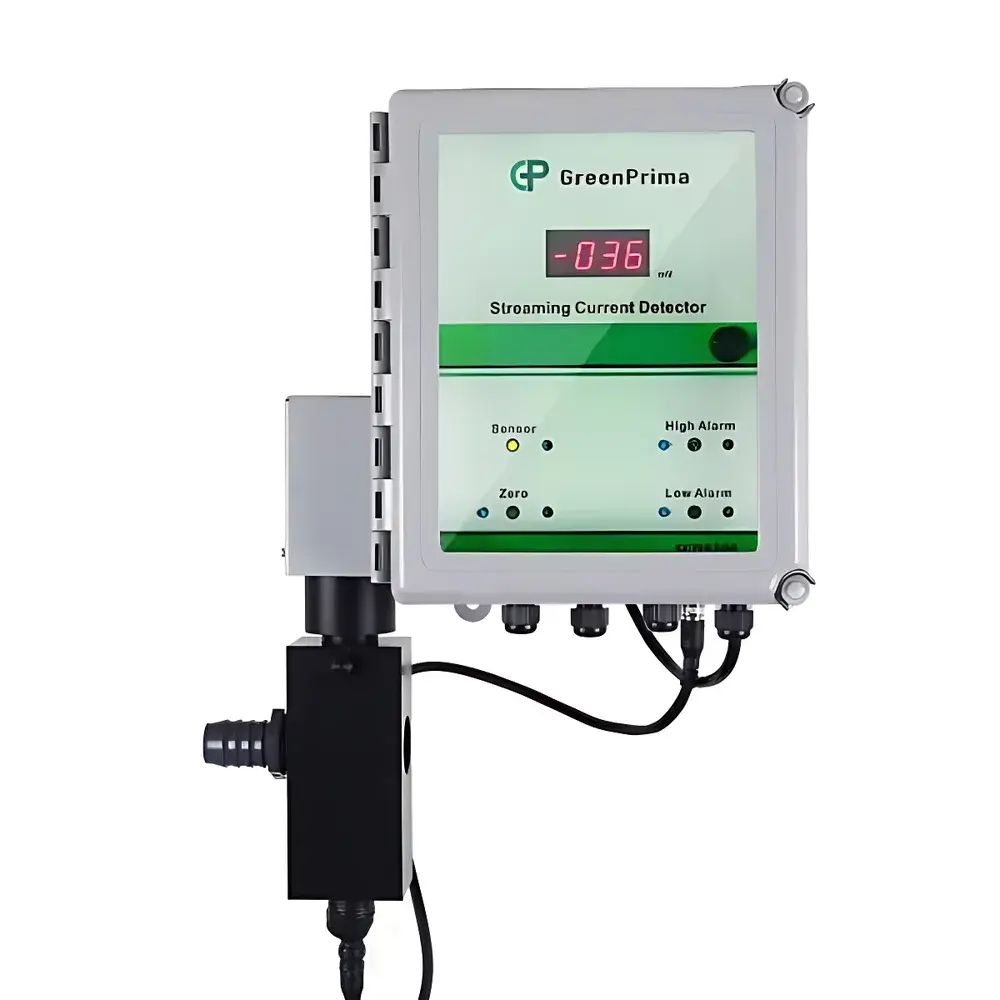
GreenPrima SC D8 200 Streaming Current Analyzer
| Brand | GreenPrima |
|---|---|
| Origin | Germany |
| Manufacturer Type | Manufacturer |
| Origin Category | Imported |
| Model | SC D8 200 |
| Price | Upon Request |
| Power Supply | 100–240 VAC |
| Measurement Range | −1000 to +1000 mV |
| Accuracy | ±0.1% of full scale |
| Display | LED |
| Flow Rate | 1 L/min |
| Inlet Connection | 1/2" |
| Outlet Connection | 3/4" |
| Response Time | 1 s |
| Sensor Material | Delrin / 316 Stainless Steel / PTFE |
| Output Signals | 4–20 mA, −10 to +10 V, 0–10 V |
| Communication | MODBUS (optional) |
| Alarm Outputs | High/Low relay |
| Enclosure Rating | IP65 |
| Dimensions | 11.0" × 6.00" |
| Weight | 9 kg |
Overview
The GreenPrima SC D8 200 Streaming Current Analyzer is an industrial-grade, online electrokinetic measurement instrument engineered for real-time monitoring and control of coagulation efficiency in water and wastewater treatment processes. It operates on the principle of streaming current detection—a well-established electrophoretic phenomenon where mechanical shear induces charge displacement at the solid–liquid interface. Specifically, a motor-driven piston reciprocates within a precision-machined sensor chamber, generating controlled laminar flow across a fixed electrode pair immersed in the sample stream. This hydrodynamic shear disrupts the electrical double layer surrounding colloidal particles and dissolved ionic species, liberating counterions that migrate under the applied electric field gradient—producing a measurable alternating current between the electrodes. The magnitude and polarity of this streaming current correlate directly with the net surface charge density (i.e., zeta potential proxy) of suspended particulates post-coagulant dosing, enabling quantitative assessment of charge neutralization efficacy.
Key Features
- Real-time, continuous streaming current measurement with 1-second response time for dynamic process adaptation
- Auto-zero calibration routine eliminating manual drift correction and ensuring long-term baseline stability
- Robust sensor construction using chemically inert materials: Delrin housing, 316 stainless steel wetted components, and PTFE-sealed electrodes for corrosion resistance in aggressive aqueous matrices
- IP65-rated enclosure suitable for installation in humid, non-hazardous plant environments including pump stations, clarifier inlets, and membrane pre-treatment skids
- Flexible analog and digital output options—including isolated 4–20 mA, ±10 V, and 0–10 V signals—enabling seamless integration into existing DCS, PLC, or SCADA architectures
- Optional MODBUS RTU communication protocol supporting remote configuration, data logging, and diagnostic access via serial interface
- Integrated high/low alarm relays for automated actuation of chemical dosing pumps or system interlocks based on predefined streaming current thresholds
Sample Compatibility & Compliance
The SC D8 200 is validated for use with potable water, surface water, municipal and industrial wastewater, sludge filtrate, and reverse osmosis feed streams across pH ranges of 4.0–10.5 and turbidity levels up to 500 NTU. Its design conforms to IEC 61000-6-2 (EMC immunity) and IEC 61000-6-4 (EMC emissions) standards. While not certified for SIL or ATEX applications, the analyzer meets general-purpose instrumentation requirements under ISO 9001 manufacturing controls and supports GLP/GMP-aligned operational documentation through configurable audit trails (when paired with compatible supervisory software). It is routinely deployed in facilities subject to EPA Clean Water Act compliance, EU Drinking Water Directive (2020/2184), and ISO 24510-based asset management frameworks.
Software & Data Management
The SC D8 200 operates as a stand-alone field instrument but supports external data acquisition via its analog outputs or optional MODBUS interface. When integrated with third-party SCADA systems or vendor-supplied configuration utilities, users can archive time-stamped streaming current values, alarm events, and sensor diagnostics. The device logs internal self-test results and flow integrity status, facilitating predictive maintenance planning. Though it does not embed FDA 21 CFR Part 11-compliant electronic signatures natively, its deterministic signal output and traceable calibration history support regulatory validation when deployed within documented quality systems requiring IQ/OQ/PQ protocols.
Applications
- Optimized coagulant dosing control in drinking water treatment plants—reducing overdosing while maintaining turbidity removal targets
- Dynamic adjustment of polymer dosage in dewatering centrifuges and belt filter presses to improve cake solids content and reduce polymer consumption
- Pre-treatment monitoring for low-pressure and high-pressure membrane systems (e.g., MF/UF/RO) to prevent fouling by charged organic colloids
- Process optimization in industrial effluent treatment—especially for textile, pulp & paper, and metal finishing wastewaters containing complex anionic/cationic contaminants
- Research and pilot-scale studies evaluating novel coagulants, hybrid coagulant–flocculant systems, or electrocoagulation performance
FAQ
What physical parameter does the SC D8 200 actually measure?
It measures streaming current—a direct electrokinetic indicator of net surface charge in flowing aqueous suspensions, proportional to residual coagulant demand and colloidal stability.
Can the SC D8 200 replace offline zeta potential measurements?
No—it provides a robust, process-relevant surrogate for zeta potential under dynamic flow conditions but lacks the controlled electrophoretic cell geometry required for absolute zeta determination per ASTM D7826.
Is field recalibration required during routine operation?
No; the auto-zero function compensates for electrode polarization drift, though periodic verification against reference standards (e.g., KCl solutions) is recommended every 6 months.
Does the instrument require sample filtration prior to analysis?
Not inherently—but inlet straining (e.g., 100 µm mesh) is advised to prevent piston jamming from coarse particulates or biofilm fragments.
How is sensor fouling mitigated in long-term installations?
The reciprocating piston action provides inherent mechanical cleaning; additionally, programmable backflush cycles can be triggered externally via relay or MODBUS command.





