
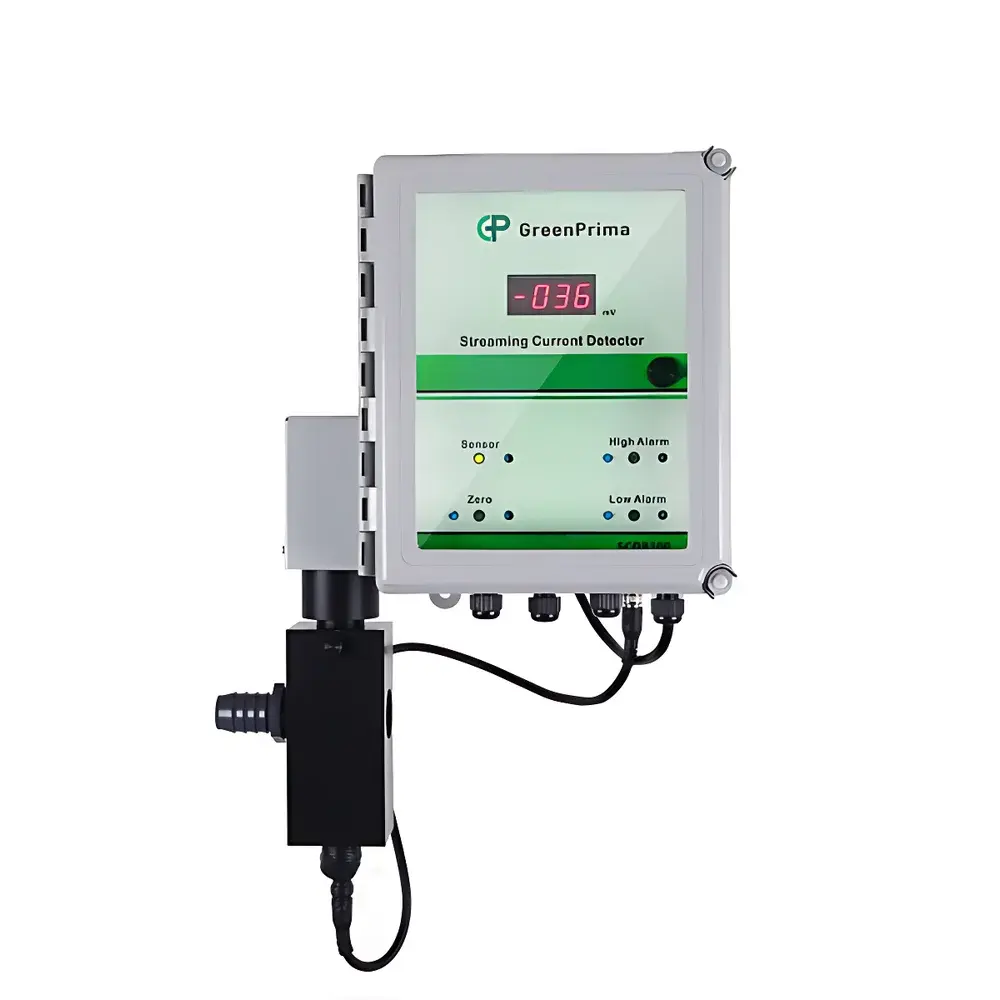
GreenPrima SCD8200 Streaming Current Detector
| Brand | GreenPrima |
|---|---|
| Origin | USA |
| Manufacturer | GreenPrima, Inc. |
| Model | SCD8200 |
| Measurement Principle | Streaming Current Detection |
| Output Signal | 4–20 mA / ±10 V / 0–10 V |
| Power Supply | 230 VAC |
| Measurement Range | −1000 to +1000 mV |
| Accuracy | ±0.1% of full scale |
| Response Time | 1 s |
| Sample Flow Rate | 1 US gal/min (≈3.785 L/min) |
| Inlet Connection | 1/2″ barbed fitting |
| Outlet Connection | 3/4″ barbed fitting |
| Enclosure Rating | NEMA 4X, IP65 |
| Operating Temperature | −10 °C to +50 °C |
| Weight | 9 kg |
| Alarm Outputs | Hi/Lo relay contacts |
Overview
The GreenPrima SCD8200 Streaming Current Detector is an industrial-grade, online electrokinetic analyzer engineered for real-time optimization of coagulant dosing in potable water and wastewater treatment processes. It operates on the principle of streaming current measurement—a well-established electrophoretic technique that quantifies the net surface charge density of colloidal particles suspended in aqueous solution. As coagulants (e.g., aluminum sulfate, ferric chloride, or polyaluminum chloride) are introduced, the detector monitors shifts in the streaming current signal, which correlates directly with the neutralization point of particle surface charge. This enables precise endpoint detection for optimal coagulant dosage—minimizing overdosing while ensuring consistent floc formation and downstream filtration performance. Deployed at the Chengdu Municipal Waterworks, the SCD8200 supports continuous, unattended operation in raw water intake, rapid mix basins, and pre-filtration stages of municipal drinking water production.
Key Features
- High-stability streaming current sensor with corrosion-resistant electrode assembly and integrated flow cell designed for long-term reliability in turbid, variable-quality source water
- NEMA 4X non-metallic enclosure with gasket-sealed hinged door and stainless-steel locking latches—rated for outdoor, wet, and dust-laden environments
- Field-adjustable zero offset and signal gain calibration—no external tools required; accessible via front-panel potentiometers
- Real-time self-diagnostic function with status-indicating LED: green = normal operation, amber = low flow or sensor fouling warning, red = fault condition
- Dual analog output configuration (4–20 mA primary, ±10 V or 0–10 V secondary) for seamless integration into existing SCADA or PLC-based control systems
- Optional Modbus RTU (RS-485) interface supporting standard register mapping for remote parameter readout, setpoint adjustment, and event logging
Sample Compatibility & Compliance
The SCD8200 is validated for use with potable water, surface water, groundwater, and clarified effluent across pH ranges of 5.5–9.0 and turbidity levels up to 100 NTU. It complies with ANSI/AWWA B100-2019 (Standard for Online Water Quality Monitoring Equipment) and meets the mechanical and environmental requirements of IEC 60529 (IP65) and UL 50E (NEMA 4X). Its analog outputs conform to NAMUR NE43 standards for signal fault detection. For regulatory reporting contexts, the instrument supports audit-trail-capable data logging when interfaced with compliant DCS platforms adhering to 21 CFR Part 11 requirements—though the unit itself does not store electronic records. Installation follows ASTM D3370 practice for sampling integrity in flowing water systems.
Software & Data Management
The SCD8200 operates as a standalone transducer without embedded firmware or onboard software. All configuration, calibration, and alarm thresholds are set locally via physical controls. Analog output signals feed directly into programmable logic controllers (PLCs) or distributed control systems (DCS), where proprietary or third-party SCADA applications (e.g., Ignition, Siemens Desigo, or Honeywell Experion) perform trend analysis, dose-response modeling, and closed-loop PID control of coagulant metering pumps. When equipped with the optional Modbus interface, the device exposes registers for live streaming current value, temperature-compensated status flag, flow verification status, and diagnostic codes—enabling integration into asset management platforms aligned with ISO 55000 principles. No cloud connectivity or vendor-specific software is required or supported.
Applications
- Municipal drinking water treatment plants seeking compliance with China’s GB 5749–2022 and EPA Clean Water Act coagulation efficiency benchmarks
- Pre-treatment monitoring for reverse osmosis (RO) and nanofiltration (NF) membrane systems to prevent fouling and extend membrane life
- Sludge dewatering optimization in wastewater treatment facilities using cationic polymer dosing control
- Industrial process water recycling loops requiring stable colloidal stability indices (CSI) under variable influent conditions
- Research and pilot-scale studies evaluating novel coagulants, hybrid coagulant–flocculant systems, or electrocoagulation parameters
FAQ
What is the recommended maintenance interval for the SCD8200 sensor?
Visual inspection and cleaning of the flow cell and electrodes are advised every 30 days in high-turbidity applications; quarterly calibration verification is sufficient for stable, low-particulate source waters.
Can the SCD8200 be installed on pressurized main lines?
No—it requires gravity-fed or low-pressure (<2 psi) sample flow; a dedicated side-stream loop with a peristaltic or diaphragm pump and pressure-reducing valve must be configured per AWWA manual M20 guidelines.
Does the instrument compensate for temperature drift?
Yes—the internal thermistor provides passive temperature feedback to the analog signal conditioning circuit, maintaining measurement stability across −10 °C to +50 °C ambient operating range.
Is the SCD8200 suitable for seawater or brackish water applications?
Not recommended—high ionic strength suppresses measurable streaming current response; alternative zeta potential analyzers or jar-test correlation methods are advised for saline matrices.
How is sensor fouling detected?
Fouling manifests as reduced signal amplitude, increased noise, or failure to respond to known coagulant spikes; the self-diagnostic LED transitions from green to amber, and the 4–20 mA output may saturate at 3.6 mA (low fault) or 21.0 mA (high fault) per NAMUR NE43.
Related Products







