
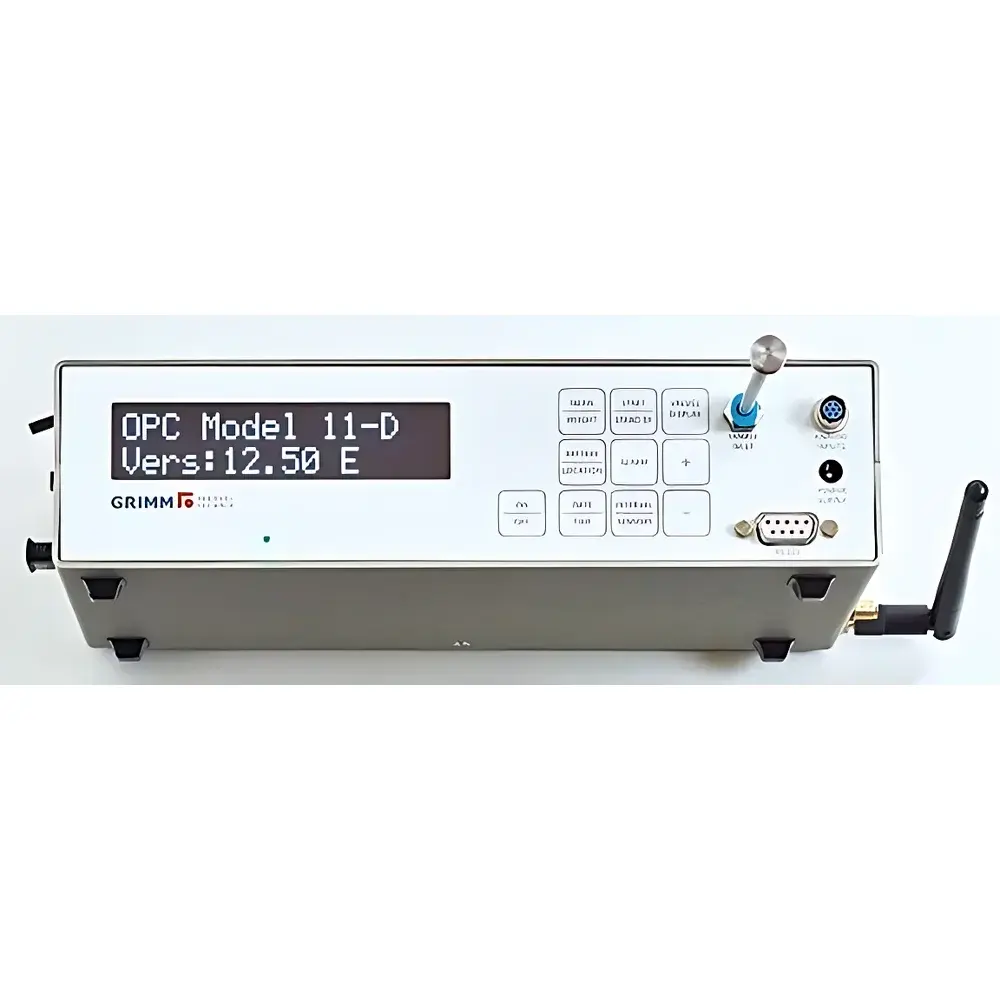
GRIMM 11-D Portable Laser Aerosol Particle Size Spectrometer
| Brand | GRIMM |
|---|---|
| Origin | Germany |
| Model | 11-D |
| Measurement Principle | Single-Particle 90° Laser Light Scattering |
| Sampling Flow Rate | 1.2 L/min ± 3% |
| Particle Size Range | 0.253–35.15 µm |
| Number Concentration Range | 1–3,000,000 particles/L |
| Size Channels | 31 equidistant logarithmic channels |
| Mass Concentration Range | 0.1 µg/m³ – 100 mg/m³ |
| Battery Life | 10 h (Li-ion, 10.8 V / 6.5 Ah) |
| Dimensions | 27 × 13 × 7 cm |
| Weight | 2.1 kg |
| Operating Temperature | +4 °C to +40 °C |
| Relative Humidity | <95% RH (non-condensing) |
| Compliance | ISO 21501-1, EN 481 |
Overview
The GRIMM 11-D Portable Laser Aerosol Particle Size Spectrometer is an ISO 21501-1 compliant, field-deployable instrument engineered for high-fidelity real-time aerosol size distribution analysis in ambient, occupational, and industrial environments. It employs single-particle detection via 90° laser light scattering (683 nm diode laser, Pmax = 40 mW), combined with aerodynamic focusing to ensure full volumetric sampling without boundary losses or inlet artifacts. Unlike ensemble-integrated optical methods, the 11-D resolves individual particle events across its 31 equidistant logarithmic size channels (0.253–35.15 µm), delivering simultaneous number concentration, mass concentration (calculated per EN 481 deposition fractions), and surface-area-weighted distributions. Its optical detection chamber features continuous purge airflow (0.4 L/min) to maintain laser path integrity and minimize contamination drift—critical for long-term field stability and measurement reproducibility (>97% at full scale).
Key Features
- Compact, ruggedized design (2.1 kg, 27 × 13 × 7 cm) optimized for handheld or tripod-mounted deployment in uncontrolled environments.
- Integrated lithium-ion battery (10.8 V / 6.5 Ah) enabling 10 hours of continuous operation; supports rapid charging and hot-swap capability via optional spare battery module (Part No. 1110).
- Precisely regulated constant-flow sampling (1.2 L/min ± 3%, per ISO 21501-1) with active feedback control, eliminating flow-dependent sizing bias.
- Real-time, on-board calculation of regulatory-relevant mass fractions: PM10, PM4, PM2.5, PM1.0, PMcoarse, and EN 481-defined inhalable, thoracic, and respirable fractions.
- Dual-output capability: simultaneous display of number concentration (particles/L) and mass concentration (µg/m³) with configurable averaging intervals (6 s to 60 min).
- 47 mm PTFE filter holder integrated into the sample stream for gravimetric, chemical, or electron microscopy follow-up analysis—compatible with standard filter protocols (e.g., EPA IO-3.2, EN 12341).
- Self-diagnostic startup sequence verifying optical alignment, laser output, photodetector response, pump performance, and purge gas flow prior to measurement initiation.
- Multi-interface connectivity: Bluetooth 4.2, Ethernet (10/100 Mbps), USB 2.0, and RS-232—enabling remote monitoring, firmware updates, and synchronized sensor integration.
Sample Compatibility & Compliance
The 11-D accepts aerosols across a broad hygroscopic and morphological spectrum—including combustion soot, mineral dust, bioaerosols, salt particles, and engineered nanomaterials—without requiring preconditioning or drying. Its isokinetic sampling probe (Part No. 1152, 4–25 m/s velocity range) ensures representative intake from ducts, stacks, or open-air plumes. The instrument complies with ISO 21501-1 for light-scattering particle sizers and implements EN 481 particle fraction definitions for occupational health assessments. Data traceability meets GLP/GMP-aligned requirements through timestamped, error-flagged logging and audit-ready metadata (battery status, pump flow, self-test results). Optional sensors (temperature, relative humidity, wind speed, GPS) extend environmental context without compromising core metrology.
Software & Data Management
GRIMM’s proprietary 1179 software (Windows 32/64-bit compatible) provides real-time visualization of time-resolved size spectra, cumulative mass distributions, and fractional PM metrics. It supports export of raw channel counts, calibrated mass concentrations, and diagnostic logs in CSV, TXT, and XML formats—structured for ingestion into LIMS, statistical analysis platforms (e.g., R, Python pandas), or regulatory reporting tools. The software enforces data integrity via embedded checksums, session-level encryption (AES-128), and configurable user access levels. All measurements include embedded calibration traceability to NIST-traceable PSL standards (polystyrene latex spheres), with documented uncertainty budgets available upon request. Firmware updates preserve backward compatibility with historical datasets and retain full audit trail functionality per FDA 21 CFR Part 11 guidelines.
Applications
- Ambient air quality monitoring (TSP, PM10, PM2.5) in urban, rural, and roadside networks.
- Occupational exposure assessment in construction, mining, pharmaceutical manufacturing, and spray coating facilities.
- Source apportionment studies—differentiating fugitive dust, process emissions, and secondary aerosols via temporal size-resolved signatures.
- Indoor air quality diagnostics in schools, hospitals, and office buildings, including HVAC system efficiency verification.
- Field validation of fixed-site monitors and low-cost sensor networks using reference-grade size distribution benchmarks.
- Research on aerosol transformation processes (coagulation, condensation, hygroscopic growth) under controlled or ambient conditions.
FAQ
How does the 11-D achieve high-size-resolution without sheath flow?
The instrument uses aerodynamic focusing within the optical sensing volume to align particles along the laser beam axis—eliminating the need for complex sheath gas systems while maintaining >97% counting efficiency across the full 0.25–35 µm range.
Can the 11-D measure ultrafine particles below 0.25 µm?
No—the lower detection limit is defined by optical scattering cross-section sensitivity at 683 nm; sub-0.25 µm particles require CPC-based or DMA-coupled instrumentation.
Is filter collection mandatory during operation?
No—filter insertion is optional and only required when offline chemical or microscopic analysis is planned; real-time optical measurement proceeds independently.
What calibration standards are used, and how often is recalibration needed?
Factory calibration uses NIST-traceable PSL spheres (0.253–35.15 µm); annual verification is recommended, with field checks possible using the included zero-filter (Part No. 1148) and dilution modules (10× or 100×, Part Nos. 1159-101 and 1159-1001).
Does the 11-D support automated data upload to cloud platforms?
Yes—via Ethernet or USB tethering, raw and processed data streams can be directed to secure FTP, MQTT brokers, or custom REST APIs using third-party middleware or GRIMM’s API extension toolkit.







