
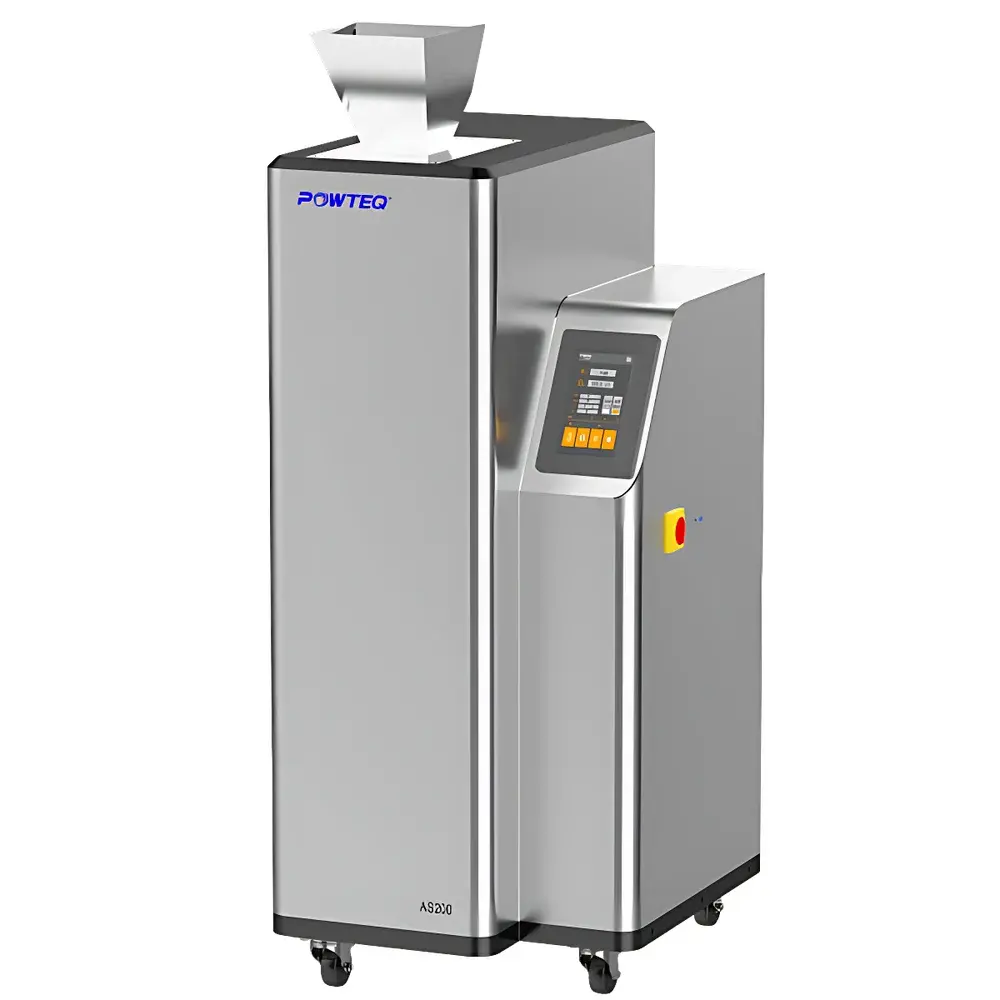
Grinder AS200 Integrated Shelling and Separation System
| Brand | Grinder |
|---|---|
| Origin | Hebei, China |
| Manufacturer Type | Direct Manufacturer |
| Product Category | Domestic |
| Model | AS200 |
| Instrument Type | Laboratory Grinder |
| Sample Compatibility | Hard-shelled samples |
| Max. Batch Capacity | ≥1 kg (continuous operation capable) |
| Shelling Efficiency | ≥70% |
| Kernel-Shell Separation Efficiency | ≥95% |
| Display | 5-inch LED touchscreen interface |
| Safety Features | Electromagnetic interlock system |
| Compliance | CE certified |
| Rated Voltage | 220 V, 50 Hz |
| Control System | Embedded microprocessor-based controller |
Overview
The Grinder AS200 Integrated Shelling and Separation System is a laboratory-scale mechanical processing unit engineered for the controlled, reproducible shelling and density-based separation of hard-shelled botanical materials. It operates on the principle of centrifugal impact fragmentation: feedstock is accelerated radially by a high-speed impeller rotor, then directed against a hardened impact ring where kinetic energy induces controlled fracture of the outer pericarp or testa. This physical disruption mechanism avoids thermal degradation or chemical alteration—critical for downstream analytical applications such as oil content analysis (e.g., ASTM D6304), proximate composition testing (AOAC 991.36), or sensory evaluation protocols requiring intact kernel morphology. Designed specifically for research laboratories, QC facilities, and pilot-scale food processing units, the AS200 bridges the gap between manual preparation and industrial-scale equipment, delivering consistent sample integrity while enabling traceable, repeatable throughput under GLP-aligned operating conditions.
Key Features
- Centrifugal impact shelling architecture with hardened wear-resistant impact ring—optimized for brittle, high-density shells including peanut, walnut, sunflower seed, and oil tea seed
- Integrated dual-stage separation: primary mechanical separation via adjustable clearance between rotating and stationary discs, followed by pneumatic classification using calibrated air velocity profiles
- 5-inch LED touchscreen interface with programmable parameters—including rotor speed, feed rate control logic, and cycle duration—supporting method recall and user-defined SOP storage
- Electromagnetic safety interlock system that automatically de-energizes the drive motor when the access door is opened, compliant with EN 60204-1 machinery safety standards
- Stainless-steel contact surfaces (AISI 304) and tool-free disassembly design for rapid cleaning and residue verification—meets hygiene requirements for food-grade sample preparation per FDA 21 CFR Part 110
- Modular airflow calibration port for in-situ validation of pneumatic separation performance using standard reference kernels and shell simulants
Sample Compatibility & Compliance
The AS200 accommodates dry, low-moisture (<10% w.b.) botanical seeds and nuts with shell hardness ranging from 25–120 MPa (Brinell scale), including but not limited to Arachis hypogaea (peanut), Juglans regia (walnut), Helianthus annuus (sunflower), Coffea arabica (green coffee bean), and Camellia oleifera (oil tea seed). It is unsuitable for high-oil-content or viscoelastic samples (e.g., fresh coconut, macadamia) due to potential adhesion and clogging. All electrical components conform to CE marking directives (2014/30/EU EMC and 2014/35/EU LVD). The system supports audit-ready documentation: event logs capture start/stop timestamps, operator ID (via optional RFID badge integration), parameter settings, and safety interlock status—enabling alignment with ISO/IEC 17025 clause 7.7 and GLP Principle 5 (record retention and traceability).
Software & Data Management
The embedded controller runs a real-time operating system (RTOS) with deterministic response latency (<10 ms). Method files (.grn format) store full operational configurations—including impeller RPM setpoint, dwell time, air pressure setpoint, and separation gate position—and support version-controlled backups via USB 2.0 interface. Audit trail functionality records all parameter modifications with user attribution and timestamp, satisfying FDA 21 CFR Part 11 requirements for electronic records and signatures when paired with networked authentication. Raw cycle data (motor current draw, temperature at bearing housing, airflow sensor output) can be exported in CSV format for statistical process control (SPC) analysis using external tools such as JMP or Minitab.
Applications
- Preparatory processing prior to Soxhlet fat extraction (AOAC 920.39) or NMR-based oil quantification
- Standardized kernel recovery for aflatoxin screening (USP ) where shell contamination must be excluded from analytical subsamples
- Pilot-scale optimization of shelling parameters for new cultivars undergoing breeding trials (e.g., USDA ARS germplasm evaluation)
- Calibration material generation—producing reference-grade shelled kernels with ≤5% residual shell fragments for instrument validation
- Teaching laboratories demonstrating mechanical property–based separation principles in food engineering curricula
FAQ
What types of samples are incompatible with the AS200?
Samples with moisture content >12% w.b., high oil content (>50%), or fibrous endocarp structures (e.g., coconut, palm nut) are not recommended due to risk of rotor imbalance, airflow obstruction, or incomplete fracture.
Can the AS200 be validated for regulated environments?
Yes—the system supports IQ/OQ documentation packages, including torque calibration certificates for the drive motor, airflow profile mapping reports, and electromagnetic lock functional test records.
Is routine maintenance required beyond cleaning?
Annual inspection of impeller dynamic balance (ISO 1940 G2.5 grade), impact ring wear depth measurement (using depth micrometer), and bearing lubrication interval verification (every 1,000 operational hours) are recommended per the manufacturer’s maintenance log template.
Does the system support integration with LIMS?
Via optional RS-485 Modbus RTU interface, the AS200 can transmit cycle completion signals, error codes, and operator ID to compatible LIMS platforms for automated sample tracking.



