
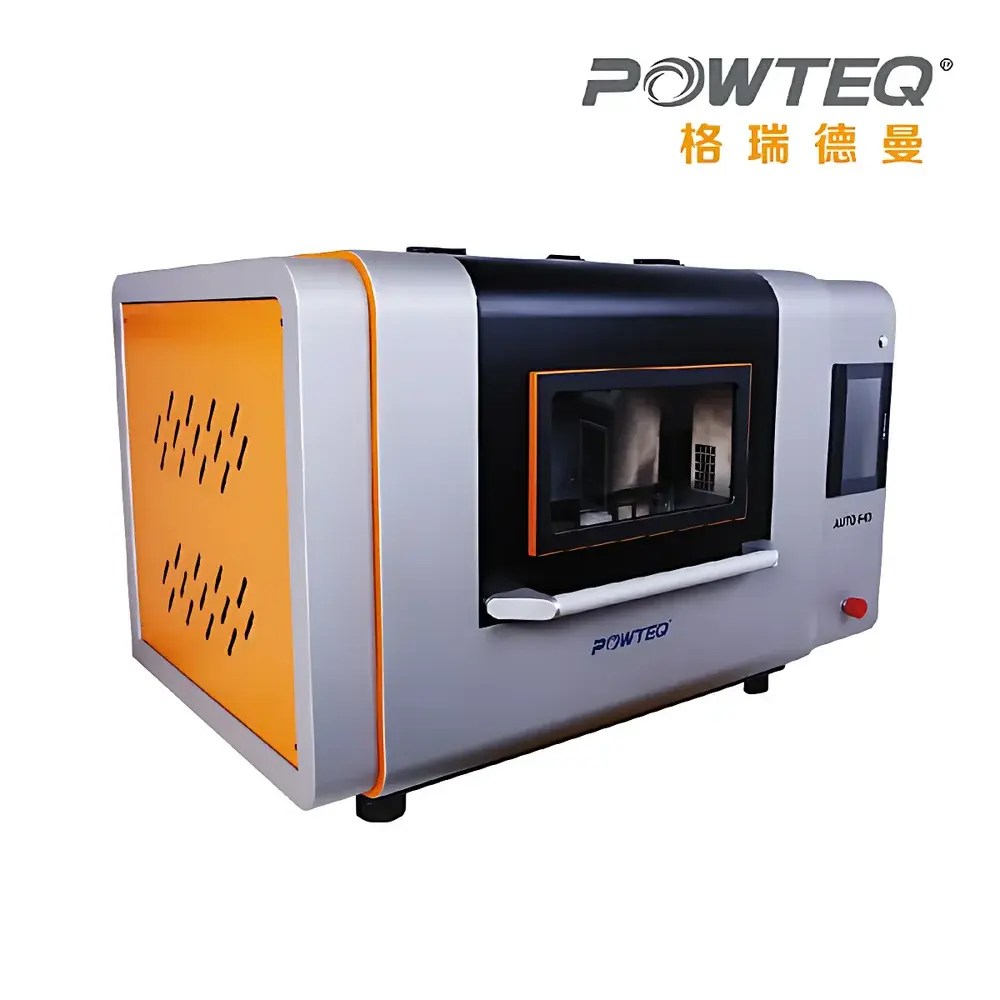
Grinderman Auto-F40 Fully Automated Fusion Machine
| Brand | Grinderman |
|---|---|
| Origin | Beijing, China |
| Manufacturer Type | Direct Manufacturer |
| Country of Origin | China |
| Model | Auto-F40 |
| Dimensions (L×W×D) | 600 × 500 × 600 mm |
| Temperature Control Accuracy | ±1 °C |
| Operating Temperature Range | 0–1200 °C |
| Sample Capacity Options | 1/2/4 crucibles per cycle |
| Rated Power | 3000 W |
| Gas Pressure Requirement | 6 bar |
| Max. Gas Consumption Rate | 1.5 m³/h |
| Throughput | 6–10 samples/h (2-platform) or 12–20 samples/h (4-platform) |
Overview
The Grinderman Auto-F40 Fully Automated Fusion Machine is an industrial-grade, programmable fusion system engineered for the precise preparation of homogeneous glass beads via high-temperature flux fusion—a critical sample preparation step prior to X-ray fluorescence (XRF), inductively coupled plasma optical emission spectrometry (ICP-OES), atomic absorption spectroscopy (AAS), and other elemental analysis techniques. It operates on the principle of controlled alkaline fusion using lithium tetraborate (Li₂B₄O₇), lithium metaborate (LiBO₂), or mixed fluxes, enabling complete dissolution of refractory matrices—including oxides, silicates, sulfides, fluorides, metals, alloys, and geological minerals—into stable, bubble-free glass discs. By eliminating mineralogical effects, particle size bias, and matrix-induced absorption/enhancement artifacts, the Auto-F40 ensures analytical reproducibility (RSD < 1.5% for major elements) and quantitative accuracy traceable to certified reference materials (CRMs). Its dual- or quad-crucible configuration supports batch processing under fully automated thermal protocols, from pre-oxidation through melt homogenization, casting, and controlled cooling.
Key Features
- Fully automated fusion sequence: Pre-oxidation → ramped heating → molten-phase 3D oscillation (±15° tilt, 15 rpm) → gravity-fed casting → programmable cooling
- High-stability silicon molybdenum (MoSi₂) heating elements with 40 °C/min maximum ramp rate and PID-controlled infrared pyrometry (±1 °C accuracy over 0–1200 °C)
- Dual- or quad-platform configurations with independent crucible positioning; compatible with standard Pt/Au (95/5) or Pt/Rh (90/10) crucibles (up to 30 mL capacity)
- Integrated ceramic crucible support and mold holder—designed to minimize thermal stress and extend precious-metal component lifetime
- Sealed fusion chamber with dedicated exhaust ducting and active fume extraction (rated for HF, SO₂, and metal oxide vapors at ≤1.5 m³/h flow)
- 7-inch capacitive touchscreen HMI with embedded PLC logic; preloaded with >20 validated fusion methods (e.g., ISO 9556, ASTM E2627, GB/T 176–2017)
- Single-heater compensation architecture ensures uniform temperature distribution across all crucibles (ΔT < 3 °C at 1100 °C)
Sample Compatibility & Compliance
The Auto-F40 accommodates a broad spectrum of inorganic solid samples: cement clinkers, iron ores, bauxites, slag, ceramics, refractories, fly ash, geological core powders, and non-ferrous metallurgical intermediates. It complies with method requirements specified in ISO 8597 (XRF fusion), ASTM E2627 (fusion for ICP analysis), and Chinese national standard GB/T 176–2017 (cement chemical analysis). All thermal profiles are logged with timestamped audit trails meeting GLP and FDA 21 CFR Part 11 data integrity requirements when paired with optional secure software licensing. The system’s gas-handling subsystem meets ISO 8573-1 Class 2 purity standards for instrument air supply.
Software & Data Management
Fusion protocols are configured and executed via the onboard Grinderman FusionSuite™ firmware, supporting method cloning, parameter locking, user-level access control (admin/operator/guest), and real-time temperature/pressure/graphic status visualization. Raw thermal logs (CSV export) include setpoint, actual temperature, crucible position, gas pressure, and event markers. Optional Ethernet/Wi-Fi connectivity enables remote monitoring, centralized fleet management, and integration with LIMS platforms via OPC UA or MODBUS TCP. Audit trail records retain full operator identity, timestamp, and parameter change history for ≥10 years.
Applications
- Quantitative major- and minor-element analysis in cement and building materials (CaO, SiO₂, Al₂O₃, Fe₂O₃, MgO, SO₃)
- Geochemical mapping of exploration drill cores and soil surveys (Na, K, P, Ti, Mn, Cr, Ni, Zn)
- Quality control of ferrous and non-ferrous alloys (stainless steels, aluminum master alloys, copper concentrates)
- Compliance testing of hazardous substances in electronics (RoHS-relevant Br, Cl, Cd, Pb, Hg, Cr⁶⁺ via fused bead XRF)
- Research-scale development of novel flux formulations and low-melting-point glass matrices
- Reference material certification workflows requiring ultra-low contamination and inter-laboratory comparability
FAQ
What crucible materials are supported?
Standard operation uses Pt/Au (95/5) or Pt/Rh (90/10) crucibles; custom adapters available for graphite or Ir-lined variants.
Is external fume hood connection mandatory?
Yes—the integrated exhaust port must be ducted to a certified chemical fume hood or central abatement system compliant with local occupational exposure limits (OELs).
Can the Auto-F40 be validated for GMP environments?
Yes—IQ/OQ documentation packages and 3Q-ready design (including calibrated IR sensor traceability to NIST standards) are available upon request.
What maintenance intervals are recommended?
Quarterly inspection of MoSi₂ elements, annual thermocouple calibration, and biannual ceramic support replacement under typical 8-hr/day usage.
Does the system support custom flux ratios and multi-step oxidation?
Yes—up to 4 discrete temperature zones and 8 programmable dwell steps per method, including timed O₂ purging sequences.



