
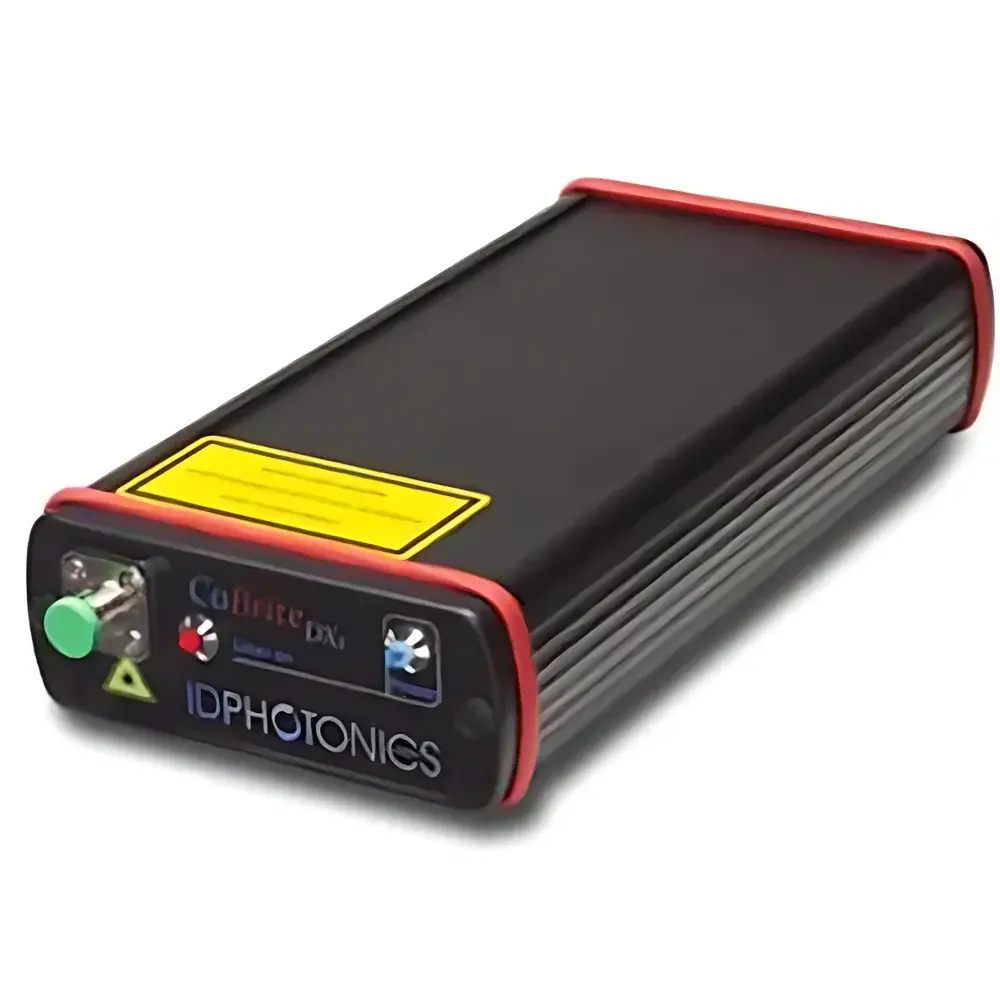
GRINTECH CobriteDX1 Tunable Laser Platform
| Brand | GRINTECH |
|---|---|
| Origin | Canada |
| Manufacturer Type | Authorized Distributor |
| Product Category | Imported Optical Instrument |
| Model | CobriteDX1 Laser Platform |
| Core Technology | Solid-State Tunable Laser System |
| Key Components | Monolithic Diode-Pumped Solid-State (DPSS) Laser Engine, Integrated Wavelength Tuning Mechanism, Precision Thermal & Current Control Electronics |
| Tuning Range | Typically 750–1100 nm (configurable per OEM specification) |
| Output Power | Up to 500 mW (CW, wavelength-dependent) |
| Linewidth | < 50 MHz (typical, with optional narrow-linewidth configuration) |
| Beam Quality | M² < 1.1 |
| Polarization Extinction Ratio | > 20 dB |
| Stability | < ±0.5% RMS power fluctuation over 8 h |
| Interface | RS-232, USB 2.0, Analog TTL for external triggering and modulation |
Overview
The GRINTECH CobriteDX1 Tunable Laser Platform is a high-stability, solid-state diode-pumped laser system engineered for precision spectroscopic applications requiring continuous, mode-hop-free wavelength tuning across the near-infrared (NIR) spectral region. Based on monolithic DPSS architecture with intracavity birefringent filtering and piezo-assisted cavity length control, the CobriteDX1 delivers exceptional spectral purity, low-amplitude noise, and long-term pointing stability—critical for Raman spectroscopy, cavity ring-down absorption (CRDS), optical coherence tomography (OCT) source development, and quantum optics experiments. Unlike tunable external-cavity diode lasers (ECDLs), the CobriteDX1 eliminates alignment sensitivity and mechanical hysteresis through its all-solid-state, hermetically sealed resonator design. Its thermally stabilized crystal mount and low-noise current drivers ensure sub-picometer wavelength repeatability and drift < 2 pm/°C under laboratory conditions.
Key Features
- Monolithic DPSS architecture with no moving parts in the optical cavity—ensuring robustness against vibration and thermal perturbation
- Continuous, mode-hop-free tuning over up to 350 nm (e.g., 750–1100 nm), configurable at time of order per application requirements
- Integrated digital control firmware supporting programmable scan profiles (linear, step, dwell), real-time wavelength lock via optional reference etalon feedback
- Low relative intensity noise (RIN) < −145 dB/Hz (10 kHz–10 MHz), optimized for heterodyne detection and interferometric metrology
- Beam collimation and polarization-maintaining output fiber coupling options available (FC/APC or free-space, user-selectable)
- Compliant with IEC 60825-1:2014 Class 3B laser safety standards; includes interlock-ready connector and key-switch enable
Sample Compatibility & Compliance
The CobriteDX1 is designed for integration into analytical platforms requiring traceable, stable NIR illumination—including custom Raman microscopes, gas-phase absorption cells, and photonic integrated circuit (PIC) characterization setups. It meets ISO/IEC 17025 calibration traceability requirements when operated with NIST-traceable wavemeters (e.g., HighFinesse WS8). The platform supports GLP-compliant operation through hardware-enforced audit trails: all wavelength setpoints, power levels, and thermal setpoints are timestamped and logged internally (non-volatile memory) and exportable via USB. Firmware adheres to FDA 21 CFR Part 11 principles for electronic records—enabling secure user authentication, role-based access control, and immutable parameter history.
Software & Data Management
GRINTECH provides the CobriteDX1 Control Suite—a cross-platform (Windows/macOS/Linux) application built on Qt and Python-based backend libraries. It enables full remote operation via TCP/IP or direct USB, including real-time spectrum monitoring (when paired with optional compact spectrometer modules), automated wavelength calibration using atomic line references (e.g., Rb D2 line at 780.24 nm), and scriptable sequence execution via Python API (PyCobrite SDK included). All operational logs—including temperature sensor readings, pump diode current/voltage, and output power monitor data—are stored in HDF5 format for compatibility with MATLAB, Python (h5py), and LabVIEW analysis workflows. Export options include CSV, XML, and JSON for LIMS integration.
Applications
- Raman spectroscopy: Excitation source for low-fluorescence biological tissue analysis and semiconductor defect mapping
- Gas sensing: High-resolution absorption spectroscopy of CH₄, CO₂, NH₃, and H₂O vapor using tunable diode laser absorption spectroscopy (TDLAS) methodology
- Optical component testing: Wavelength-dependent loss (WDL) and polarization-dependent loss (PDL) characterization of filters, isolators, and WDM devices
- Ultrafast photonics: Seeding of optical parametric amplifiers (OPAs) and synchronization with femtosecond oscillator systems
- Fundamental physics: Cold atom trapping (e.g., MOT loading at 780 nm or 852 nm), precision spectroscopy of Rydberg states
FAQ
Is the CobriteDX1 compatible with third-party wavelength meters for active stabilization?
Yes—the platform provides analog voltage output (0–10 V) proportional to instantaneous wavelength and TTL sync signals for external locking loops. Integration with HighFinesse, Bristol, or EXFO wavemeters is supported via documented GPIO and serial protocols.
Can the CobriteDX1 be operated in pulsed mode?
No—it is a continuous-wave (CW) platform. For pulsed applications, GRINTECH recommends pairing it with external acousto-optic modulators (AOMs) or electro-optic modulators (EOMs); driver compatibility documentation is provided in the system integration manual.
What maintenance is required for long-term operation?
No routine optical alignment or consumable replacement is needed. Annual verification of wavelength accuracy and power calibration is recommended using traceable standards; GRINTECH-certified service centers offer on-site or return-based recalibration per ISO/IEC 17025.
Does the system support OEM integration into larger instruments?
Yes—mechanical drawings, electrical interface specifications (pinout, timing diagrams), and firmware command sets are supplied under NDA. Custom firmware builds (e.g., embedded web server, Modbus TCP support) are available for volume OEM deployments.



