
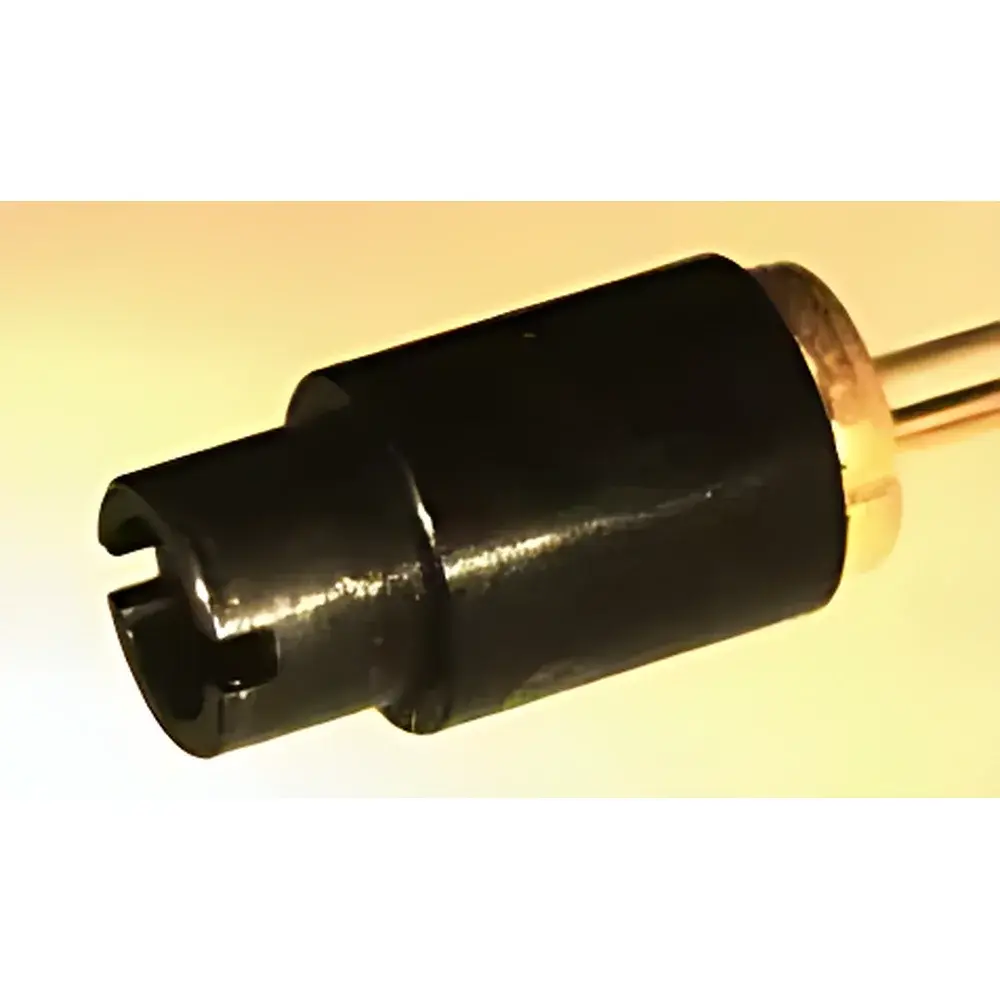
GRINTECH Miniature Laser Line Generator with Gradient-Index Micro-Optics
| Brand | GRINTECH |
|---|---|
| Origin | Canada |
| Manufacturer Type | Authorized Distributor |
| Import Status | Imported |
| Model | Miniature Laser Line Generator |
| Core Component | Solid-State Laser Module (Single-Mode Laser Diode + GRIN Micro-Optic Line Forming Element) |
| Laser Wavelength | 660 nm |
| Output Power | 50 mW |
| Beam Profile | Diffraction-Limited Focused Line |
| Line Uniformity | ±8% |
| Line Width (FWHM) | 0.6 µm/mm vs. Working Distance |
| Fan Angle Options | ±10°, ±15°, ±20° |
| Focus Range | 80 mm to ∞ |
| Optical Efficiency | 90–95% |
| Deviation Angle | ≤2° |
| Operating Temperature | 0–50 °C |
| Storage Temperature | −20–+70 °C |
| Laser Safety Class | 3B |
| Dimensions | Ø6.43 mm × 10.5 mm |
| Mass | 0.9 g |
| Housing Material | Anodized Aluminum |
Overview
The GRINTECH Miniature Laser Line Generator is a precision solid-state optical module engineered for high-fidelity line projection in space-constrained, high-reliability applications. It integrates a single-mode 660 nm laser diode (QLF063A-AA, 50 mW, TO-5.6 package) with a monolithic gradient-index (GRIN) micro-optic element—fabricated using ion-exchange technology on planar glass substrates. Unlike conventional cylindrical lens or Powell lens-based line generators, this GRIN-based design transforms the input Gaussian beam into a highly uniform, diffraction-limited laser line without introducing astigmatism or higher-order aberrations. The optical path is inherently aligned and permanently stabilized within the anodized aluminum housing, eliminating sensitivity to thermal drift or mechanical shock. Its ultra-compact form factor (Ø6.43 mm × 10.5 mm, 0.9 g) enables direct integration into OEM instrumentation, embedded vision systems, and portable metrology platforms where volumetric footprint and mass are critical constraints.
Key Features
- Monolithic GRIN micro-optic line-forming element ensuring intrinsic beam collimation and minimal wavefront error
- Diffraction-limited line focus with line width scaling at 0.6 µm/mm—enabling sub-micron lateral resolution at standard working distances
- Selectable fan angles (±10°, ±15°, ±20°) and user-defined focus distance (80 mm to infinity), supporting flexible optical layout integration
- High optical throughput (90–95% transmission efficiency) and low angular deviation (≤2°), critical for alignment-critical applications
- Hermetically sealed, anodized aluminum housing rated for industrial ambient conditions (0–50 °C operating, −20–+70 °C storage)
- Laser Class 3B compliant per IEC 60825-1:2014; includes integrated aperture and beam containment geometry for safe handling and system-level interlock compatibility
Sample Compatibility & Compliance
This laser line generator is designed for use with collimated single-mode laser diodes and requires external constant-current drivers (sold separately). It does not incorporate active temperature stabilization or modulation circuitry, and therefore must be paired with externally regulated power supplies meeting IEC 61000-6-3 EMC emission limits. The module complies with RoHS 2015/863/EU and REACH SVHC regulations. While not certified as a standalone medical device, its optical stability and repeatability support use in ISO 13485-aligned biophotonic instrumentation (e.g., structured-light profilometry in clinical-grade 3D surface scanners). For GMP/GLP environments, traceable calibration reports (including line uniformity mapping and far-field divergence characterization) can be supplied upon request.
Software & Data Management
As a passive optical component, the GRINTECH Miniature Laser Line Generator does not include embedded firmware or digital interfaces. However, it is fully compatible with industry-standard machine vision SDKs (e.g., HALCON, OpenCV, NI Vision) when used with CMOS/CCD line-scan or area-scan cameras. For automated calibration workflows, its predictable line geometry (fan angle, focus distance, and line width slope) allows precise synthetic model generation in ray-tracing software such as Zemax OpticStudio or CODE V. Audit trails for installation parameters—including orientation, mounting torque, and thermal soak history—should be maintained per FDA 21 CFR Part 11 requirements when deployed in regulated manufacturing or QC systems.
Applications
- 3D topographic profiling via triangulation-based laser scanning, particularly in handheld or robotic-arm-mounted sensors requiring minimal payload inertia
- Sub-pixel optical alignment in semiconductor packaging, fiber coupling, and MEMS assembly stations
- Real-time feature extraction in high-speed machine vision inspection systems (e.g., PCB solder-joint verification, automotive weld seam monitoring)
- Reference line projection in confocal or multi-focus fluorescence microscopy setups for z-axis calibration and stage registration
- Calibration artifact generation for ISO 10360-compliant coordinate measuring machines (CMMs) and laser trackers
FAQ
Is driver electronics included with the module?
No. A constant-current laser diode driver compatible with TO-5.6 packages and capable of delivering stable 50 mW output (e.g., ILX Lightwave LDC-3724B or equivalent) must be sourced separately.
Can the focus distance be adjusted after installation?
No. Focus distance is fixed during manufacturing by the axial position of the GRIN optic relative to the laser diode facet. Custom focus distances (80 mm to ∞) must be specified at time of order.
What is the expected lifetime under continuous operation?
Based on accelerated life testing of the QLF063A-AA diode at 25 °C case temperature, median operational lifetime exceeds 10,000 hours at rated optical output.
Does the module support TTL or analog modulation?
The laser diode is DC-operated only. Modulation capability requires an external driver with modulation input (e.g., 0–5 V analog or 0–5 V TTL); GRINTECH does not provide modulated versions of this standard module.
Is custom wavelength or power available?
GRINTECH offers engineering support for derivative designs (e.g., 405 nm, 520 nm, or 785 nm variants) under NRE agreement; standard catalog units are limited to the 660 nm / 50 mW configuration described herein.



