
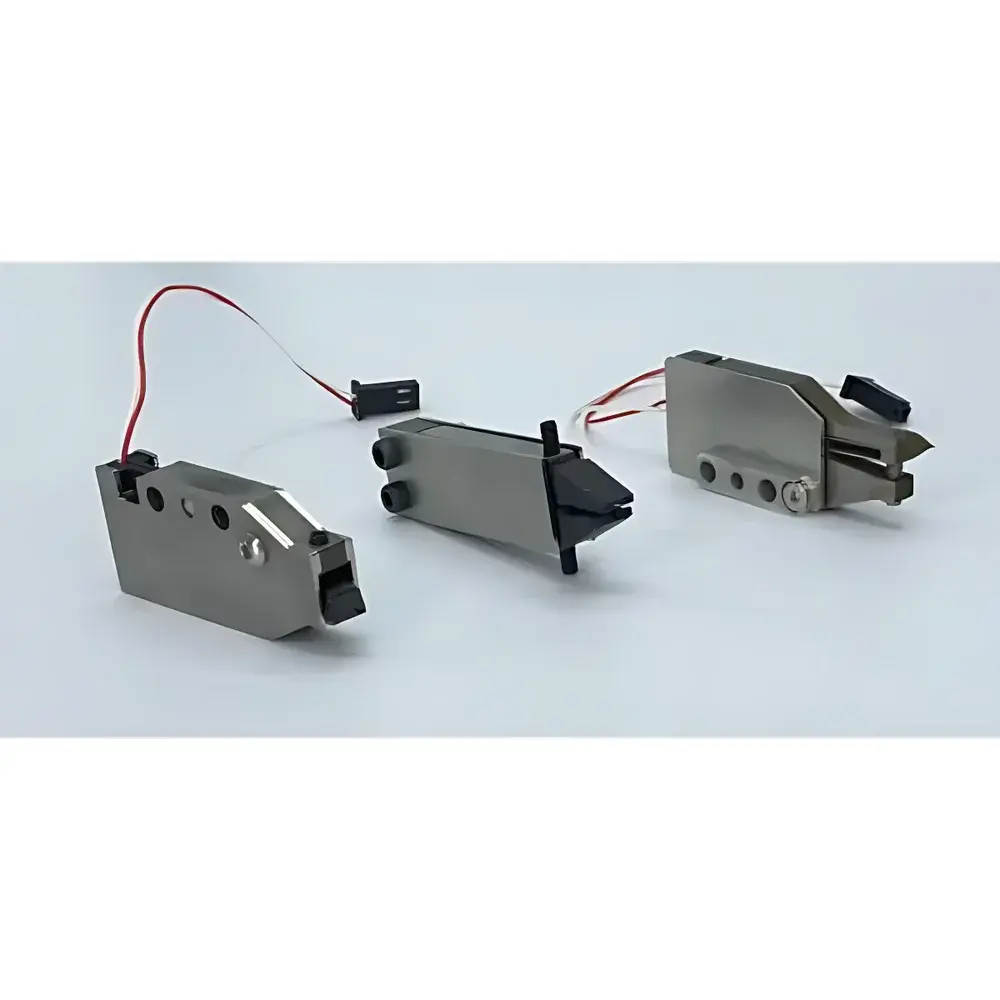
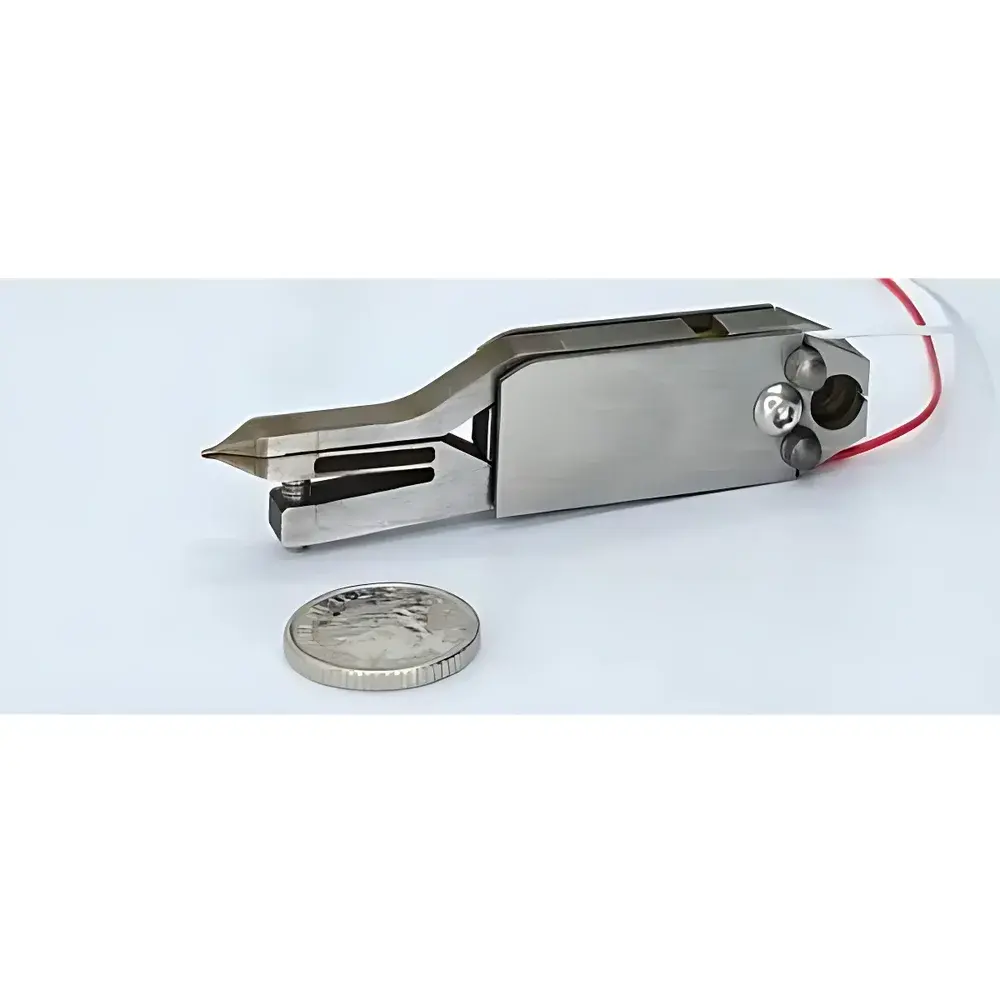
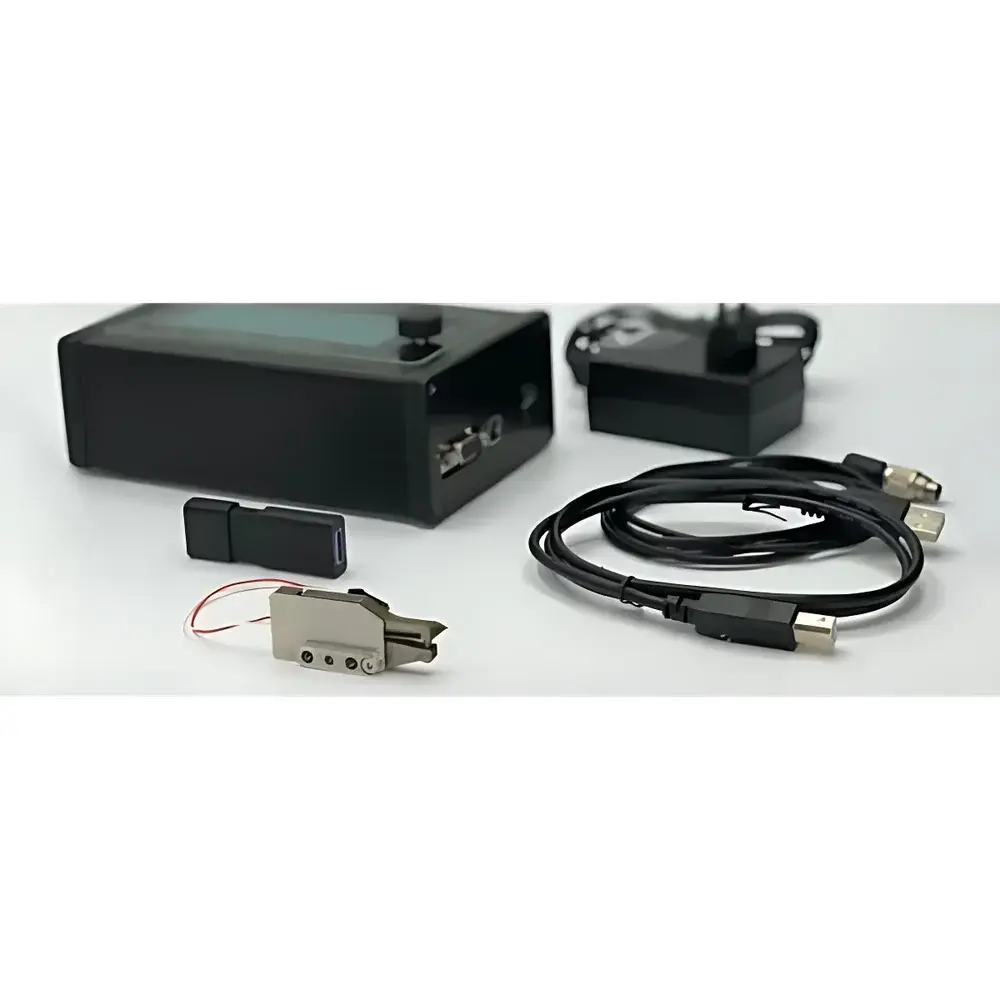
GriPhi High-Precision Micro Electromechanical Gripper
| Brand | auniontech |
|---|---|
| Origin | Shanghai, China |
| Model | GriPhi Series |
| Type | Piezo-Driven Micro-Gripper |
| Actuation Principle | Piezoelectric Bimorph/Bender Drive |
| Max. Open-Close Frequency | Up to 50 Hz |
| Stroke Range | Adjustable (Standard: 10–200 µm) |
| Positioning Resolution | Sub-micron (Open-Loop), <100 nm (Closed-Loop with Encoder Feedback) |
| Cycle Life | >40 million cycles |
| Sample Handling Range | 10 µm – 20 mm |
| Integration Options | Standalone or PHI-W 5-Axis Integrated Manipulation Platform |
| Compliance | RoHS, CE (for lab equipment) |
| Software Interface | USB 2.0 / RS-485 |
| Enclosure | Anodized aluminum housing, non-magnetic option available |
Overview
The GriPhi High-Precision Micro Electromechanical Gripper is a piezoelectric actuator-based micro-handling device engineered for sub-micron positioning accuracy and repeatable force control in constrained optical and microscale environments. Unlike conventional stepper- or servo-driven grippers, the GriPhi leverages low-voltage piezoelectric bimorph bending elements to generate precise, hysteresis-compensated displacement—enabling direct, frictionless motion without gear trains or backlash. Its core architecture supports both open-loop operation for high-speed sequencing and closed-loop integration via external position sensors or encoder-equipped stages (e.g., PHI-SS-ME rotary stage and PHI-SS-TS tilt platform). Designed specifically for integration into optical laboratory setups—including confocal microscopy workstations, fiber alignment benches, and photonic packaging testbeds—the GriPhi delivers deterministic mechanical response under vacuum-compatible and EMI-shielded conditions, making it suitable for cleanroom-certified micro-assembly protocols.
Key Features
- Piezo-driven actuation with sub-100 nm resolution in closed-loop configuration using integrated encoder feedback pathways
- Scalable gripping range: accommodates objects from 10 µm microspheres to 20 mm macro-components via interchangeable jaw geometries (flat, V-groove, curved, conductive)
- High-cycle durability: validated for >40 million open-close cycles at rated load (≤100 mN static grip force)
- Programmable duty cycle: adjustable dwell time, ramp rate, and hold voltage via ASCII command protocol over USB or RS-485
- Modular mechanical interface: standardized M3/M4 threaded mounting holes; compatible with Thorlabs, Newport, and Standa translation stage rails
- Dual operational modes: standalone actuation (using GriPhi Driver electronics) or synchronized motion within PHI-W 5-axis manipulation systems
Sample Compatibility & Compliance
The GriPhi gripper is routinely deployed in applications requiring non-invasive handling of optically sensitive, electrically fragile, or biologically active specimens. Jaw surfaces can be coated with DLC (diamond-like carbon), gold, or SiO₂ to minimize adhesion, charging, or chemical interaction. All standard configurations comply with RoHS Directive 2011/65/EU and carry CE marking for laboratory instrumentation. When integrated into ISO/IEC 17025-accredited metrology labs, the system supports traceable calibration via NIST-traceable interferometric verification of stroke linearity and repeatability. For GMP-regulated micro-manufacturing (e.g., medical device component assembly), optional documentation packages include FAT/SAT reports, material certifications (EN 10204 3.1), and electromagnetic compatibility (EMC) test summaries per EN 61326-1.
Software & Data Management
Control is implemented through the GriPhi Driver firmware (v3.2+), which exposes a deterministic real-time command set compliant with IEEE 1278.1 (HLA) messaging conventions. A native PC application (Windows/Linux/macOS) provides GUI-based waveform generation, sequence scripting, and live position/force logging at up to 10 kHz sampling. APIs are provided for C/C++, Python (PySerial + NumPy), and LabVIEW (NI-VISA compatible), enabling seamless incorporation into custom automation frameworks such as MATLAB Instrument Control Toolbox or Python-based PyMotion control stacks. Audit trails—including timestamped actuation commands, thermal drift compensation logs, and firmware version stamps—are stored locally and exportable in CSV/JSON format for 21 CFR Part 11-compliant environments when paired with validated electronic signature modules.
Applications
- Optical alignment: passive coupling of single-mode fibers, lenslet array positioning, and MEMS mirror engagement in free-space optical interconnects
- Micro-opto-electro-mechanical systems (MOEMS) assembly: pick-and-place of VCSEL arrays, photodetector dies, and hybrid-integrated silicon photonics chips
- Life science instrumentation: automated handling of glass capillaries, microfluidic channel inserts, and cryo-EM grid carriers under inverted microscope observation
- Nanofabrication support: probe tip exchange in scanning probe microscopy (SPM) stations and AFM cantilever mounting on multi-probe platforms
- Quantum device packaging: alignment and bonding of superconducting qubit chips with sub-5 µm positional tolerance under dry nitrogen purge
FAQ
What is the maximum recommended gripping force for continuous operation?
The nominal static grip force is 80–100 mN at 120 V drive voltage; sustained loads above 60 mN require active thermal monitoring to maintain piezo element longevity.
Can the GriPhi be operated in vacuum environments?
Yes—standard models operate down to 10⁻⁴ mbar; UHV-compatible variants (with ceramic feedthroughs and outgassing-tested adhesives) are available upon request.
Is encoder feedback built into the gripper itself?
No—the gripper is inherently open-loop; closed-loop performance requires external position sensing (e.g., capacitive sensor, laser Doppler vibrometer) or integration with encoder-equipped PHI-SS series stages.
Does the system support synchronization with external triggers (TTL, optical)?
Yes—GriPhi Driver includes dedicated SYNC_IN and TRIG_OUT BNC ports for hardware-level coordination with cameras, lasers, or motion controllers.
Are jaw geometry modifications available for custom sample shapes?
Yes—custom jaw designs (including electrostatic, magnetic, or fluidic hybrid variants) are supported under NDA with lead times starting at 8 weeks.





