
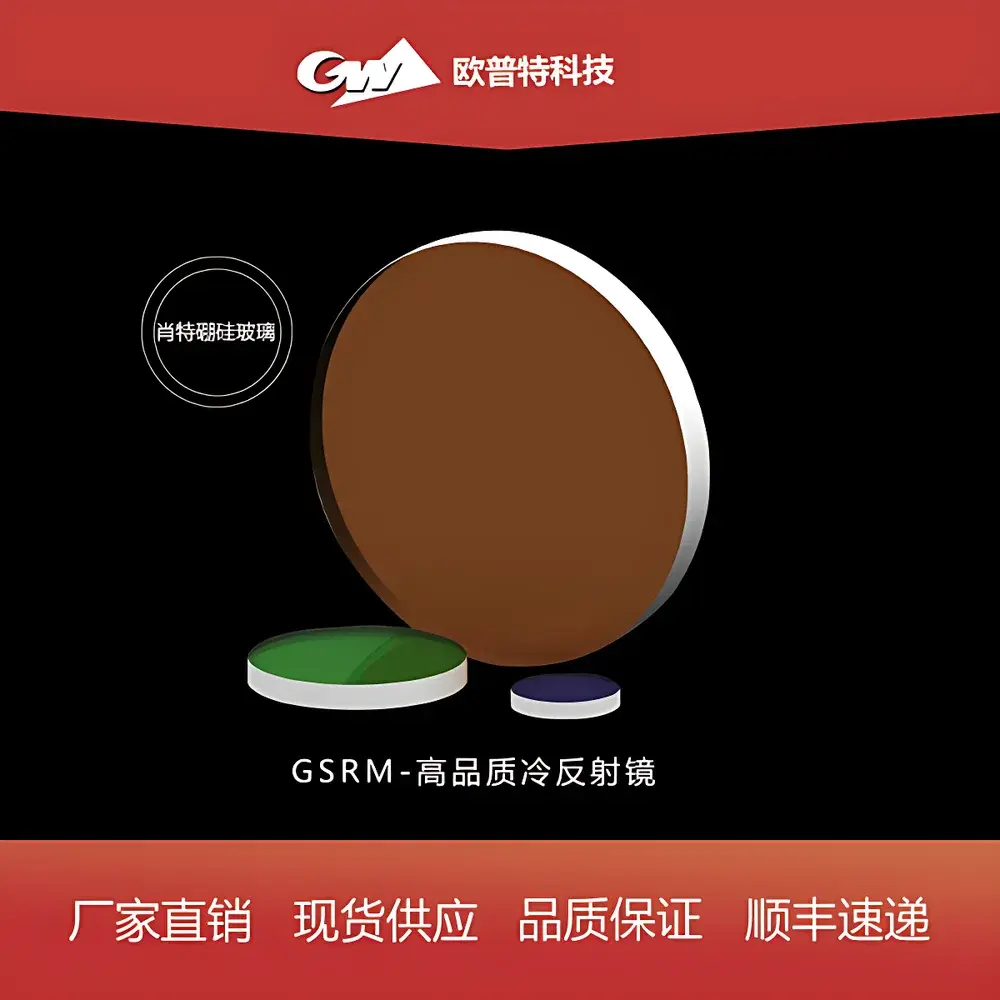
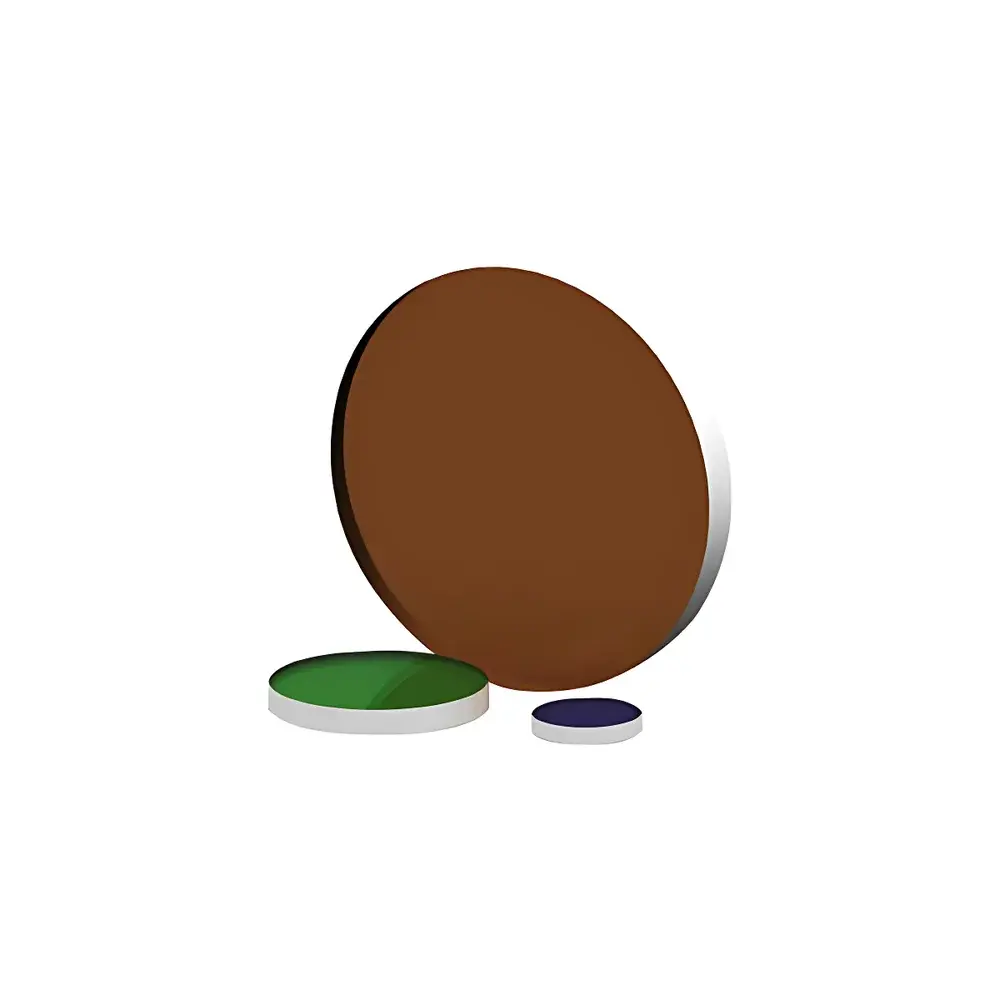
GSRM High-Performance Cold Mirror
| Origin | Beijing |
|---|---|
| Manufacturer Type | Distributor |
| Origin Category | Domestic (China) |
| Model | GSRM |
| Price Range | USD 0.15–75.00 (per unit) |
| Component Category | Optical Element |
| Material | Schott Borofloat® borosilicate glass |
| Surface Flatness | <5λ/25 mm² @ 633 nm |
| Parallelism | <1 arcmin |
| Surface Quality | 4–5 scratch-dig |
| Round Substrate Diameter Tolerance | +0.0 / −0.25 mm |
| Square/Rectangular Substrate Tolerance | ±0.25 mm (edge-cut) |
| Thickness | 2.0 ±0.2 mm |
| Avg. Visible Reflectance | Rₐᵥg >95% @ 425–675 nm |
| Avg. IR Transmittance | Tₐᵥg >90% @ 750–1150 nm |
Overview
The GSRM High-Performance Cold Mirror is a precision dielectric thin-film optical component engineered for spectral separation in demanding optomechanical and photonic systems. Operating on the principle of wavelength-selective interference, the GSRM reflects visible light while transmitting near-infrared (NIR) radiation—enabling efficient thermal management in illumination, imaging, and laser delivery architectures. Its design leverages multilayer dielectric coatings deposited onto high-homogeneity Schott Borofloat® borosilicate glass substrates, ensuring exceptional thermal stability (CTE ≈ 3.2 × 10⁻⁶ K⁻¹), low birefringence, and resistance to environmental aging. Unlike metallic mirrors, the GSRM achieves >95% average reflectance across the 425–675 nm band without significant absorption-induced heating—critical for high-flux applications such as LED-based projection optics, fluorescence microscopy illumination paths, and broadband spectroscopic beam combiners.
Key Features
- Optimized spectral performance: Ravg >95% over 425–675 nm (visible), Tavg >90% over 750–1150 nm (NIR)—validated per ISO 9050:2003 spectral measurement protocols
- Ultra-stable substrate: Schott Borofloat® glass with certified refractive index homogeneity (Δn < 5 × 10⁻⁶) and low thermal expansion, minimizing focus shift under thermal cycling
- Sub-arcminute parallelism (<1 arcmin) and wavefront distortion <5λ/25 mm² @ 633 nm—ensuring minimal beam deviation in collimated optical trains
- Surface quality rated 4–5 scratch-dig per MIL-PRF-13830B, compatible with Class 100 cleanroom handling and post-coating inspection
- Tight mechanical tolerances: round substrates held to +0.0 / −0.25 mm diameter; square/rectangular variants cut to ±0.25 mm edge tolerance using CNC diamond-scribe or precision sawing
- Standard thickness of 2.0 ±0.2 mm—optimized for mechanical rigidity and minimal flexure under mounting stress in kinematic mounts
Sample Compatibility & Compliance
The GSRM is compatible with standard optical mounting hardware (e.g., SM1-threaded lens tubes, kinematic mirror mounts, and custom flange interfaces). It meets baseline requirements for ISO 10110-7 (surface imperfections), ISO 10110-3 (surface form), and ISO 10110-8 (coating specifications). While not inherently certified to IEC 61215 or UL 61000-4-3, its material composition and coating architecture support integration into systems compliant with IEC 61000-6-3 (EMC emission limits) and IEC 60825-1 (laser safety), provided system-level thermal and mechanical validation is performed. No RoHS exemptions apply—the coating stack contains no lead, cadmium, or hexavalent chromium.
Software & Data Management
As a passive optical component, the GSRM requires no embedded firmware or software drivers. However, its spectral performance data (reflectance/transmittance curves, phase response, and angular sensitivity profiles) are supplied in standardized ASCII format (.csv) and Spectral Data Interchange Format (SDIF) v2.1, compatible with Zemax OpticStudio™, CODE V®, FRED, and ASAP optical design suites. Coating design files (layer stack, material indices, deposition parameters) are available upon request for customers performing in-house tolerance analysis or Monte Carlo system modeling. All delivered units include a traceable calibration certificate referencing NIST-traceable spectrophotometric measurements at accredited third-party labs (ISO/IEC 17025:2017 accredited).
Applications
- Laser illumination systems requiring visible/NIR dichroism—e.g., RGB laser projectors, confocal scanning modules, and multi-wavelength flow cytometers
- Thermal load mitigation in high-brightness LED optical engines, where NIR transmission prevents heat accumulation in downstream optics
- Beam combining/splitting in hyperspectral imaging systems operating across visible–SWIR bands
- Reference optics in interferometric metrology setups where substrate flatness and thermal drift must remain below λ/10 over 8-hour stabilization periods
- Education and R&D labs conducting polarization-insensitive spectral filtering experiments, leveraging its non-metallic, low-absorption architecture
FAQ
What is the maximum incident power density the GSRM can withstand without coating degradation?
For continuous-wave (CW) sources at normal incidence, the damage threshold is ≥5 kW/cm² (measured at 532 nm, 10 s exposure, ISO 21254-1). Pulsed operation requires case-specific LIDT evaluation based on pulse duration, repetition rate, and spot size.
Is the GSRM suitable for use at non-normal angles of incidence?
Yes—performance remains stable up to ±15° AOI for s-polarized light; p-polarized reflectance drops gradually beyond 10°. Angular characterization data (0°–30°) is included in the SDIF file package.
Can custom coating designs be applied to the same Borofloat® substrate?
Yes—custom spectral bands (e.g., UV-enhanced, extended SWIR, or polarizing variants) are available via OEM agreement with full coating design documentation and batch traceability.
Does the GSRM meet FDA or EU MDR requirements for medical device integration?
As a Class I passive component, it carries no standalone regulatory classification. Integration into Class IIa/IIb devices requires system-level biocompatibility testing (ISO 10993-5) and electromagnetic compatibility validation per IEC 62304.
What cleaning protocols are recommended for maintaining surface integrity?
Use only solvent-rinsed, Class 100-cleanroom-grade lens tissues with reagent-grade isopropanol or acetone. Avoid ultrasonic cleaning or abrasive wiping; dry under filtered nitrogen flow.




